View as PDF

Missouri Chemistry · Unit 1 · 25 questions

Matter and Atomic Structure, 25-question test — Practice Test

This practice test was made by AI and there may be mistakes. If a question or answer looks wrong, use the Flag a mistake button to let Brett know so he can fix it.

1

Which particle has a negative charge
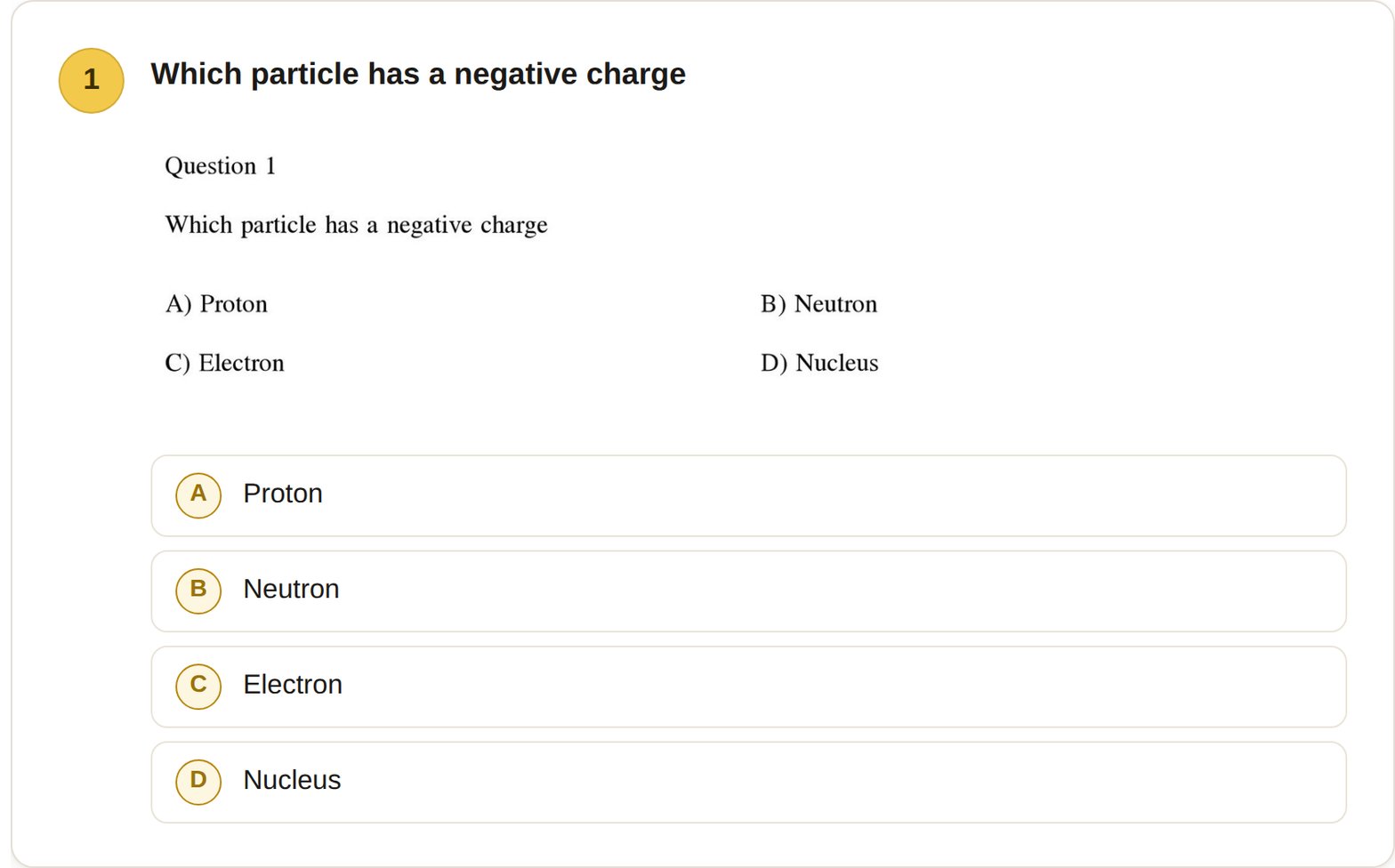
Question 1 diagram and text as printed in the PDF
Understand It with Pulse
2

An atom has 11 protons and 12 neutrons. The element is
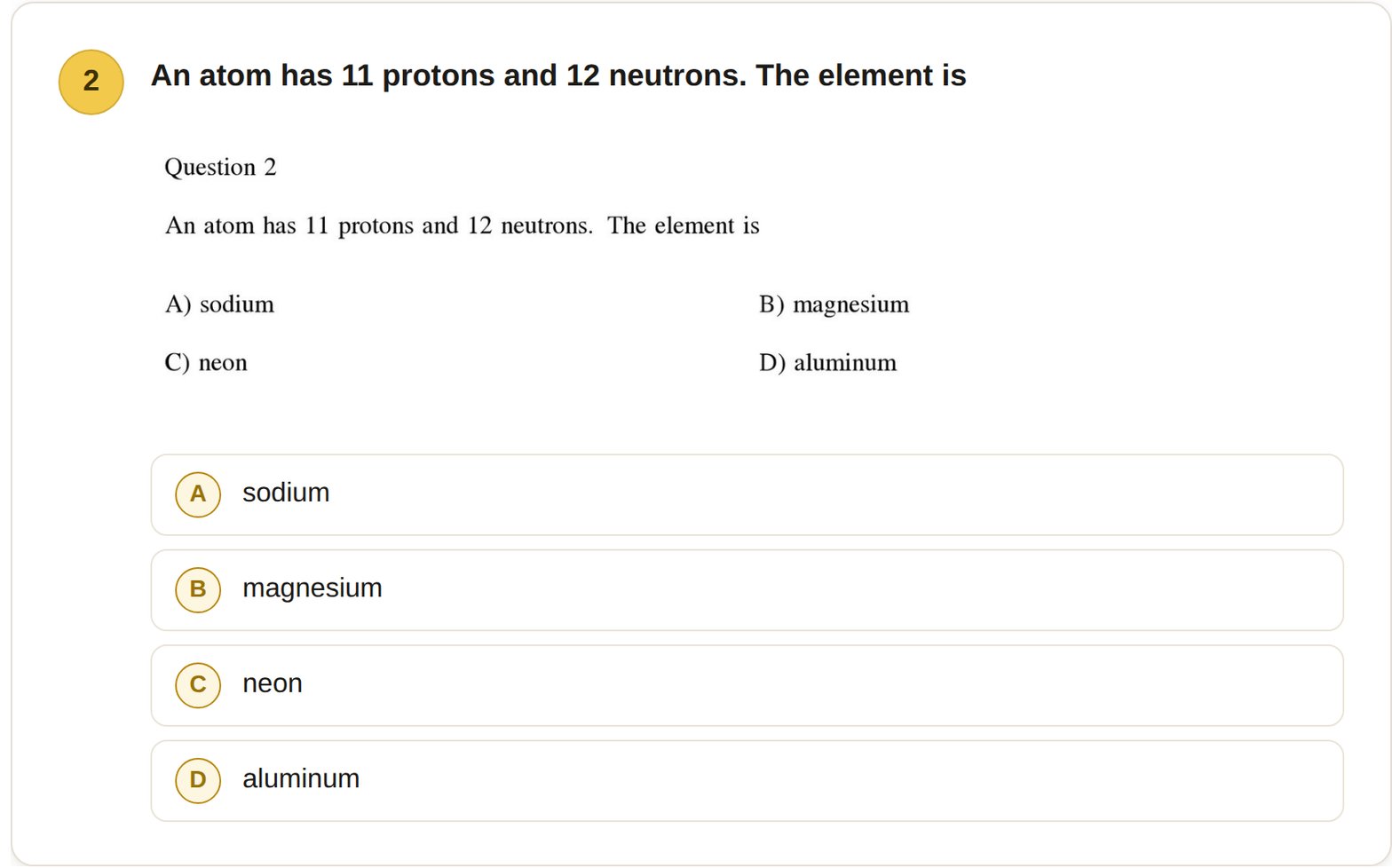
Question 2 diagram and text as printed in the PDF
Understand It with Pulse
3

Chlorine has atomic number 17 and mass number 37. The number of neutrons in this atom is ____
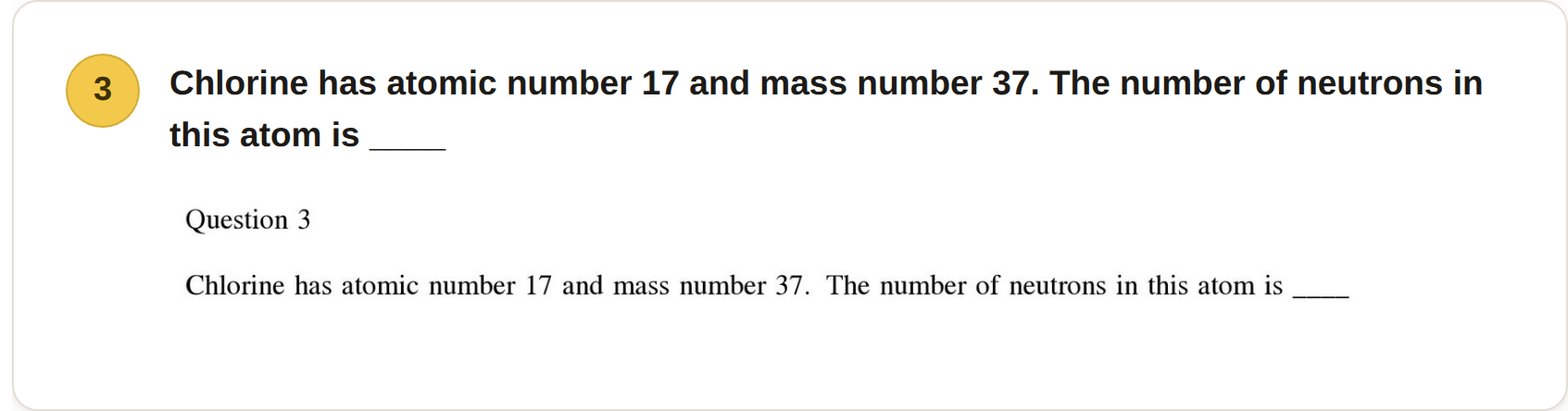
Question 3 diagram and text as printed in the PDF
Understand It with Pulse
4

Isotopes of an element have the same number of
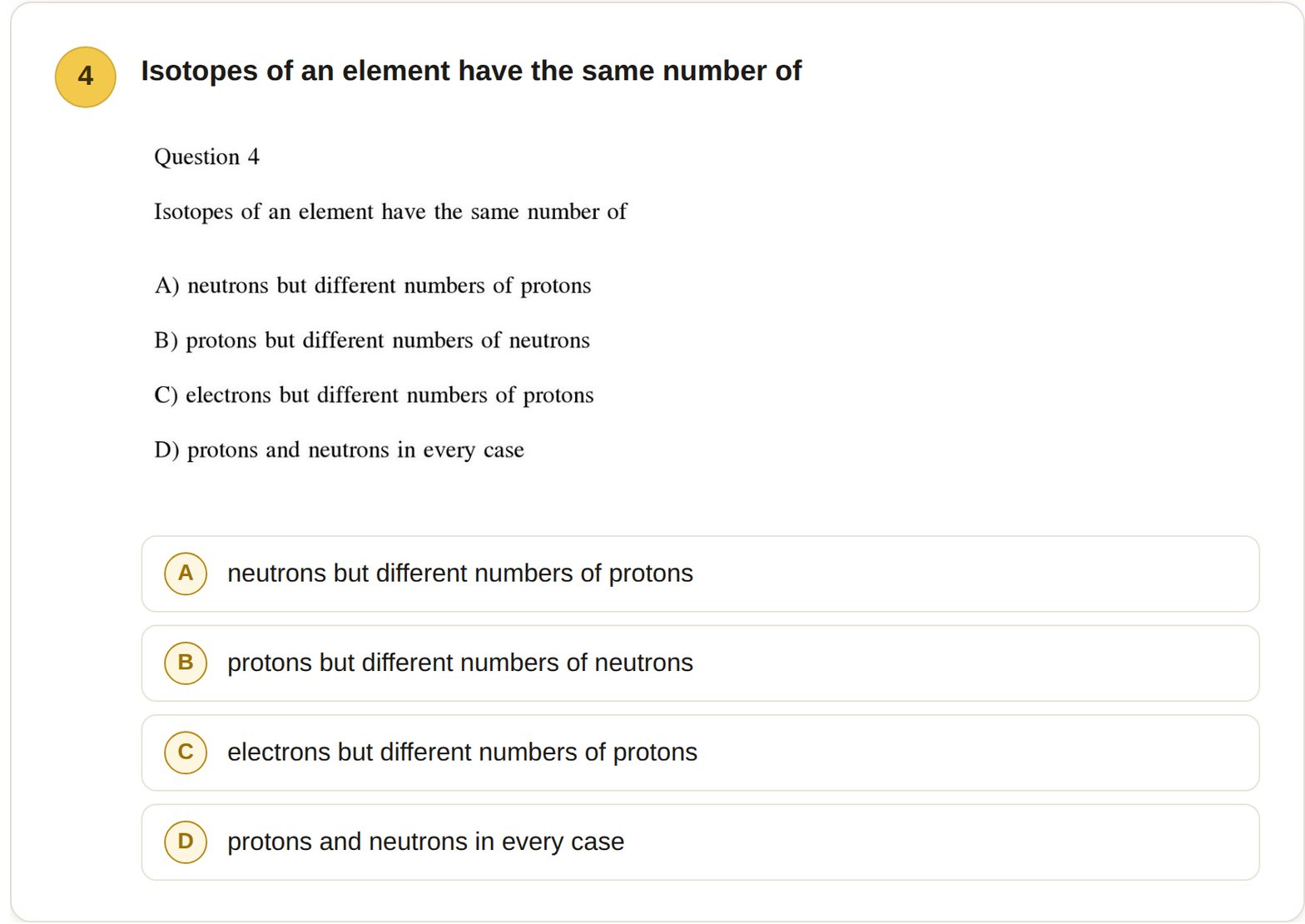
Question 4 diagram and text as printed in the PDF
Understand It with Pulse
5

A neutral atom has 8 protons. The number of electrons it has is
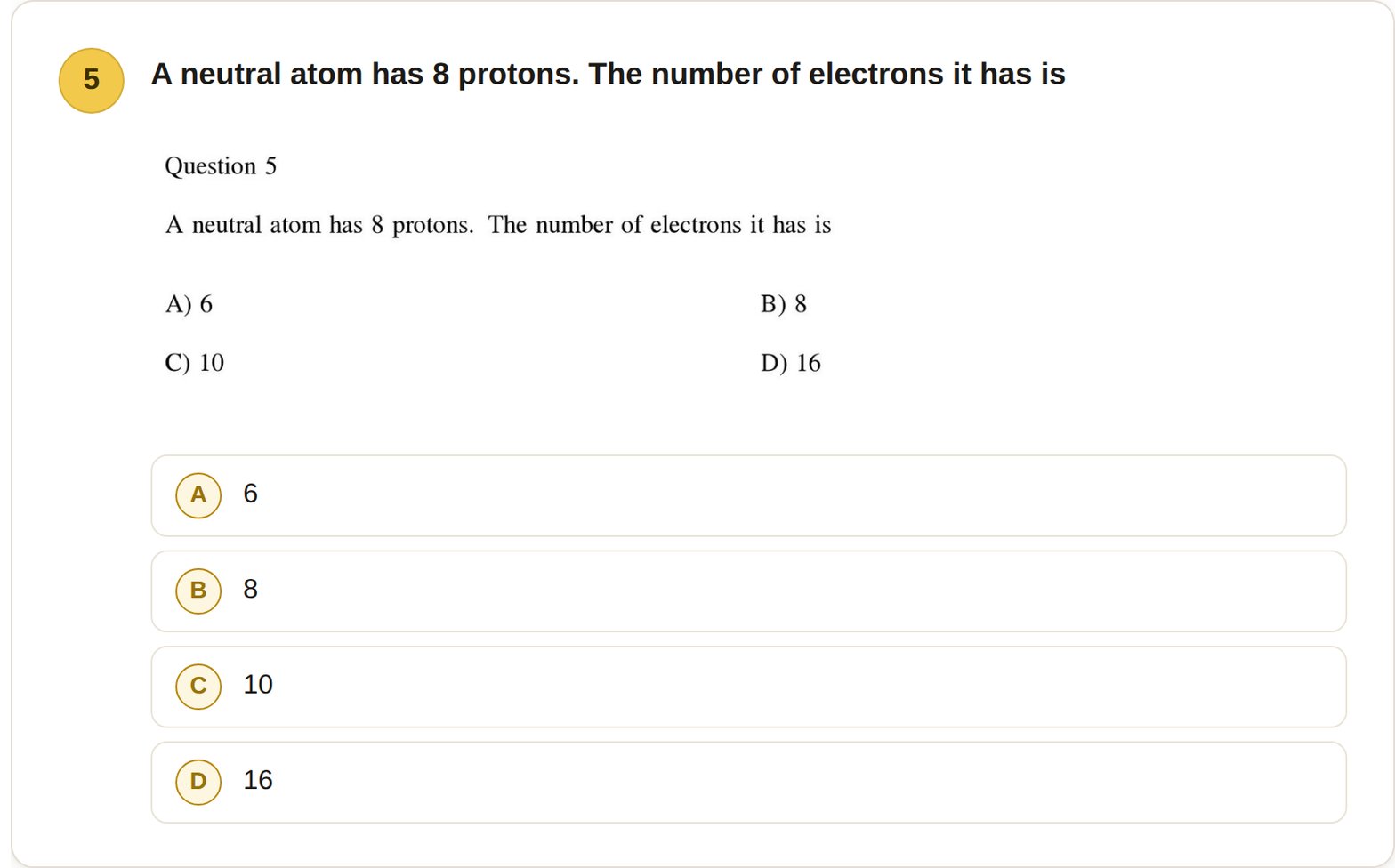
Question 5 diagram and text as printed in the PDF
Understand It with Pulse
6

Magnesium has atomic number 12. The number of electrons in Mg²⁺ is ____
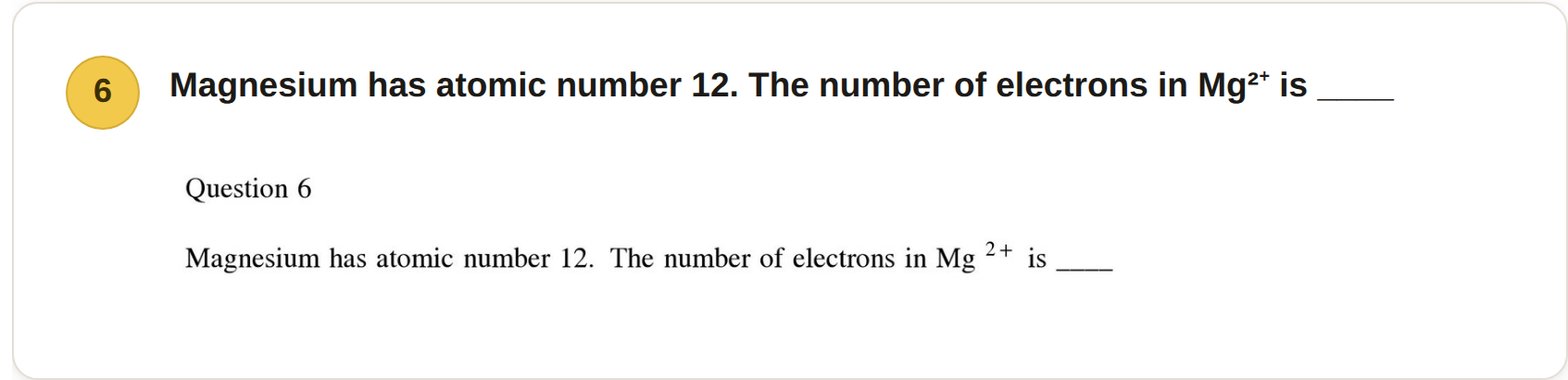
Question 6 diagram and text as printed in the PDF
Understand It with Pulse
7

The mass number of an atom is the sum of its
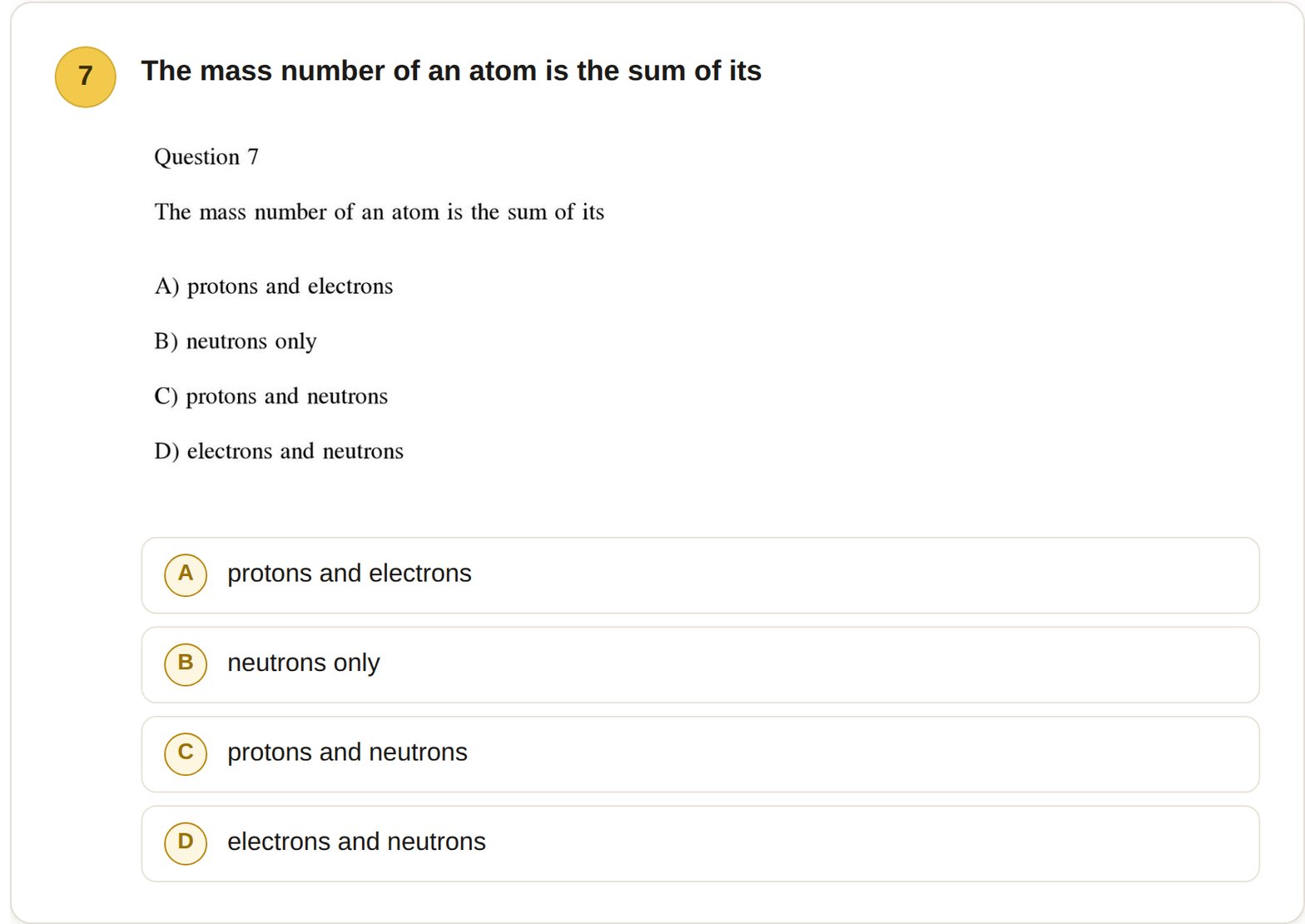
Question 7 diagram and text as printed in the PDF
Understand It with Pulse
8

The element in group 2 and period 4 is
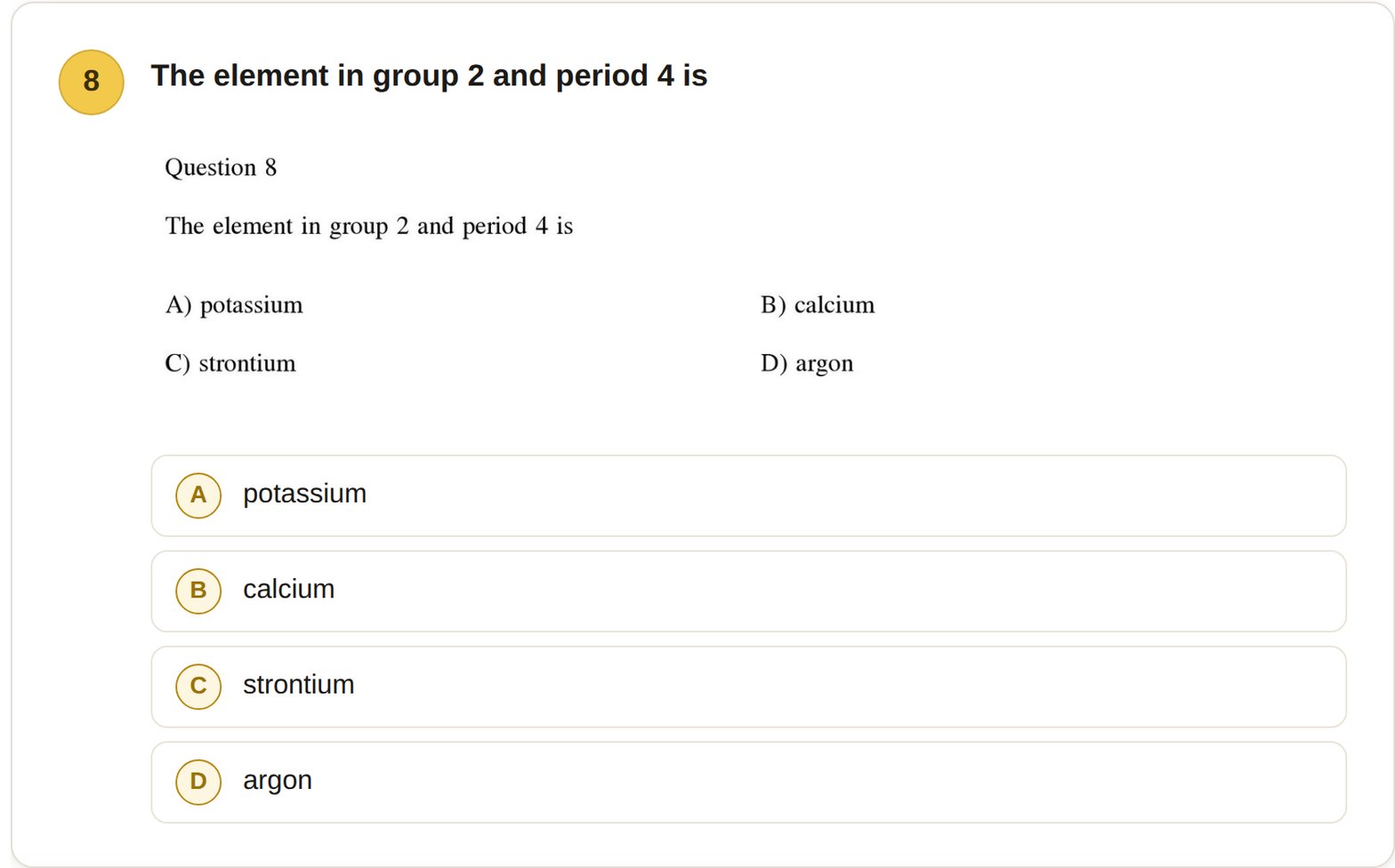
Question 8 diagram and text as printed in the PDF
Understand It with Pulse
9

Sulfur is in group 16. The number of valence electrons it has is ____
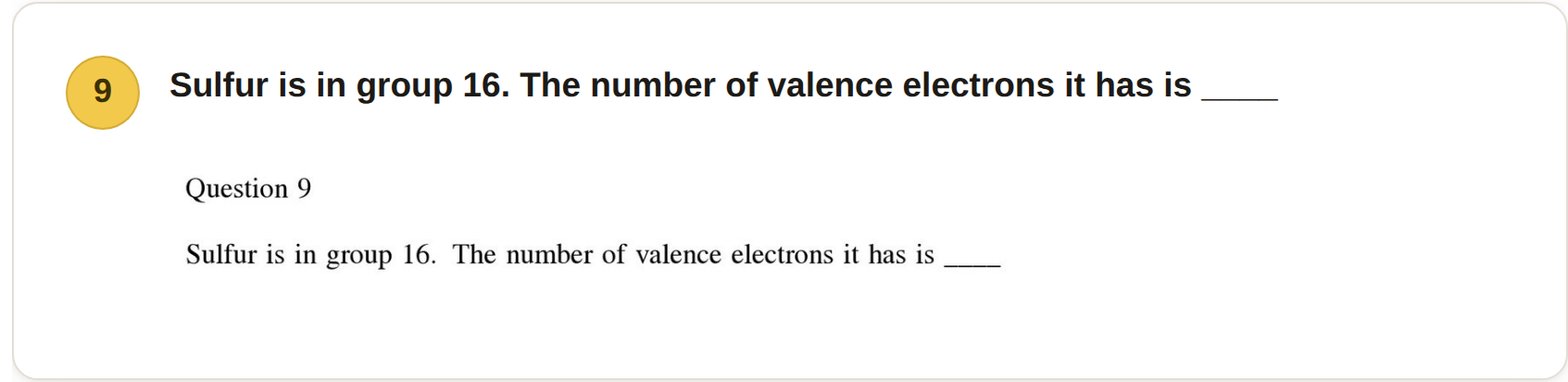
Question 9 diagram and text as printed in the PDF
Understand It with Pulse
10

Going down a group in the periodic table, atomic radius generally
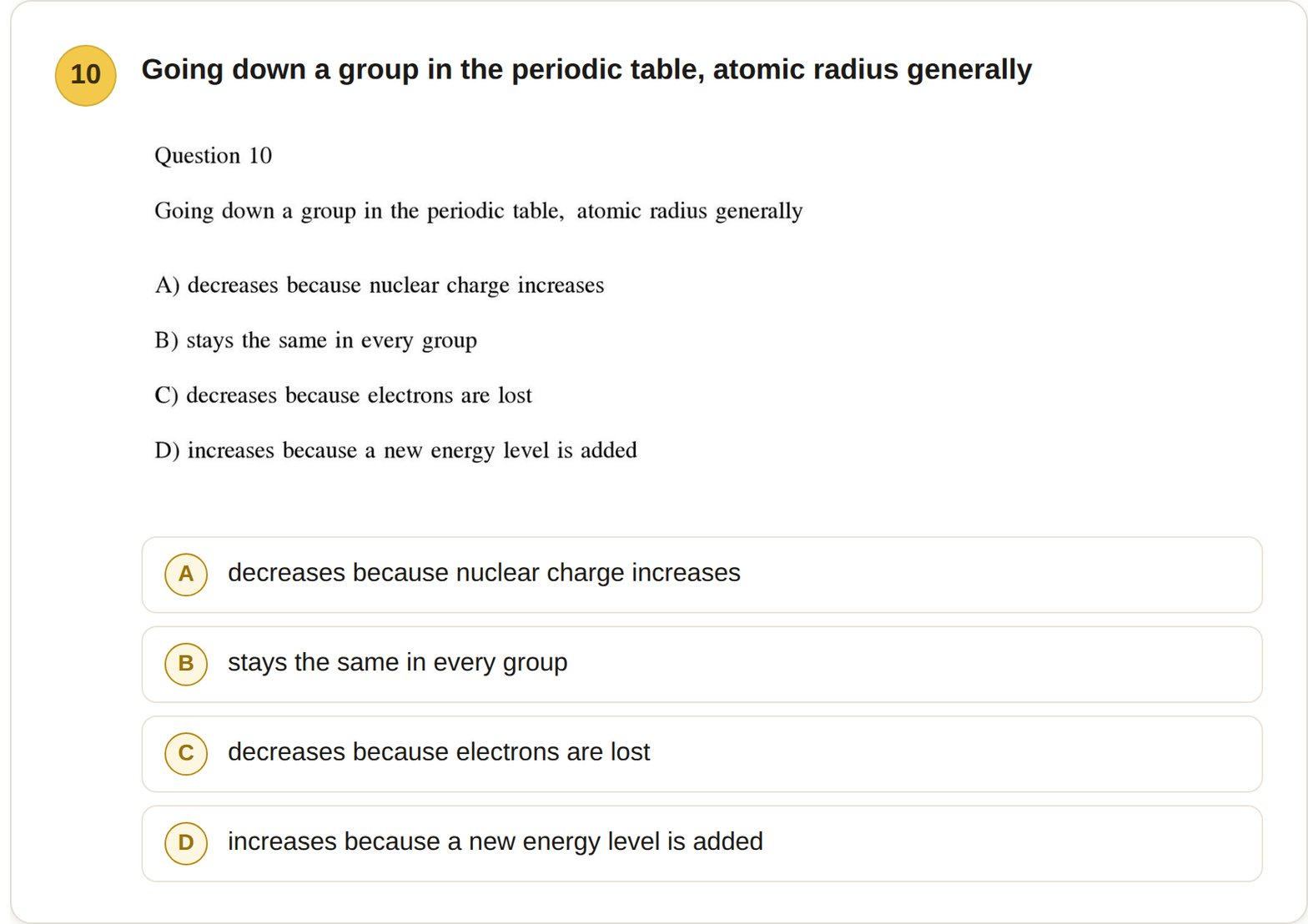
Question 10 diagram and text as printed in the PDF
Understand It with Pulse
11

Going across a period from left to right, ionization energy generally
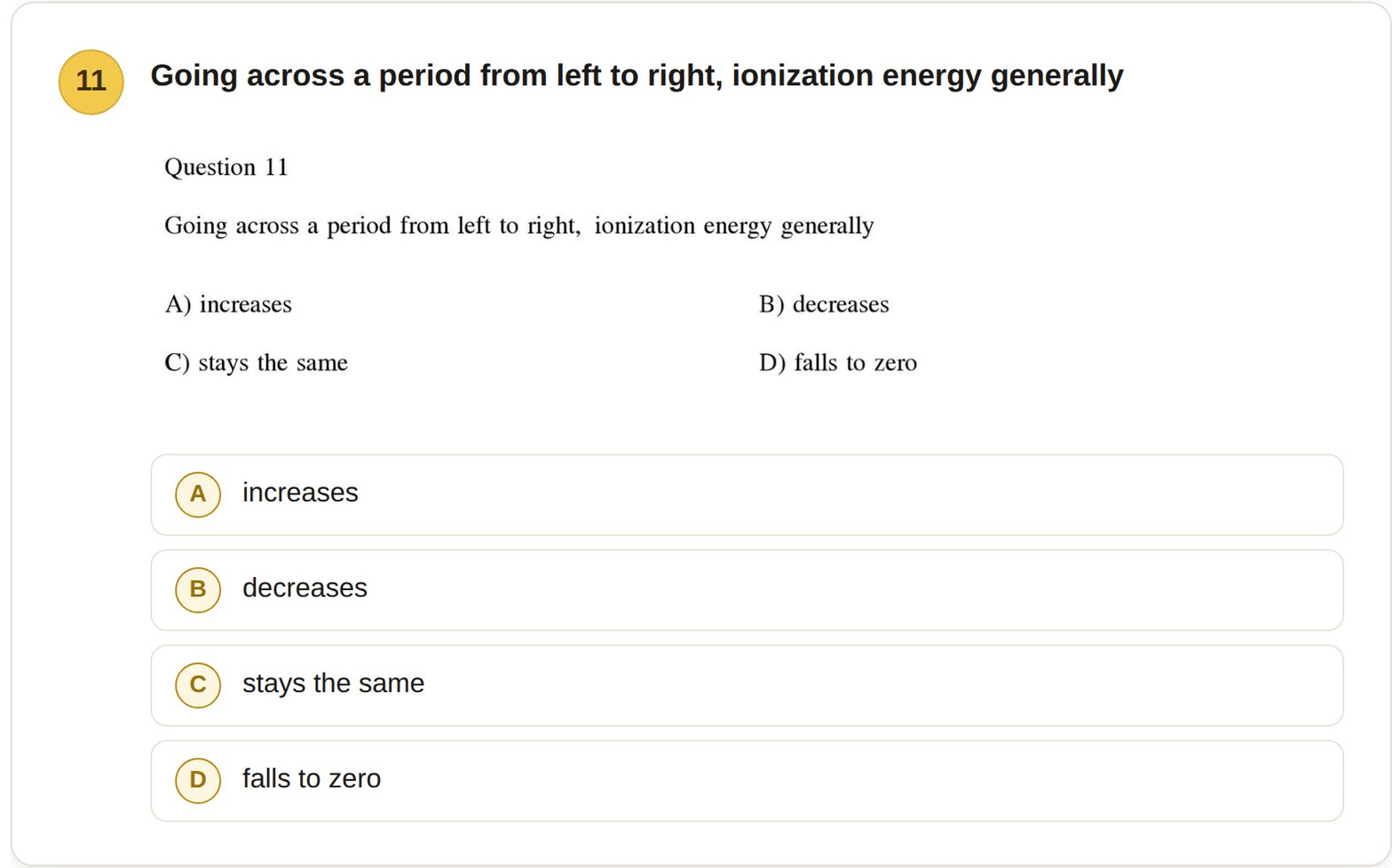
Question 11 diagram and text as printed in the PDF
Understand It with Pulse
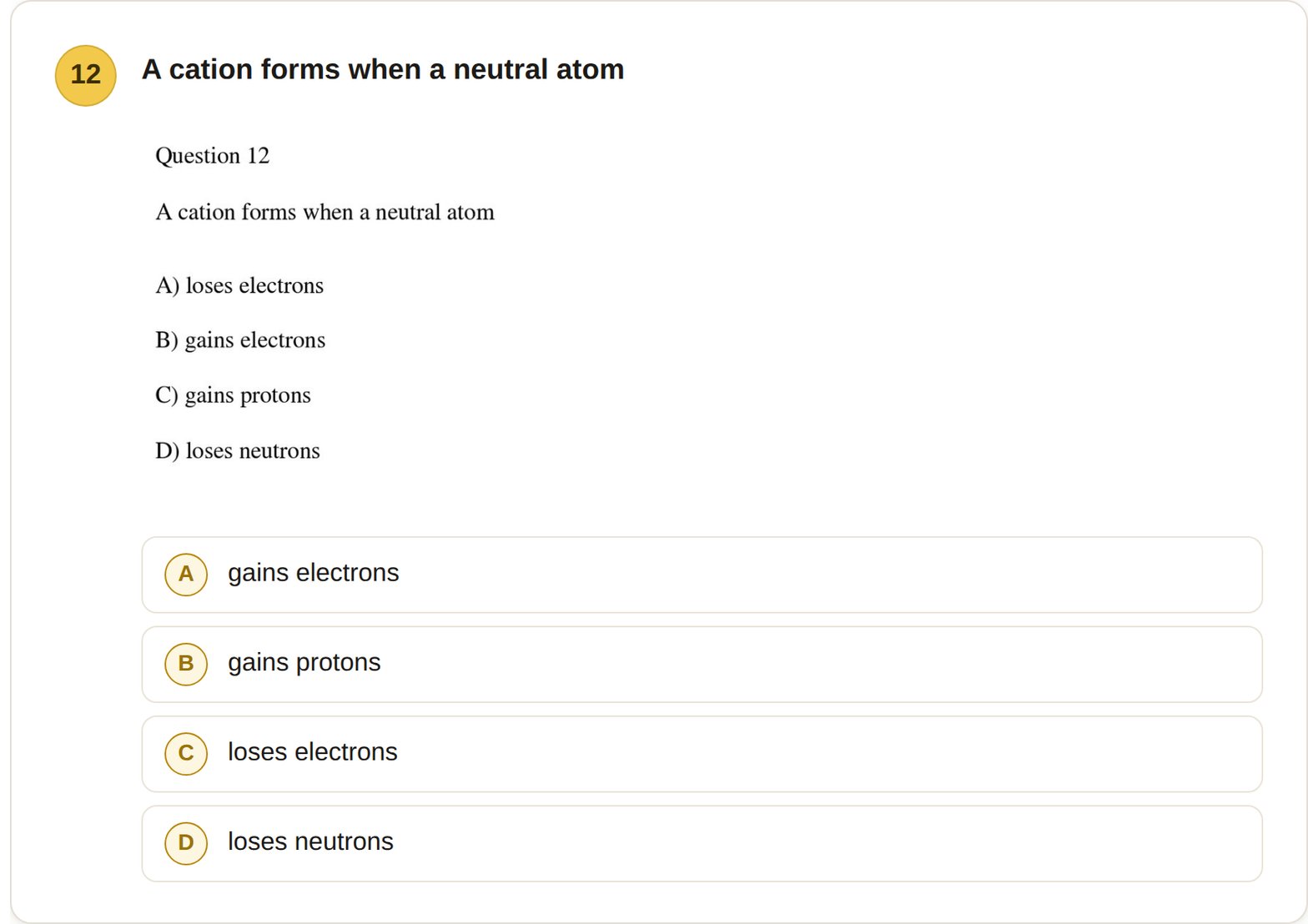
12

A cation forms when a neutral atom

Question 12 diagram and text as printed in the PDF
Understand It with Pulse
13

An atom has 26 protons and 30 neutrons. Its mass number is ____
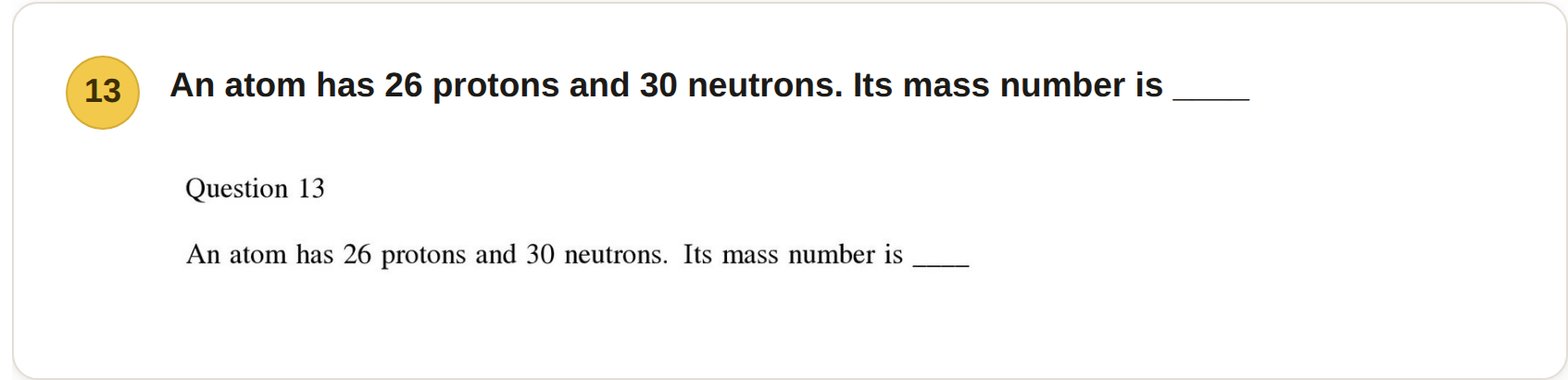
Question 13 diagram and text as printed in the PDF
Understand It with Pulse
14

In the Bohr model of the atom, electrons are described as
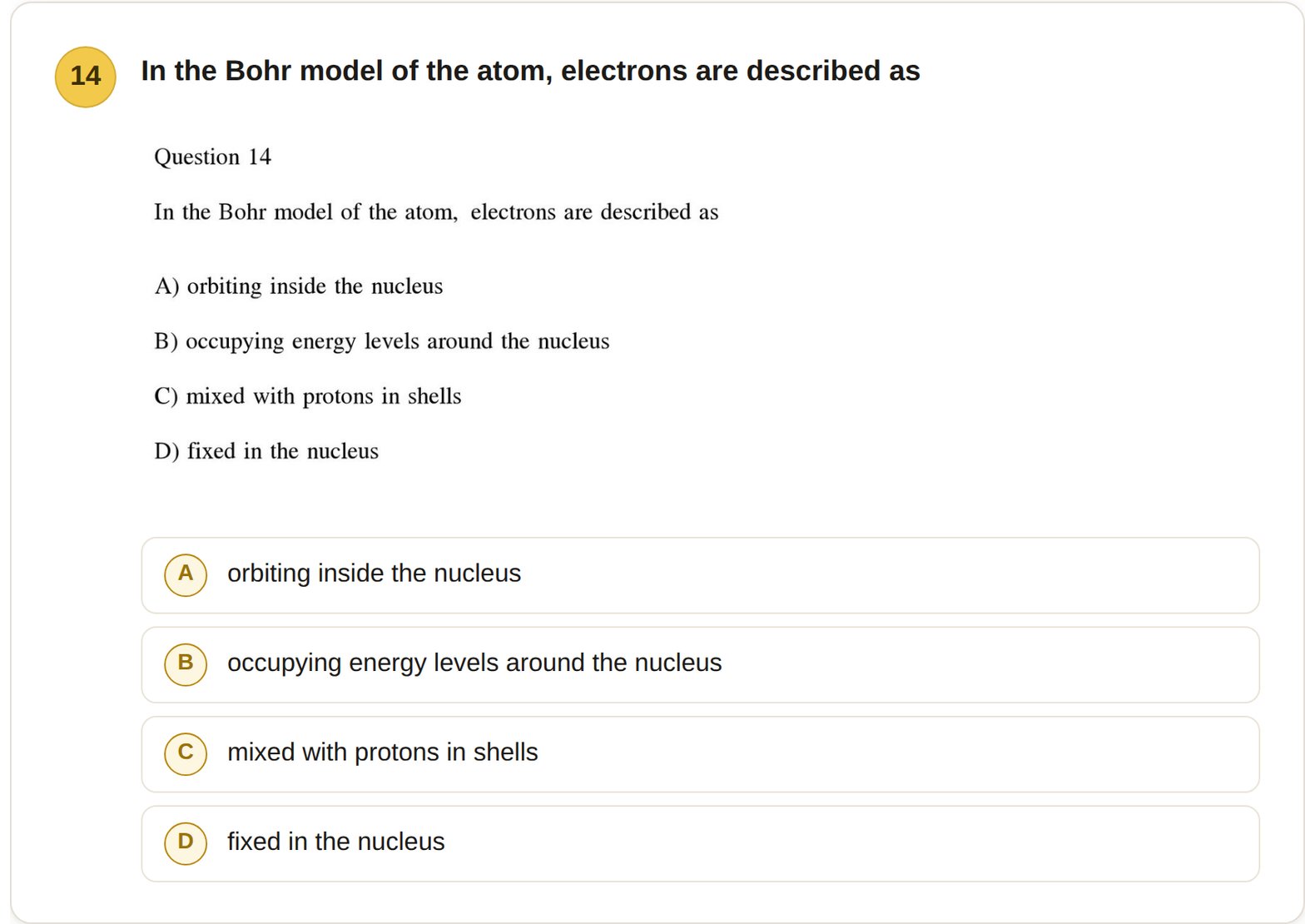
Question 14 diagram and text as printed in the PDF
Understand It with Pulse
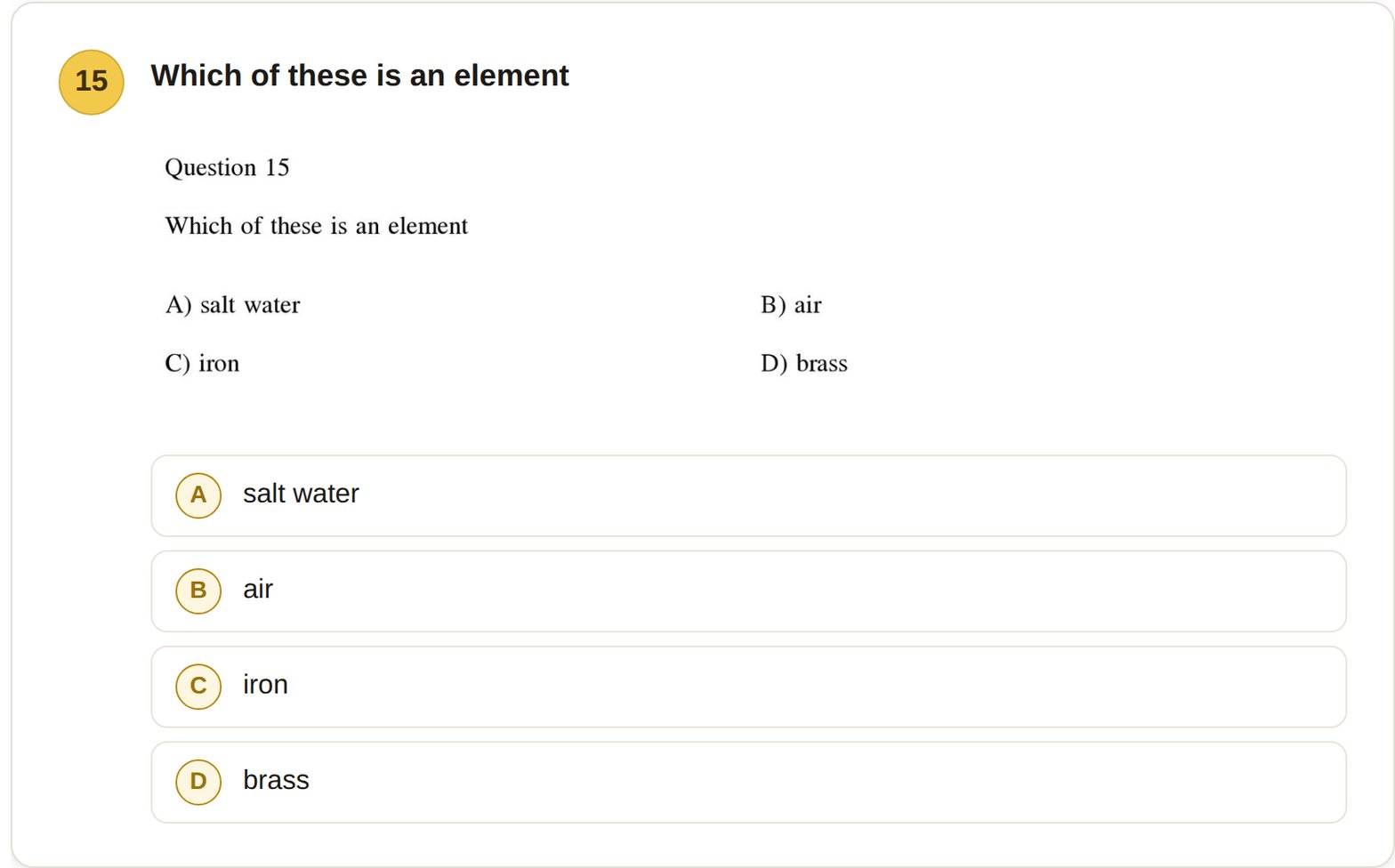
15

Which of these is an element

Question 15 diagram and text as printed in the PDF
Understand It with Pulse
16

The number of protons in a carbon-14 atom is ____
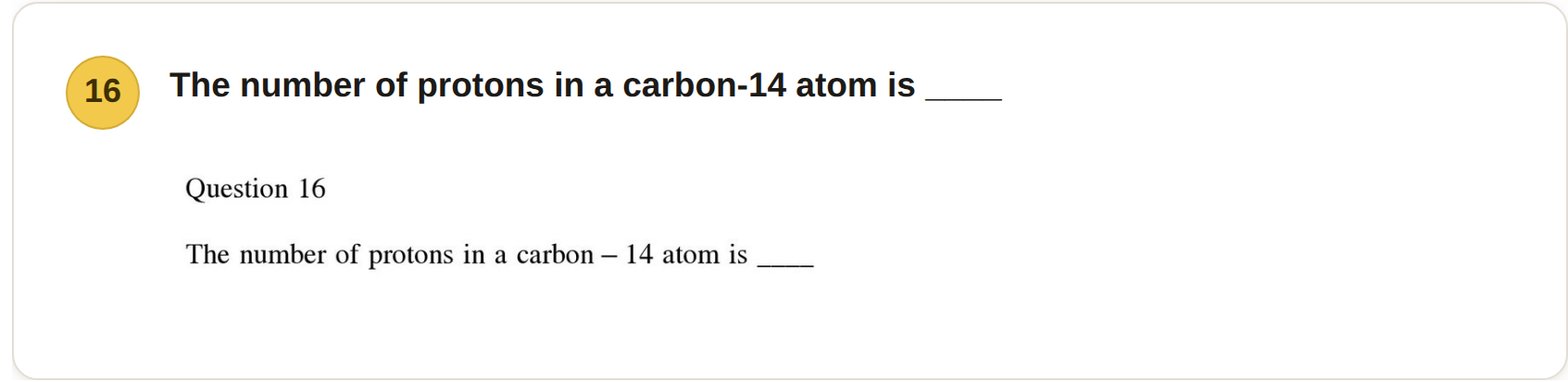
Question 16 diagram and text as printed in the PDF
Understand It with Pulse
17

Which of these is a heterogeneous mixture
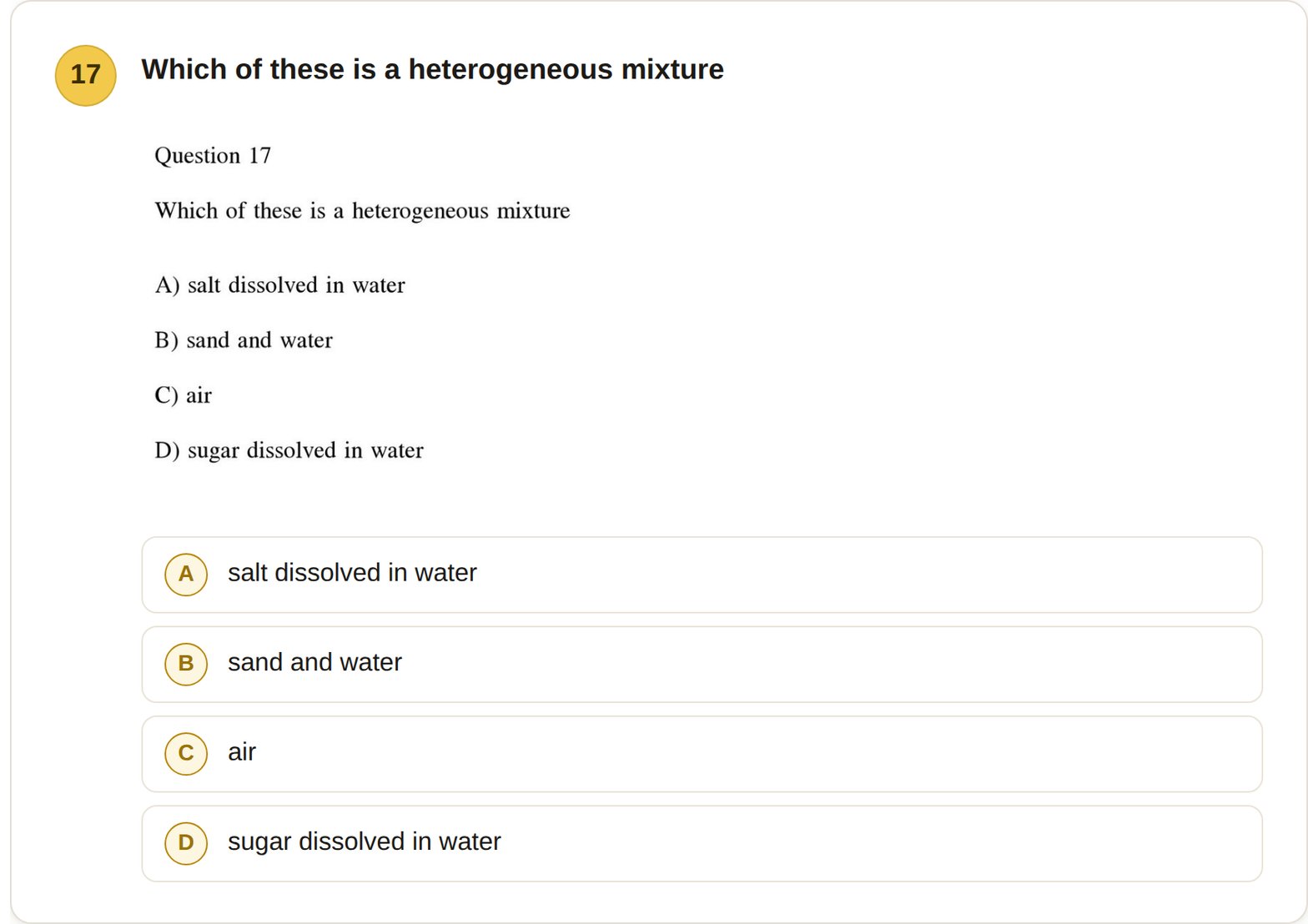
Question 17 diagram and text as printed in the PDF
Understand It with Pulse
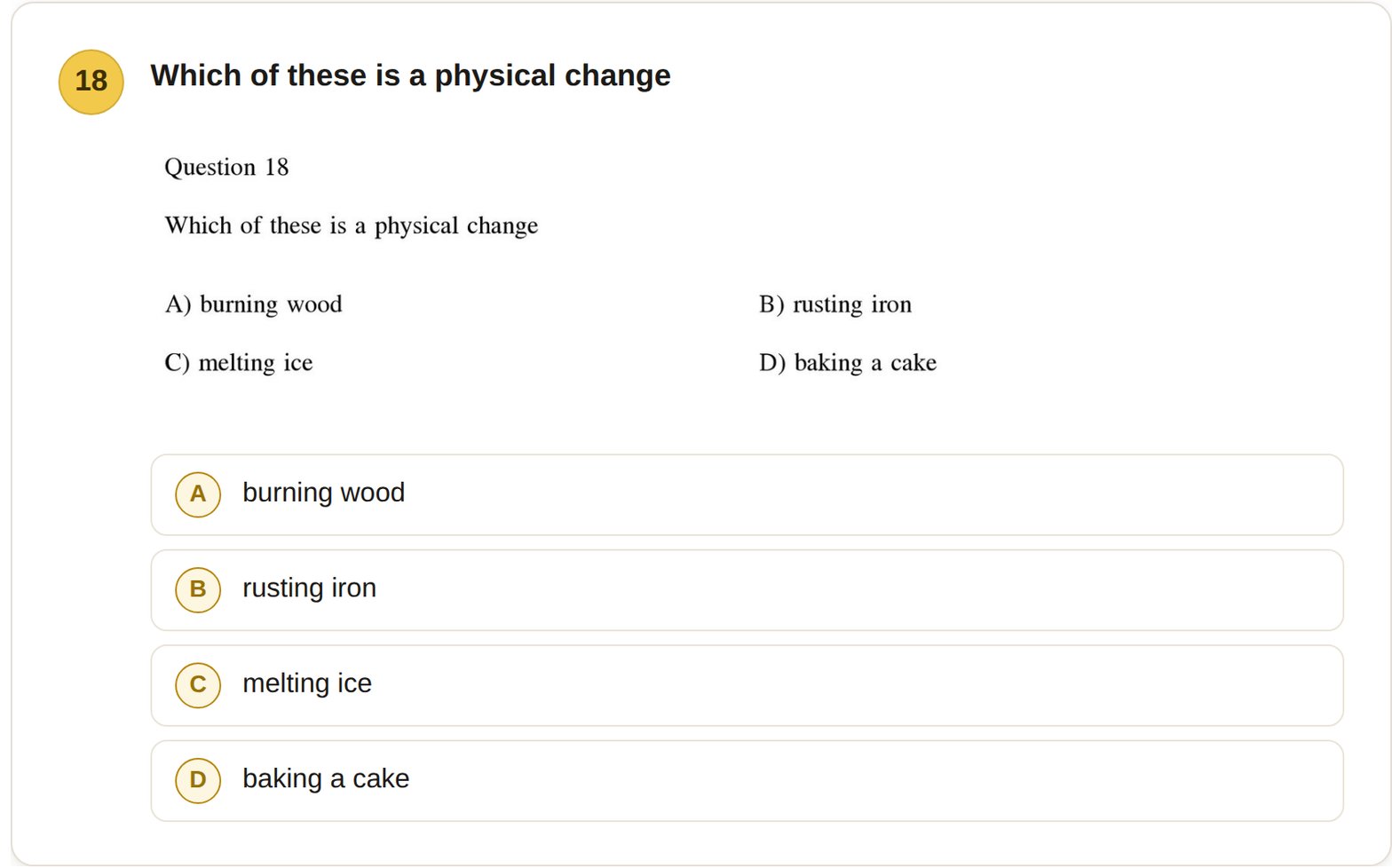
18

Which of these is a physical change

Question 18 diagram and text as printed in the PDF
Understand It with Pulse
19

A sample has mass 50 g and volume 25 cm³. Its density, in grams per cubic centimeter, is ____
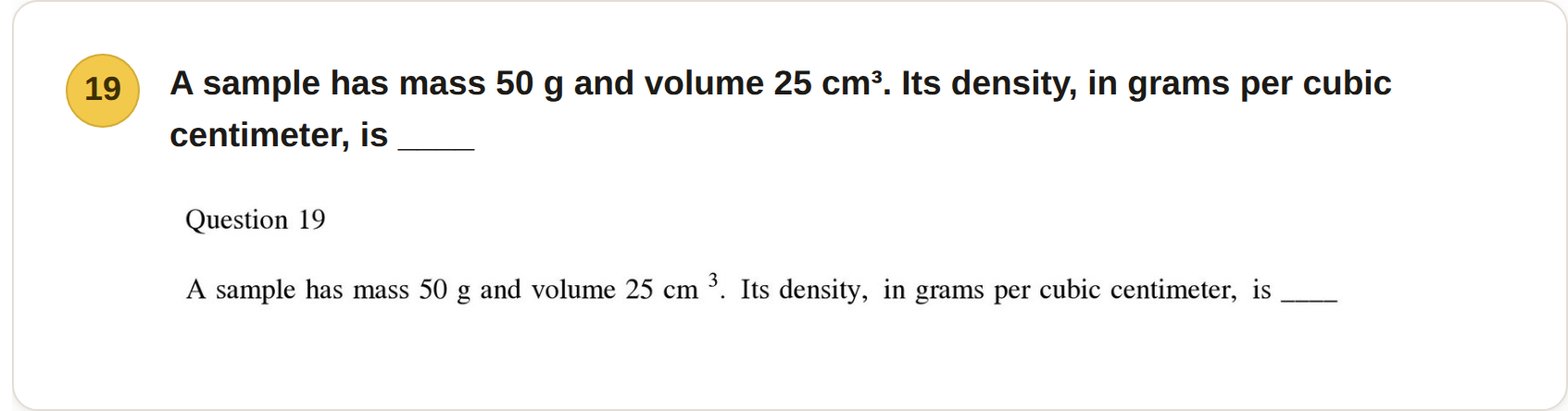
Question 19 diagram and text as printed in the PDF
Understand It with Pulse
20

The electron arrangement of a sodium atom is
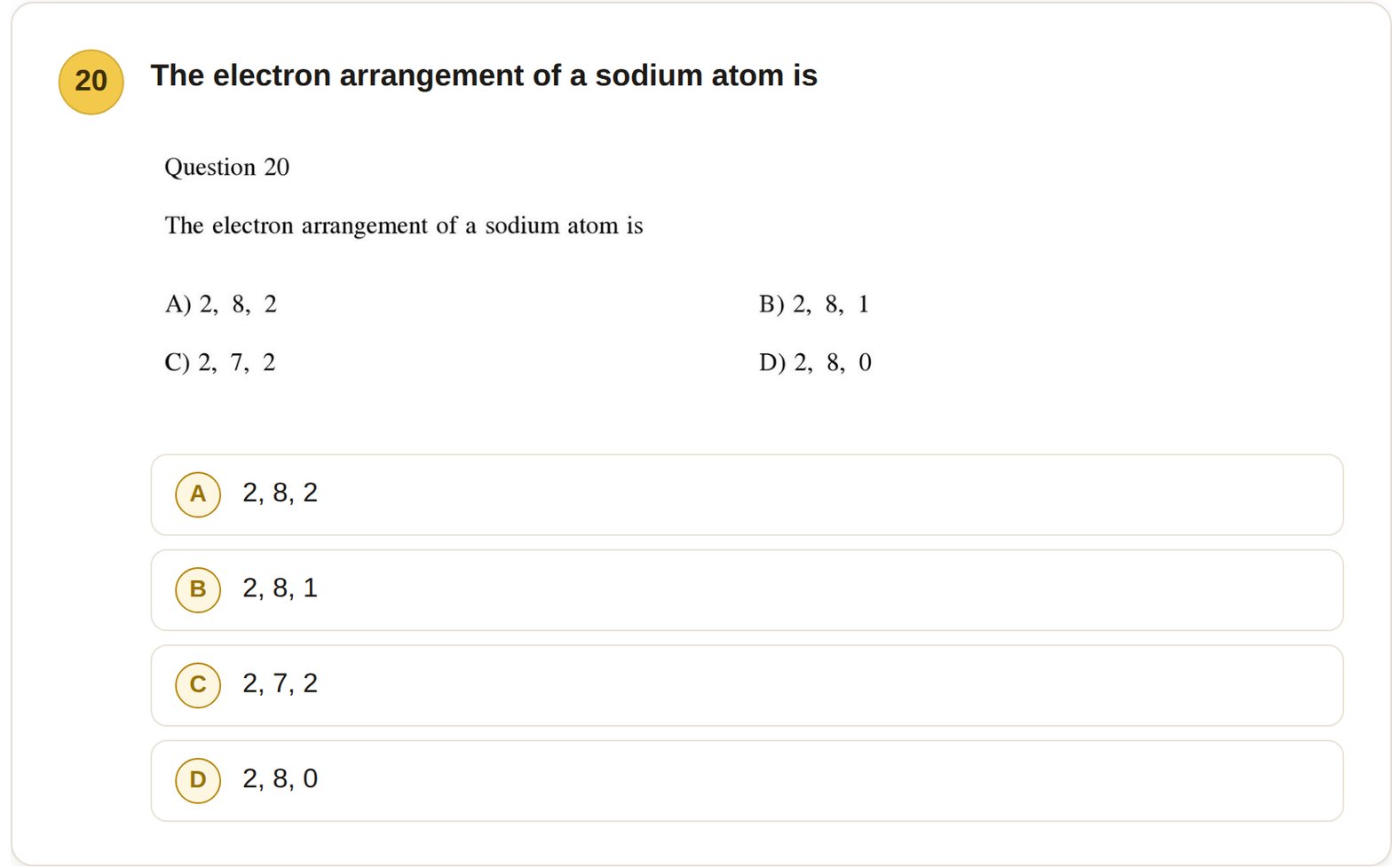
Question 20 diagram and text as printed in the PDF
Understand It with Pulse
21

Going down a group, electronegativity generally
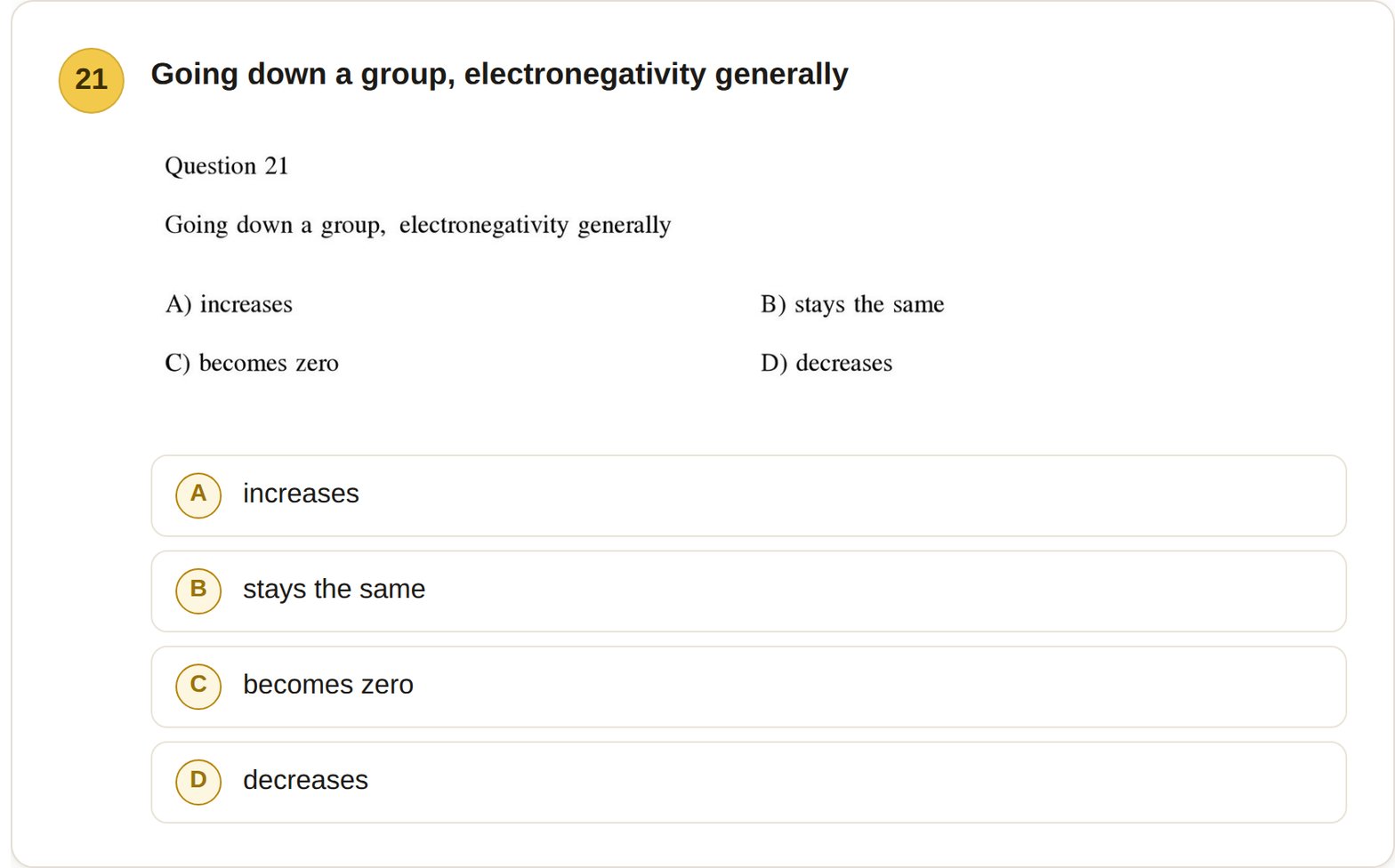
Question 21 diagram and text as printed in the PDF
Understand It with Pulse
22

Using whole number atomic masses (H = 1, O = 16), the molar mass of water, in grams per mole, is ____
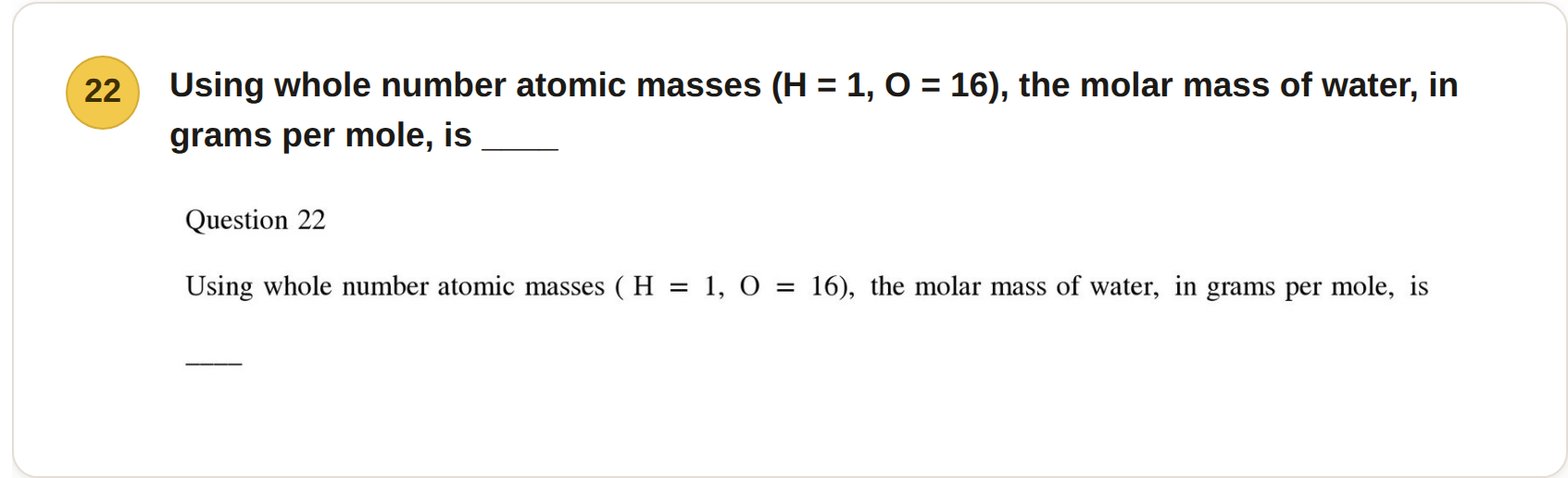
Question 22 diagram and text as printed in the PDF
Understand It with Pulse
23

Carbon dioxide is a compound because it
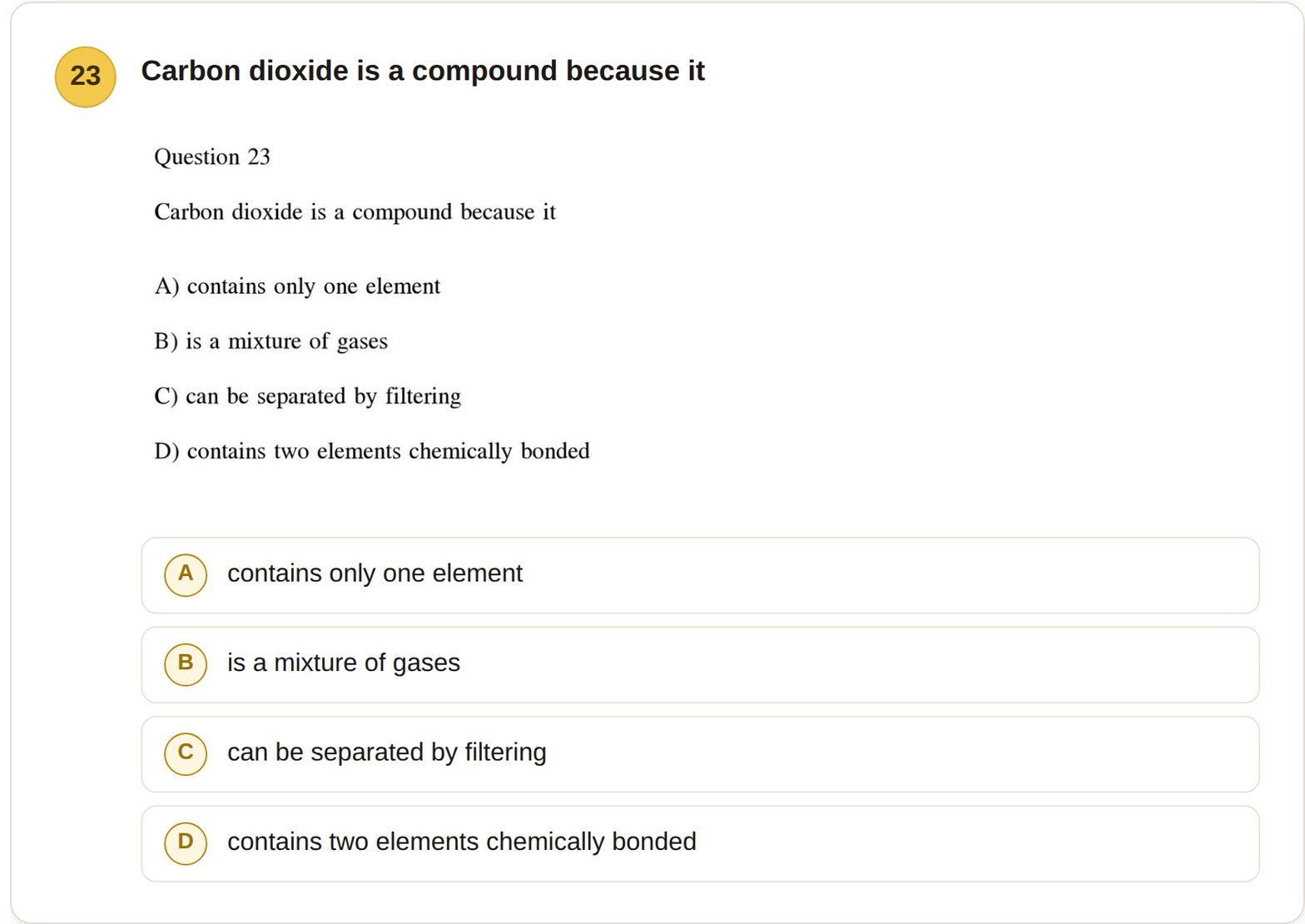
Question 23 diagram and text as printed in the PDF
Understand It with Pulse
24

Which particles are found in the nucleus of an atom
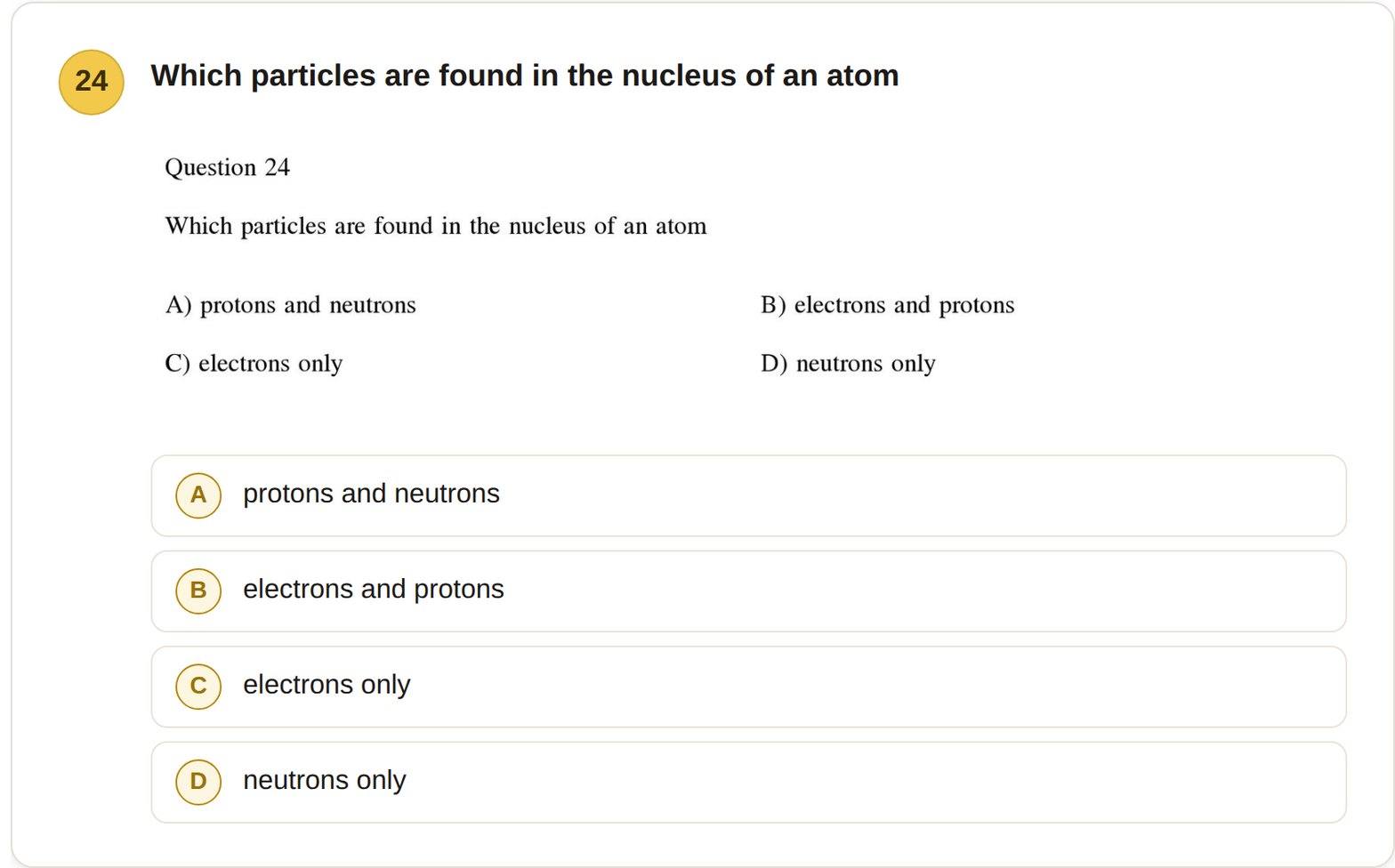
Question 24 diagram and text as printed in the PDF
Understand It with Pulse
25

Using whole number atomic masses (Ca = 40, C = 12, O = 16), the molar mass of calcium carbonate, in grams per mole, is ____
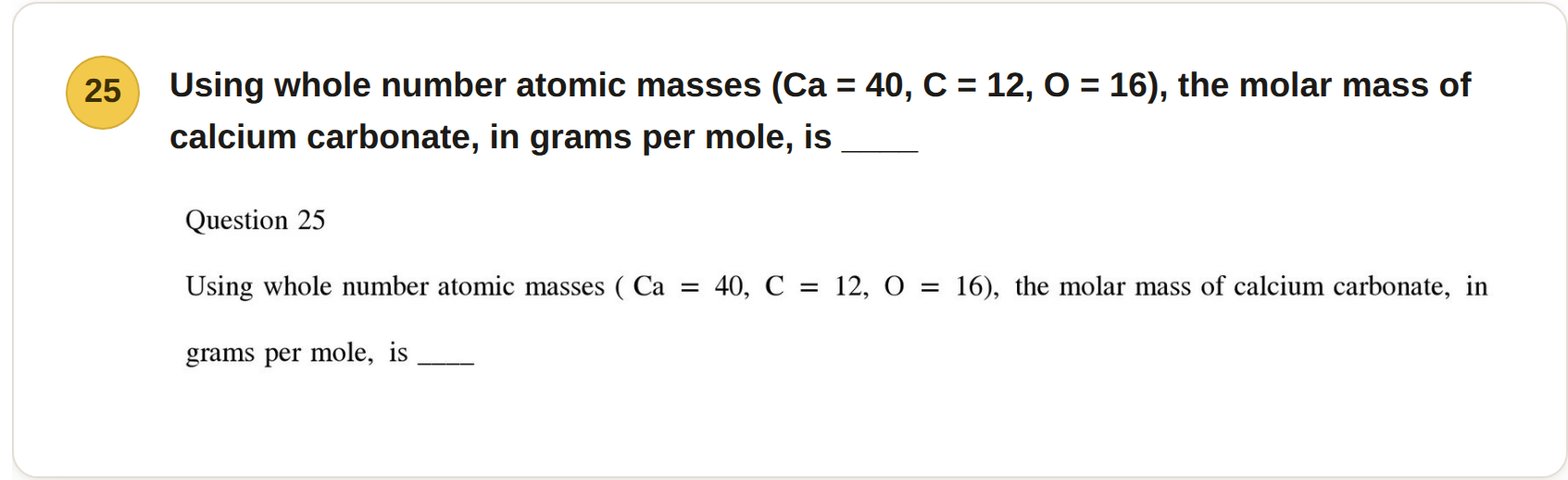
Question 25 diagram and text as printed in the PDF
Understand It with Pulse