1
According to Source I, what is the central idea of the article?
Reading Informational Text - Practice Test | Missouri English 10 · Unit 2 · 25 questions
This practice test was made by AI and there may be mistakes. If a question or answer looks wrong, use the Flag a mistake button to let Brett know so he can fix it.
According to Source I, what is the central idea of the article?
Teenagers need 8 to 10 hours of sleep each night, yet many get far less. Early school start times, homework, sports, and late night screen use all cut into sleep time. When sleep is short night after night, the effects build up.
Sleep helps the brain store what was learned during the day. Students who sleep well are more likely to remember lessons, solve problems, and stay focused in class. Sleep also affects mood: tired students are more likely to feel irritable and stressed.
The article argues that families and schools should protect sleep time. Simple steps help, such as keeping phones out of the bedroom at night and keeping a regular bedtime. Better sleep is not laziness; it is part of learning well and staying healthy.
According to Source I, how many hours of sleep do teenagers need each night?
Teenagers need 8 to 10 hours of sleep each night, yet many get far less. Early school start times, homework, sports, and late night screen use all cut into sleep time. When sleep is short night after night, the effects build up.
Sleep helps the brain store what was learned during the day. Students who sleep well are more likely to remember lessons, solve problems, and stay focused in class. Sleep also affects mood: tired students are more likely to feel irritable and stressed.
The article argues that families and schools should protect sleep time. Simple steps help, such as keeping phones out of the bedroom at night and keeping a regular bedtime. Better sleep is not laziness; it is part of learning well and staying healthy.
According to Source I, what is the author's main purpose?
Teenagers need 8 to 10 hours of sleep each night, yet many get far less. Early school start times, homework, sports, and late night screen use all cut into sleep time. When sleep is short night after night, the effects build up.
Sleep helps the brain store what was learned during the day. Students who sleep well are more likely to remember lessons, solve problems, and stay focused in class. Sleep also affects mood: tired students are more likely to feel irritable and stressed.
The article argues that families and schools should protect sleep time. Simple steps help, such as keeping phones out of the bedroom at night and keeping a regular bedtime. Better sleep is not laziness; it is part of learning well and staying healthy.
According to Source I, which detail supports the idea that sleep helps learning?
Teenagers need 8 to 10 hours of sleep each night, yet many get far less. Early school start times, homework, sports, and late night screen use all cut into sleep time. When sleep is short night after night, the effects build up.
Sleep helps the brain store what was learned during the day. Students who sleep well are more likely to remember lessons, solve problems, and stay focused in class. Sleep also affects mood: tired students are more likely to feel irritable and stressed.
The article argues that families and schools should protect sleep time. Simple steps help, such as keeping phones out of the bedroom at night and keeping a regular bedtime. Better sleep is not laziness; it is part of learning well and staying healthy.
According to Source I, which text structure does the author mainly use?
Teenagers need 8 to 10 hours of sleep each night, yet many get far less. Early school start times, homework, sports, and late night screen use all cut into sleep time. When sleep is short night after night, the effects build up.
Sleep helps the brain store what was learned during the day. Students who sleep well are more likely to remember lessons, solve problems, and stay focused in class. Sleep also affects mood: tired students are more likely to feel irritable and stressed.
The article argues that families and schools should protect sleep time. Simple steps help, such as keeping phones out of the bedroom at night and keeping a regular bedtime. Better sleep is not laziness; it is part of learning well and staying healthy.
According to Source I, what can the reader infer about a student who starts sleeping more regularly?
Teenagers need 8 to 10 hours of sleep each night, yet many get far less. Early school start times, homework, sports, and late night screen use all cut into sleep time. When sleep is short night after night, the effects build up.
Sleep helps the brain store what was learned during the day. Students who sleep well are more likely to remember lessons, solve problems, and stay focused in class. Sleep also affects mood: tired students are more likely to feel irritable and stressed.
The article argues that families and schools should protect sleep time. Simple steps help, such as keeping phones out of the bedroom at night and keeping a regular bedtime. Better sleep is not laziness; it is part of learning well and staying healthy.
According to Source II, what is the main idea of the passage?
Last spring, the town of Cedar Falls turned an empty lot beside its library into a garden for readers. Volunteers cleared weeds, built raised beds, and planted flowers, herbs, and vegetables. The project was paid for by a grant from the town council and money raised at a community bake sale.
The garden opened in June with benches, a small stage, and a path wide enough for wheelchairs. Since then, the library has held story hours and summer reading clubs outdoors. Neighbors who once walked past the empty lot now stop to read, talk, and pick herbs for cooking.
Town leaders say the garden has changed how people use the library. It is no longer only a place to borrow books. It has become a gathering place where reading and community life grow together.
According to Source II, how was the garden project paid for?
Last spring, the town of Cedar Falls turned an empty lot beside its library into a garden for readers. Volunteers cleared weeds, built raised beds, and planted flowers, herbs, and vegetables. The project was paid for by a grant from the town council and money raised at a community bake sale.
The garden opened in June with benches, a small stage, and a path wide enough for wheelchairs. Since then, the library has held story hours and summer reading clubs outdoors. Neighbors who once walked past the empty lot now stop to read, talk, and pick herbs for cooking.
Town leaders say the garden has changed how people use the library. It is no longer only a place to borrow books. It has become a gathering place where reading and community life grow together.
According to Source II, which step happened first in building the garden?
Last spring, the town of Cedar Falls turned an empty lot beside its library into a garden for readers. Volunteers cleared weeds, built raised beds, and planted flowers, herbs, and vegetables. The project was paid for by a grant from the town council and money raised at a community bake sale.
The garden opened in June with benches, a small stage, and a path wide enough for wheelchairs. Since then, the library has held story hours and summer reading clubs outdoors. Neighbors who once walked past the empty lot now stop to read, talk, and pick herbs for cooking.
Town leaders say the garden has changed how people use the library. It is no longer only a place to borrow books. It has become a gathering place where reading and community life grow together.
According to Source II, what is the author's tone?
Last spring, the town of Cedar Falls turned an empty lot beside its library into a garden for readers. Volunteers cleared weeds, built raised beds, and planted flowers, herbs, and vegetables. The project was paid for by a grant from the town council and money raised at a community bake sale.
The garden opened in June with benches, a small stage, and a path wide enough for wheelchairs. Since then, the library has held story hours and summer reading clubs outdoors. Neighbors who once walked past the empty lot now stop to read, talk, and pick herbs for cooking.
Town leaders say the garden has changed how people use the library. It is no longer only a place to borrow books. It has become a gathering place where reading and community life grow together.
According to Source II, in this passage the word transformed would most nearly mean
Last spring, the town of Cedar Falls turned an empty lot beside its library into a garden for readers. Volunteers cleared weeds, built raised beds, and planted flowers, herbs, and vegetables. The project was paid for by a grant from the town council and money raised at a community bake sale.
The garden opened in June with benches, a small stage, and a path wide enough for wheelchairs. Since then, the library has held story hours and summer reading clubs outdoors. Neighbors who once walked past the empty lot now stop to read, talk, and pick herbs for cooking.
Town leaders say the garden has changed how people use the library. It is no longer only a place to borrow books. It has become a gathering place where reading and community life grow together.
According to Source III, what is the purpose of this text?
Step 1: Choose a topic that asks a question you can test with an experiment. Step 2: Get your teacher approval by March 3. Do not start building until your teacher has approved your plan.
Step 3: Build your display and write a clear summary of your results. Step 4: Practice explaining your project in two minutes or less. Step 5: On fair day, bring your display, your summary, and your signed entry form.
According to Source III, what must a student do before building a display?
Step 1: Choose a topic that asks a question you can test with an experiment. Step 2: Get your teacher approval by March 3. Do not start building until your teacher has approved your plan.
Step 3: Build your display and write a clear summary of your results. Step 4: Practice explaining your project in two minutes or less. Step 5: On fair day, bring your display, your summary, and your signed entry form.
According to Source III, what is the deadline for teacher approval?
Step 1: Choose a topic that asks a question you can test with an experiment. Step 2: Get your teacher approval by March 3. Do not start building until your teacher has approved your plan.
Step 3: Build your display and write a clear summary of your results. Step 4: Practice explaining your project in two minutes or less. Step 5: On fair day, bring your display, your summary, and your signed entry form.
According to Source III, what should a student bring on fair day?
Step 1: Choose a topic that asks a question you can test with an experiment. Step 2: Get your teacher approval by March 3. Do not start building until your teacher has approved your plan.
Step 3: Build your display and write a clear summary of your results. Step 4: Practice explaining your project in two minutes or less. Step 5: On fair day, bring your display, your summary, and your signed entry form.
According to Source III, why does the text use numbered steps?
Step 1: Choose a topic that asks a question you can test with an experiment. Step 2: Get your teacher approval by March 3. Do not start building until your teacher has approved your plan.
Step 3: Build your display and write a clear summary of your results. Step 4: Practice explaining your project in two minutes or less. Step 5: On fair day, bring your display, your summary, and your signed entry form.
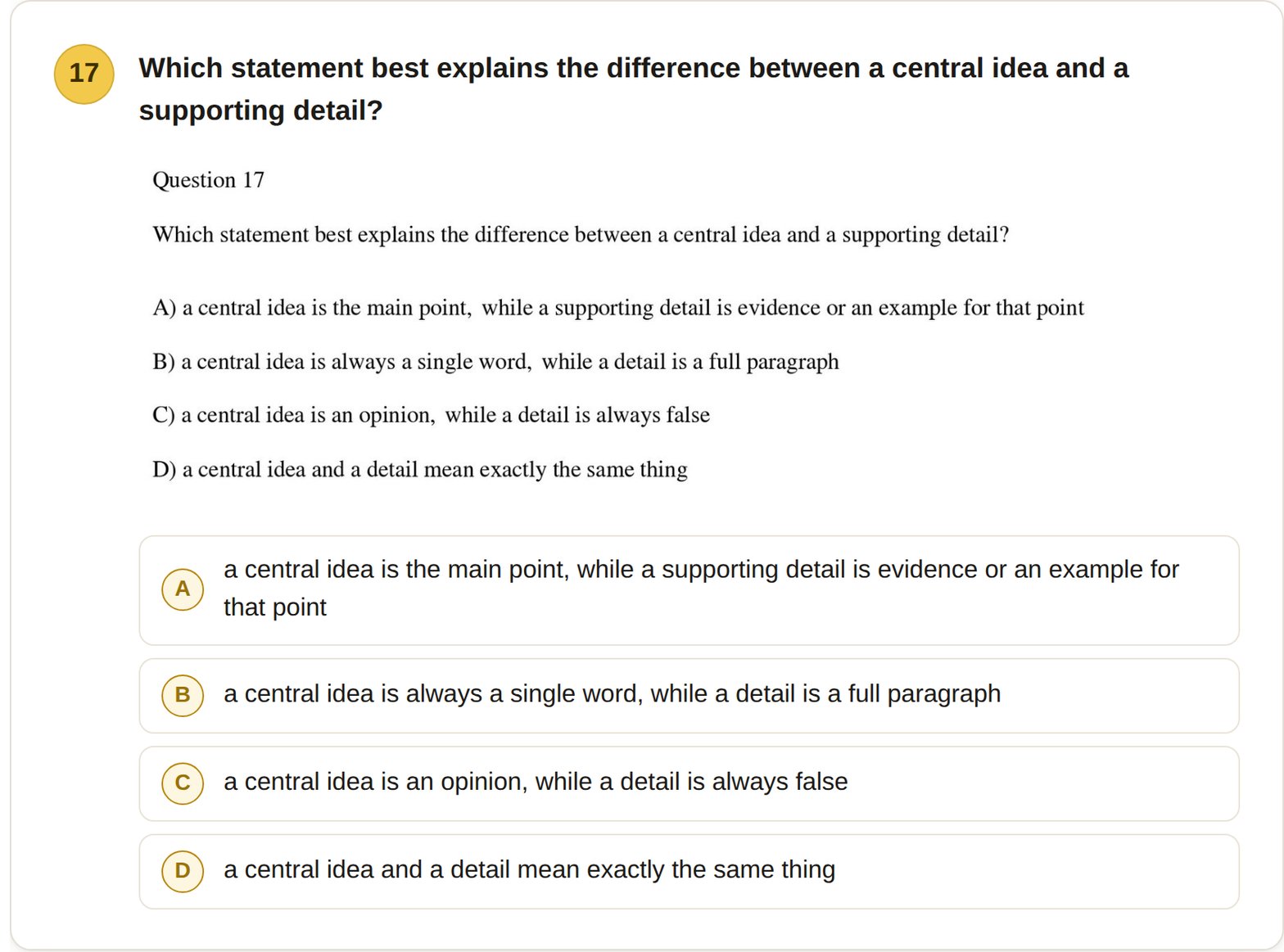
Which statement best explains the difference between a central idea and a supporting detail?
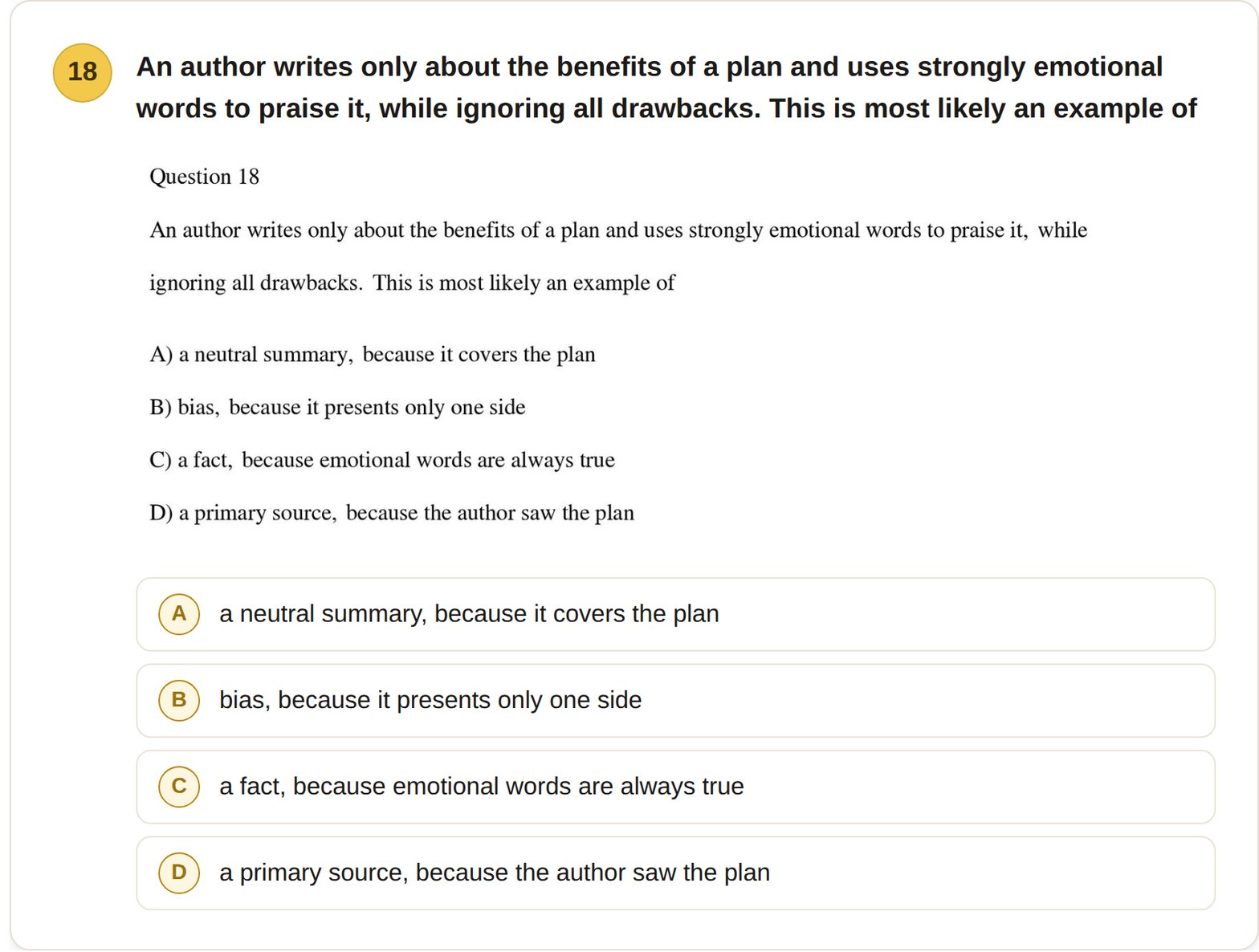
An author writes only about the benefits of a plan and uses strongly emotional words to praise it, while ignoring all drawbacks. This is most likely an example of
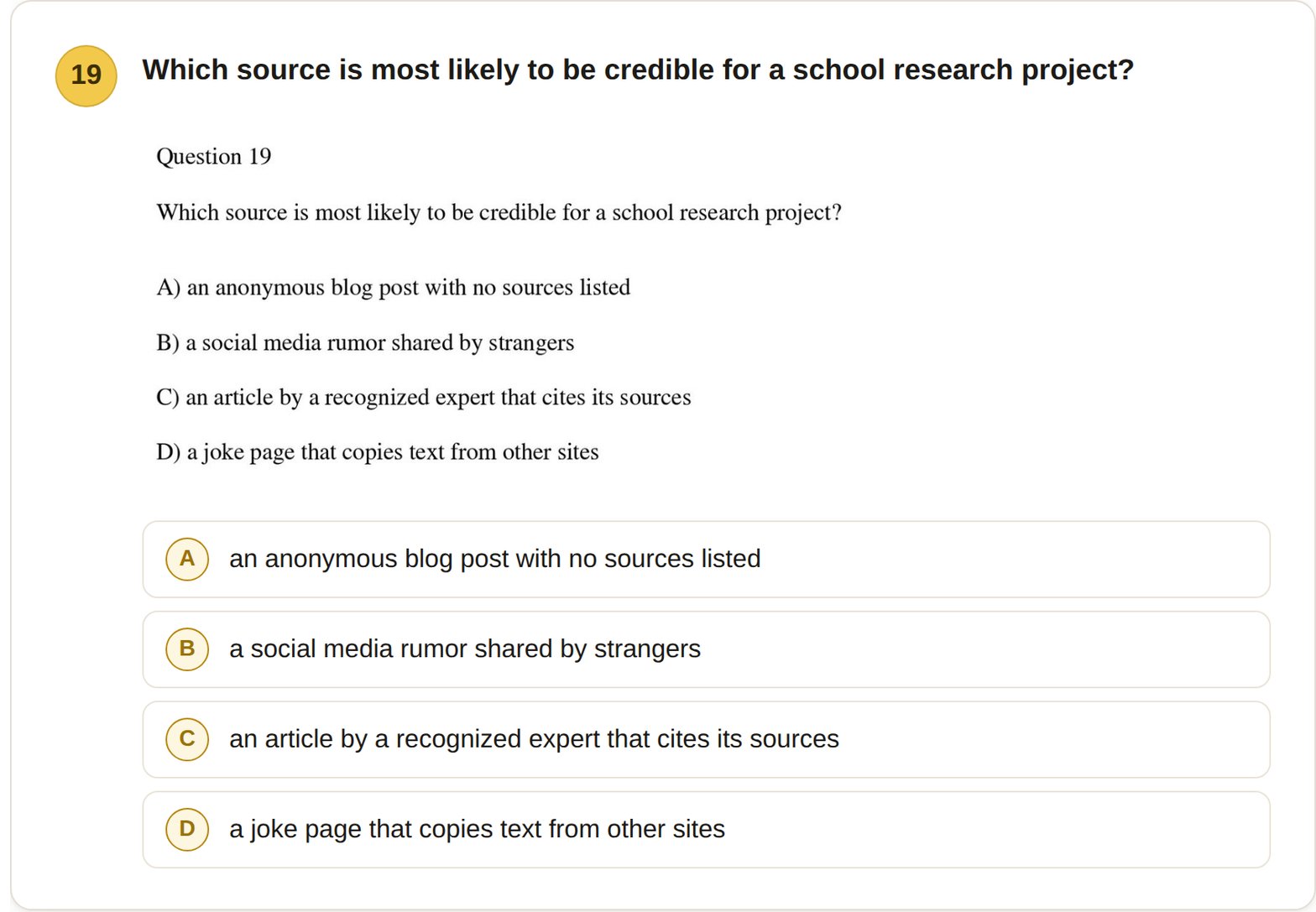
Which source is most likely to be credible for a school research project?
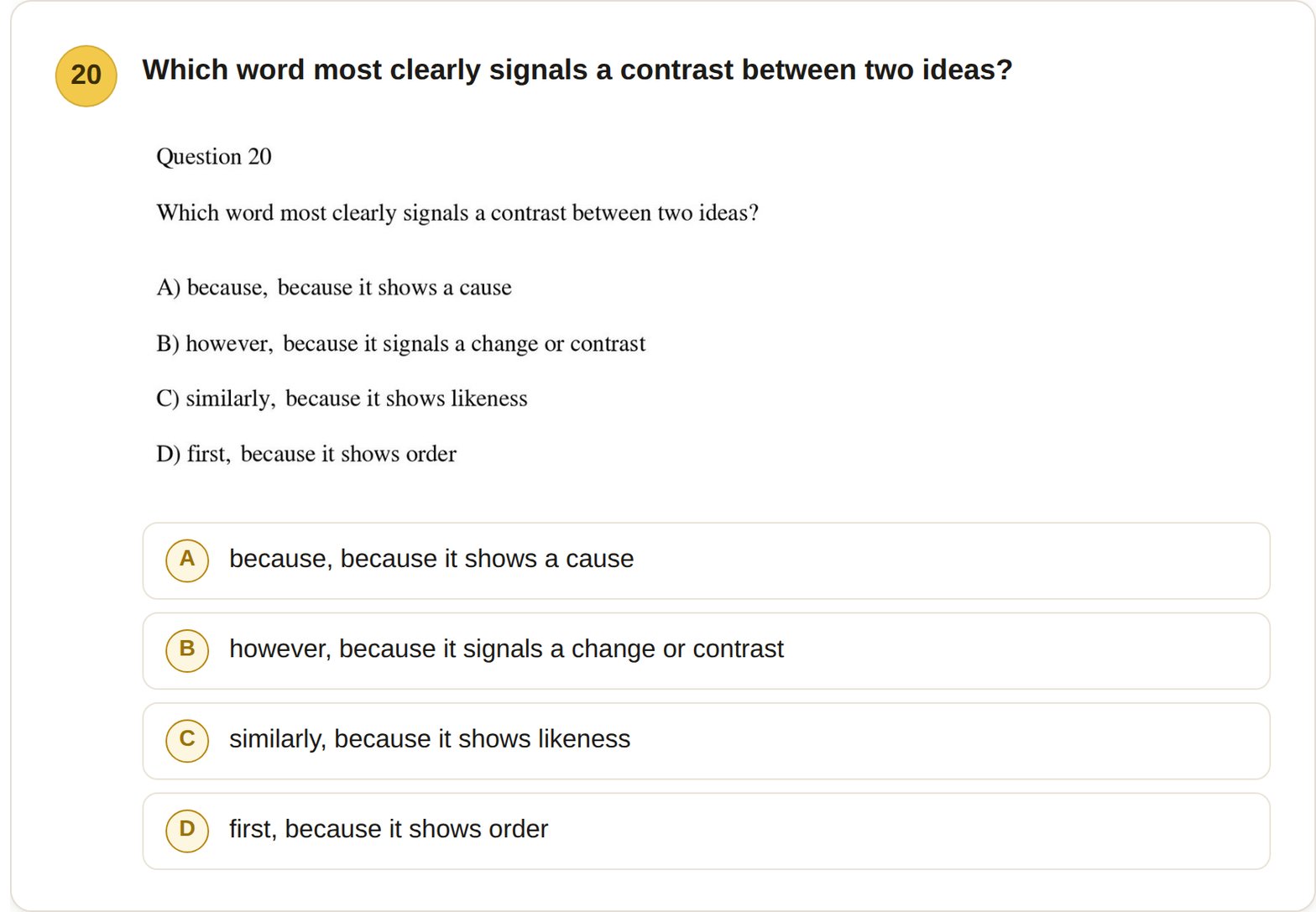
Which word most clearly signals a contrast between two ideas?
Which word most clearly signals a cause?
Which sentence states an opinion rather than a fact?
Which summary best summarizes an article about how regular exercise improves health?
An article states that library attendance doubled from 200 visitors to 400 visitors in one year. What can the reader correctly conclude?
A writer claims that a new study program works. Which evidence would best support that claim?
Your score: 0 / 25