1
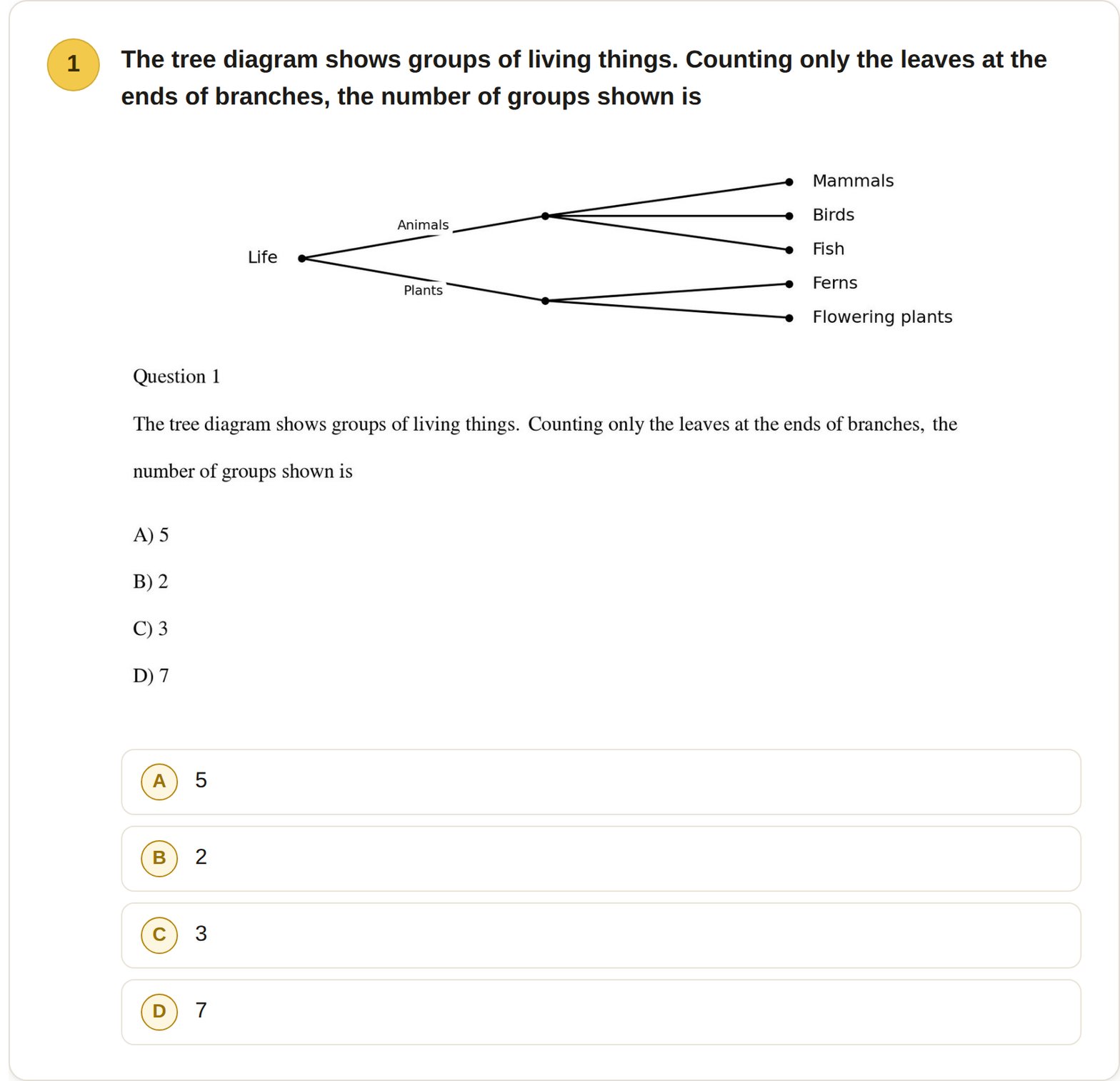
The tree diagram shows groups of living things. Counting only the leaves at the ends of branches, the number of groups shown is
Taxonomy and Major Groups - Practice Test | New Brunswick Biology 111-112 · Unit C · 25 questions
This practice test was made by AI and there may be mistakes. If a question or answer looks wrong, use the Flag a mistake button to let Brett know so he can fix it.
The tree diagram shows groups of living things. Counting only the leaves at the ends of branches, the number of groups shown is
The science of naming and classifying organisms is
In binomial nomenclature, the first name gives the
In binomial nomenclature, the second name gives the
The broadest level of classification used today is the
Humans belong to the kingdom
A dichotomous key identifies an organism by a series of
Which domain includes single-celled organisms without a nucleus, such as E. coli?
Fungi obtain food by
Protists are mostly
Viruses are not classified as living because they
The correct order from broad to specific is
Two organisms in the same genus are more closely related than two in the same
The scientific name Homo sapiens refers to
Archaea are prokaryotes that often live in
Plants are distinguished from animals because plants
A classification list has 8 levels from domain to species. If 2 levels are removed, the levels remaining are
A genus contains 4 species. Three genera in one family contain, in total, species numbering
A genus contains 6 species. Two genera in one family contain, in total, species numbering
A family contains 2 genera with 7 species each. The total number of species is
A classification list has 8 levels. If 3 levels are removed, the levels remaining are
A kingdom contains 3 phyla with 4 classes each. The total number of classes is
A genus contains 5 species. Four genera in one family contain, in total, species numbering
A family contains 4 genera with 3 species each. The total number of species is
A classification list has 7 levels from kingdom to species. If 1 level is removed, the levels remaining are
Your score: 0 / 25