1
A fossil layer is dated by a radioisotope with a half life of 1000 years. After 2000 years the fraction remaining in percent is
percent
Evolution, Change and Diversity - Practice Test | New Brunswick Biology 121-122 · Unit C · 25 questions
This practice test was made by AI and there may be mistakes. If a question or answer looks wrong, use the Flag a mistake button to let Brett know so he can fix it.
A fossil layer is dated by a radioisotope with a half life of 1000 years. After 2000 years the fraction remaining in percent is
A population grows from 100 to 200 in one generation. The growth factor is
A population of 400 doubles twice. The final population is
A species has 5 finch beak types on islands. The number of beak types is
In a population 80 percent survive a drought and 20 percent do not. The percent that do not survive is
A fossil record shows 12 species in an older layer and 4 in a newer layer. The decrease in species count is
Two populations are separated for 10000 years. The number of populations is
A gene pool has 200 alleles and 50 are allele A. The frequency of allele A in percent is
A gene pool has 400 alleles and 100 are allele a. The frequency of allele a in percent is
An antibiotic kills 99 percent of bacteria. The percent surviving is
A population starts at 50 and grows by 10 each year for 5 years. The final population is
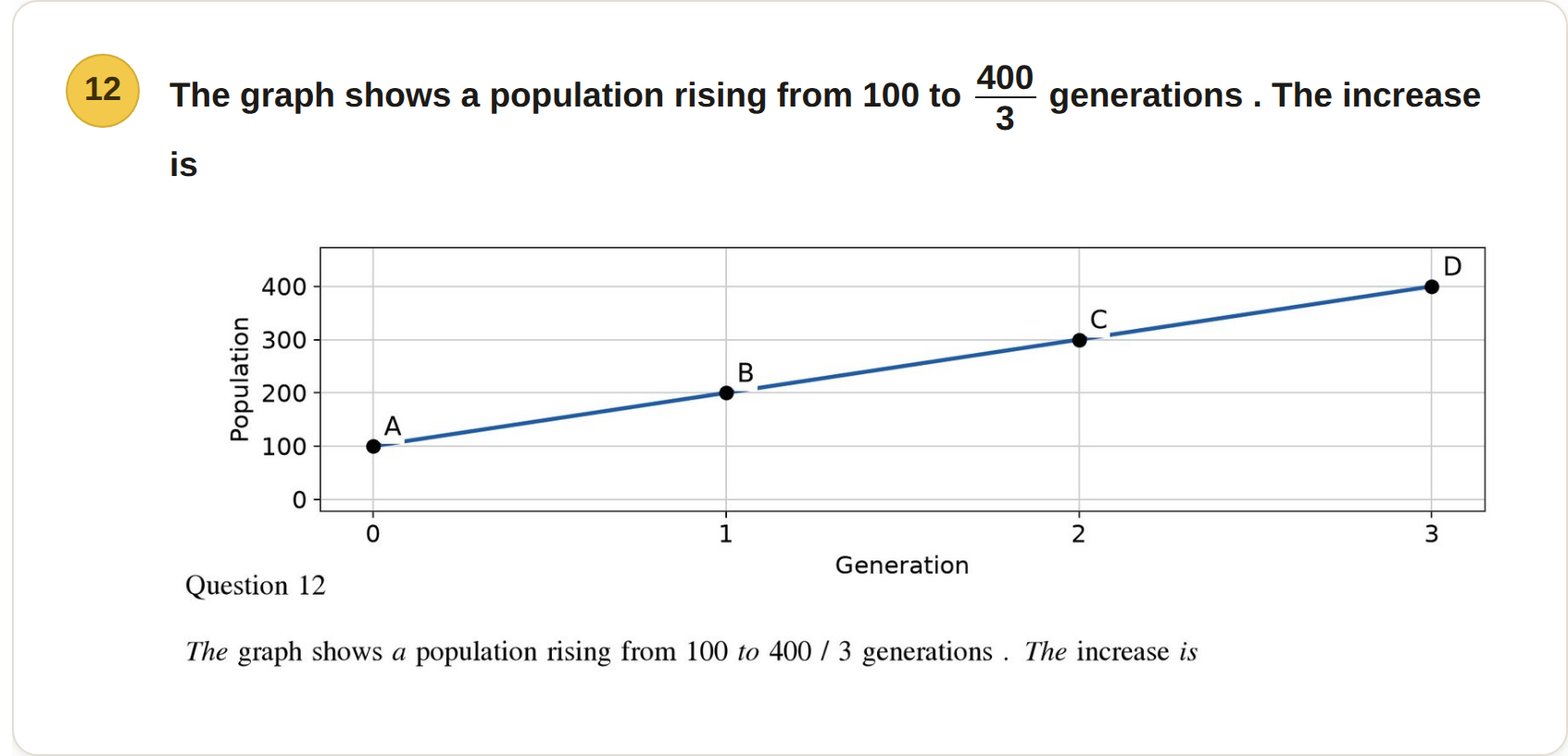
The graph shows a population rising from 100 to 4003 generations . The increase is
Natural selection requires variation, inheritance and
Fossils provide evidence for evolution because they show
Homologous structures suggest species share a
Analogous structures have similar function but different
Darwin proposed natural selection after observing finches in the
The first to propose evolution by natural selection with Wallace was
Lamarck proposed inheritance of
Speciation occurs when populations become
Geographic isolation can lead to
Adaptive radiation is rapid diversification into
A vestigial structure is a structure that has
Biodiversity is greatest in which biome
Mass extinction events in Earth history have
Your score: 0 / 25