1
A menstrual cycle lasts 28 days and ovulation occurs on day 14. The days from ovulation to the end of the cycle are
Human Reproduction - Practice Test | New Brunswick Biology 121-122 · Unit E · 25 questions
This practice test was made by AI and there may be mistakes. If a question or answer looks wrong, use the Flag a mistake button to let Brett know so he can fix it.
A menstrual cycle lasts 28 days and ovulation occurs on day 14. The days from ovulation to the end of the cycle are
A cycle lasts 30 days and ovulation occurs on day 16. The days after ovulation are
Human gestation lasts about 40 weeks. In days this is about
A sperm count sample has 20 million per millilitre and volume 3 millilitres. The total in millions is
An ovary releases 1 egg per cycle for 12 cycles. The total eggs released is
A couple uses a method that is 99 percent effective. The failure rate in percent is
Twins occur in 3 of 100 births. In 1000 births the expected number of twin births is
A pregnancy test detects a hormone after 14 days. The test is taken on day 28. The days since the hormone became detectable are
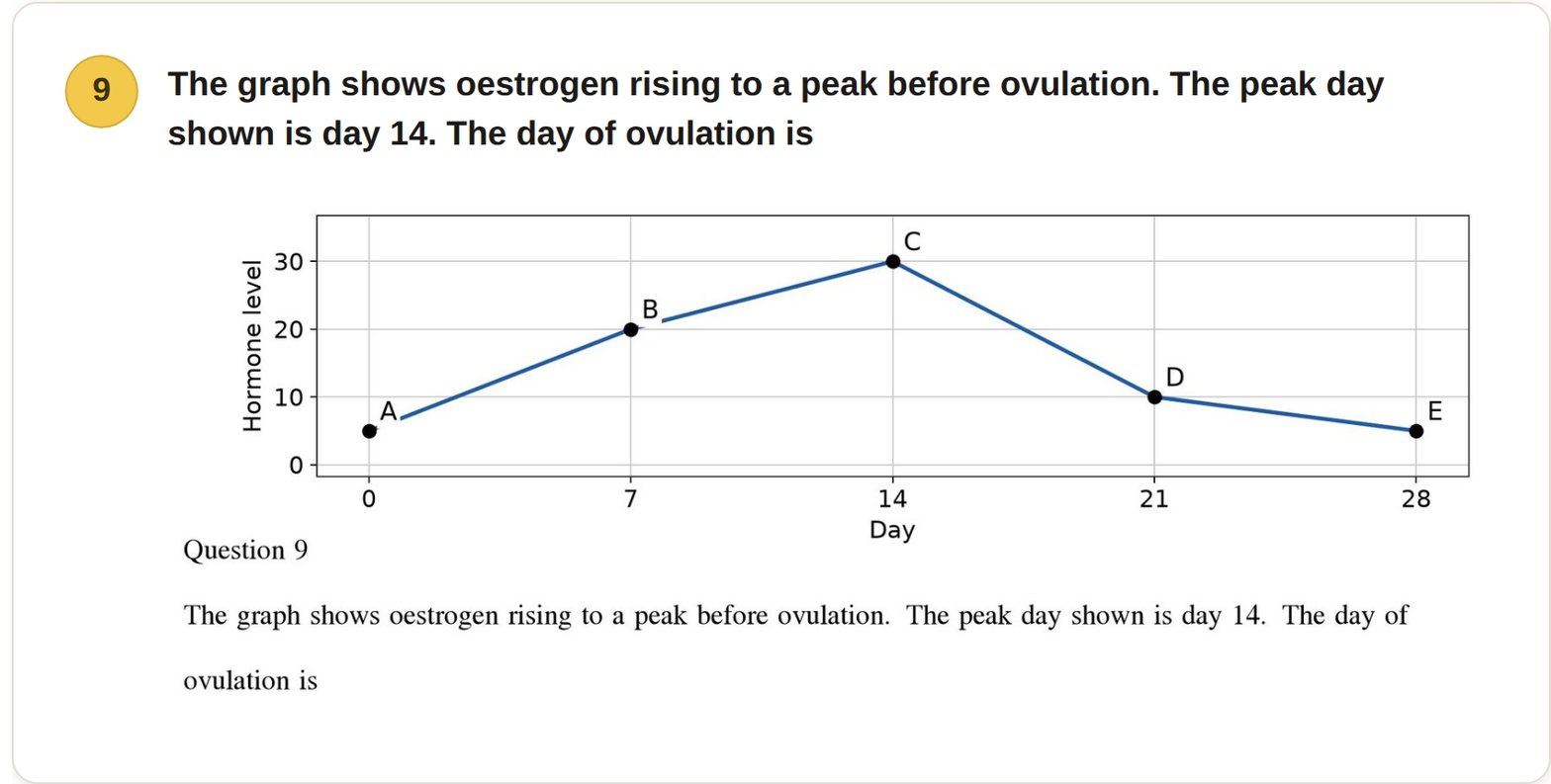
The graph shows oestrogen rising to a peak before ovulation. The peak day shown is day 14. The day of ovulation is
A fertilised egg divides to 2 then 4 then 8 cells. The number after 3 divisions is
A zygote has 46 chromosomes. Each cell of the blastocyst normally has how many chromosomes
Puberty in a student begins at age 12 and ends at age 16. The duration in years is
Fertilisation in humans normally occurs in the
The male gamete is the
The female gamete is the
Implantation occurs in the
The placenta allows exchange between mother and
FSH stimulates in females the
LH triggers which event in females
Progesterone maintains the
Testosterone is produced mainly in the
The umbilical cord connects the foetus to the
A sexually transmitted infection caused by bacteria can often be treated with
Contraception that prevents ovulation is the
Human chorionic gonadotropin is the hormone detected by a
Your score: 0 / 25