1
For f(x) = 2x² + 3 , the average rate of change from x = 0 to x = 2 is
Rates of Change and Increasing and Decreasing Functions - Practice Test | New Brunswick Calculus 120 · Unit B · 25 questions
This practice test was made by AI and there may be mistakes. If a question or answer looks wrong, use the Flag a mistake button to let Brett know so he can fix it.
For f(x) = 2x² + 3 , the average rate of change from x = 0 to x = 2 is
For f(x) = 3x² + 1 , the average rate of change from x = 0 to x = 2 is
For f(x) = 4x² + 2 , the average rate of change from x = 0 to x = 2 is
A car travels 120 kilometres in 2 hours. Its average rate of change of distance is, in kilometres per hour,
The secant slope of f(x) = x² between x = 1 and x = 3 is
The average rate of change of f(x) = 2x + 1 between any two points is
For f(x) = 2x² + 3 , the instantaneous rate of change at x = 1 is
For f(x) = 3x² + 1 , the instantaneous rate of change at x = 1 is
For f(x) = 4x² + 2 , the instantaneous rate of change at x = 1 is
The instantaneous rate of change of f(x) = x² at x = 3 is
A particle has position s(t) = t² . Its instantaneous velocity at t = 4 , in metres per second, is
The derivative is the instantaneous rate of change. For f(x) = 3x² , the instantaneous rate of change at x = 1 is
For f(x) = x² - 2x , the critical point is at x =
For f(x) = x² - 3x , the critical point is at x =
For f(x) = x² - 4x , the critical point is at x =
The function f(x) = x² - 4x has a critical point at x =
A critical point of a function is a point where the derivative is
The critical points of f(x) = x³ - 3x are at x =
For f(x) = x² - 4x , the derivative at x = 3 is
For f(x) = x² - 6x , the derivative at x = 4 is
For f(x) = x² - 8x , the derivative at x = 5 is
The derivative of f(x) = x² + 5x at x = 2 equals
If f'(x) = 4x , then f'(3) is
The slope of the tangent to f(x) = x at x = 4 is
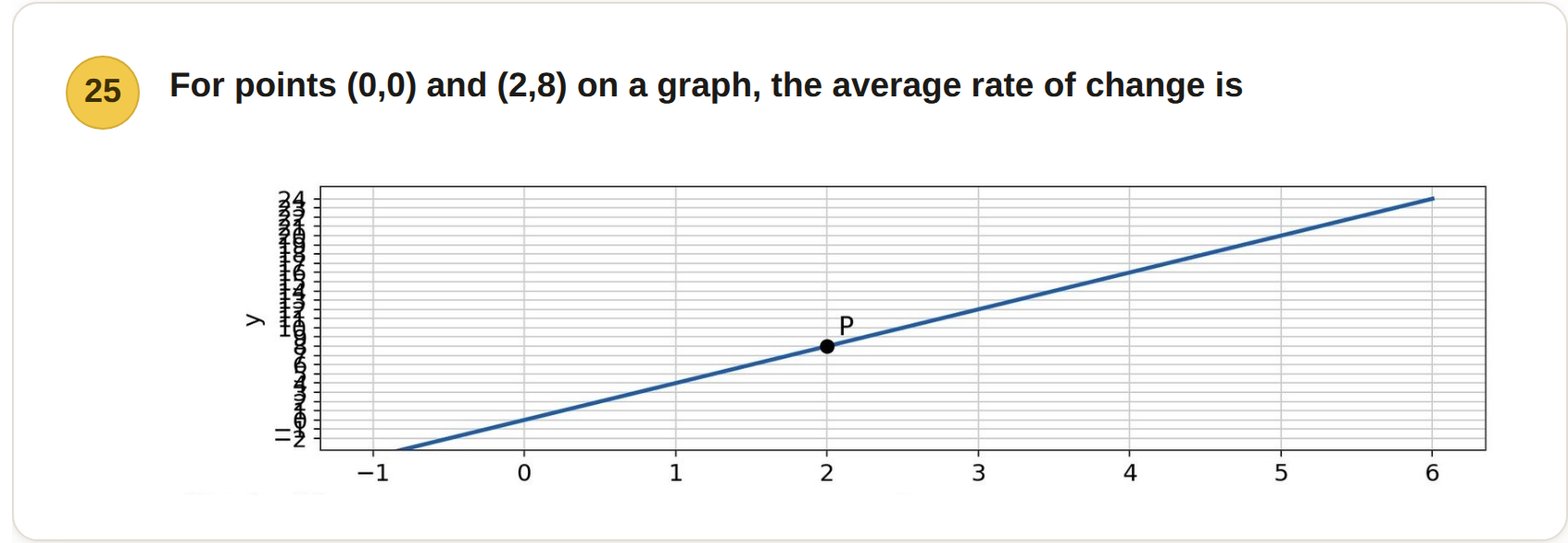
For points (0,0) and (2,8) on a graph, the average rate of change is
Your score: 0 / 25