1
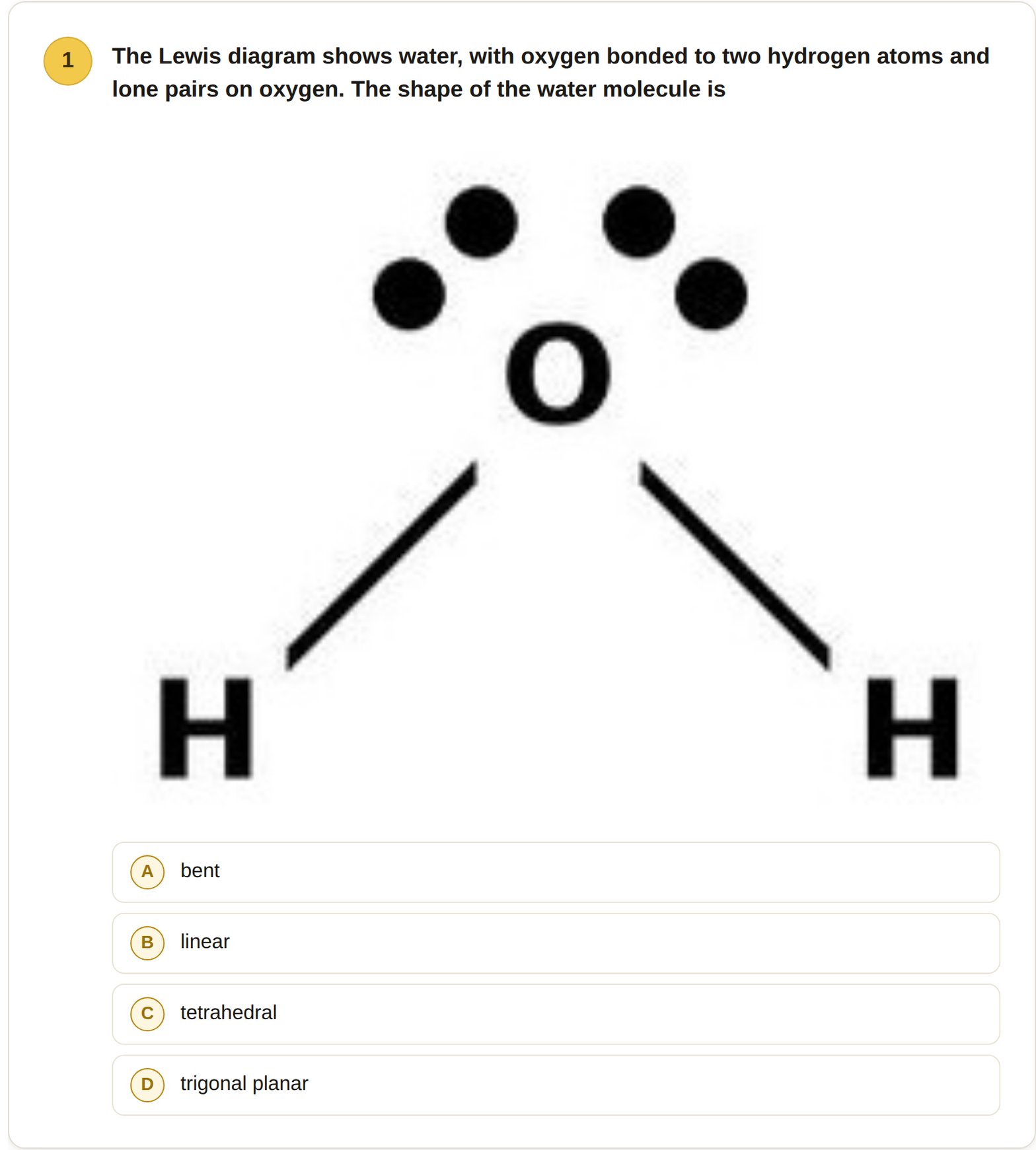
The Lewis diagram shows water, with oxygen bonded to two hydrogen atoms and lone pairs on oxygen. The shape of the water molecule is
Chemical Bonding, Molecular Shape (VSEPR Theory), Intermolecular Forces, and Properties - Practice Test | New Brunswick Chemistry 111-112 · Unit B · 25 questions
This practice test was made by AI and there may be mistakes. If a question or answer looks wrong, use the Flag a mistake button to let Brett know so he can fix it.
The Lewis diagram shows water, with oxygen bonded to two hydrogen atoms and lone pairs on oxygen. The shape of the water molecule is
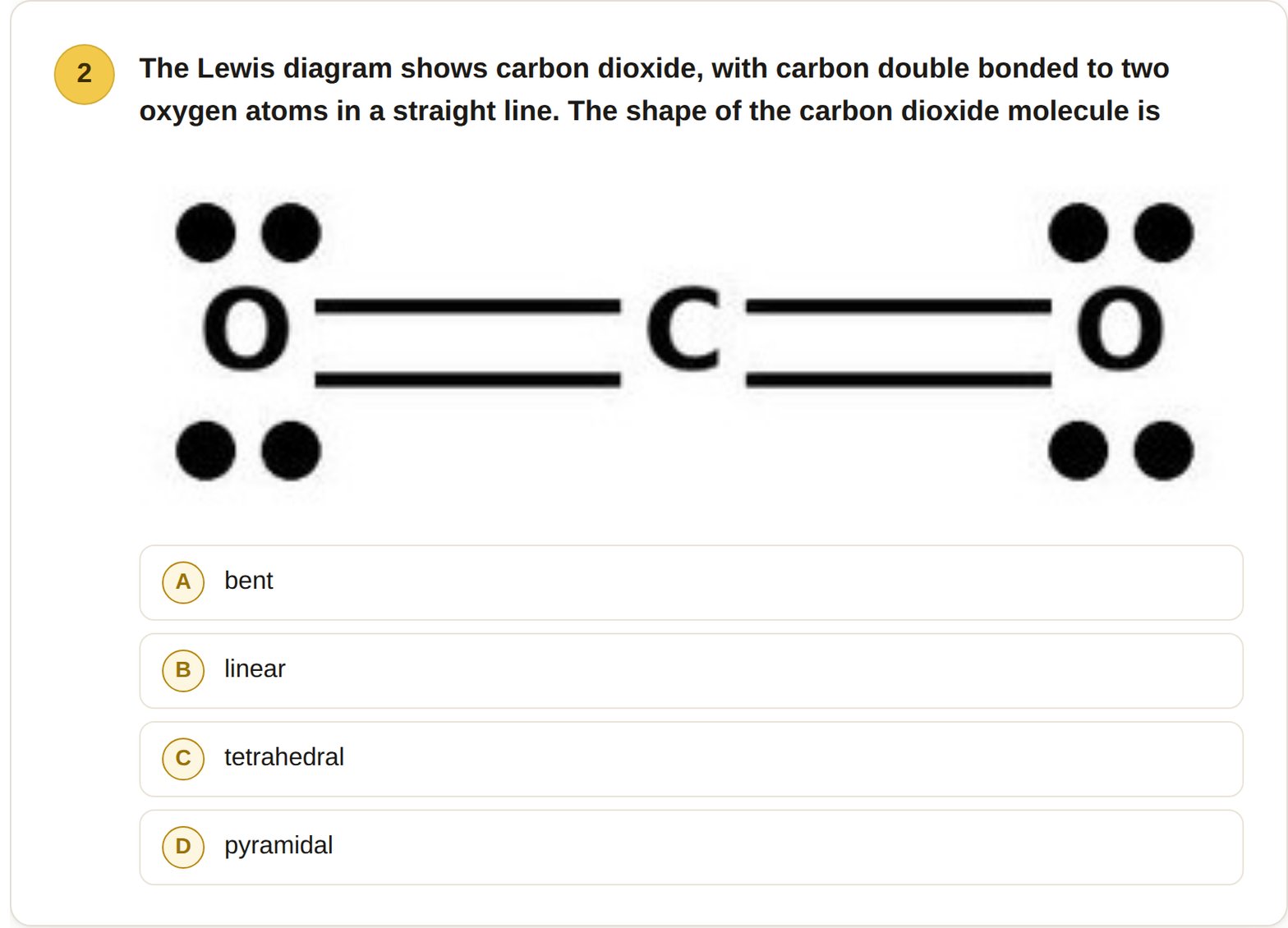
The Lewis diagram shows carbon dioxide, with carbon double bonded to two oxygen atoms in a straight line. The shape of the carbon dioxide molecule is
An ionic bond forms between a metal and a nonmetal by
A covalent bond forms by
A polar covalent bond has electrons shared
Water is polar because oxygen attracts shared electrons
Hydrogen bonding is a strong intermolecular force between molecules containing hydrogen bonded to
London dispersion forces are present in
Ionic compounds generally have
VSEPR theory predicts molecular shape from the repulsion of
A molecule with 4 bonding pairs and no lone pairs on the central atom is
A molecule with 2 bonding pairs and no lone pairs on the central atom is
A molecule with 3 bonding pairs and no lone pairs on the central atom is
Carbon dioxide is nonpolar overall because its polar bonds are
Methane is nonpolar because its bonds are arranged
The electronegativity difference is largest in a bond that is most
A bond between atoms with electronegativity values 3.5 and 2.1 has a difference of
A bond between atoms with electronegativity values 3.0 and 2.5 has a difference of
A bond between atoms with electronegativity values 3.2 and 2.4 has a difference of
A bond between atoms with electronegativity values 3.6 and 2.8 has a difference of
A bond between atoms with electronegativity values 2.6 and 2.2 has a difference of
A bond between atoms with electronegativity values 3.1 and 2.3 has a difference of
A bond between atoms with electronegativity values 3.9 and 2.1 has a difference of
A bond between atoms with electronegativity values 2.9 and 2.5 has a difference of
A bond between atoms with electronegativity values 3.4 and 2.0 has a difference of
Your score: 0 / 25