1
A compound is a substance made of two or more elements
Final Exam - Practice Test | New Brunswick Chemistry 111-112 · Final Exam · 50 questions
This practice test was made by AI and there may be mistakes. If a question or answer looks wrong, use the Flag a mistake button to let Brett know so he can fix it.
A compound is a substance made of two or more elements
An ionic bond forms between a metal and a nonmetal by
The molar mass of NaCl is 58.5 grams per mole. A sample of 117 grams contains, in moles
A solution of concentration 2 moles per litre and volume 100 millilitres is diluted to 200 millilitres. Its new concentration, in moles per litre, is
In a reaction, 3 moles of A react with 1 moles of B to make product. Starting with 6 moles of A, the moles of B needed are
An anion is formed when an atom
Hydrogen bonding is a strong intermolecular force between molecules containing hydrogen bonded to
The molar mass of CO₂ is 44 grams per mole. A sample of 2 moles has a mass, in grams, of
An unsaturated solution can still dissolve
A gas occupies 300 millilitres at 300 kelvin. At constant pressure its temperature is changed to 600 kelvin. Its new volume, in millilitres, is
An atom of Ca has atomic number 20 and mass number 40. Its number of neutrons is
A molecule with 4 bonding pairs and no lone pairs on the central atom is
The molar mass of a substance is its mass per
A solution contains 5 grams of solute in 50 grams of solution. Its percent by mass is
At standard temperature and pressure one mole of gas occupies 22.4 litres. A sample occupying 67.2 litres at standard temperature and pressure contains, in moles
An atom of He has atomic number 2. Its number of protons is
Methane is nonpolar because its bonds are arranged
In the equation 2H₂ plus O₂ gives 2H₂O, the mole ratio of H₂ to O₂ is
A solution contains 4 moles of solute in 2 litres. Its concentration, in moles per litre, is
Percent yield compares actual yield to
An atom of Na has atomic number 11 and mass number 23. Its number of neutrons is
A bond between atoms with electronegativity values 3.2 and 2.4 has a difference of
The molar mass of CaCO₃ is 100 grams per mole. A sample of 200 grams contains, in moles
A solution of concentration 2 moles per litre and volume 200 millilitres is diluted to 800 millilitres. Its new concentration, in moles per litre, is
Stoichiometry uses mole ratios from the
Elements in the same group of the periodic table have similar
A bond between atoms with electronegativity values 3.9 and 2.1 has a difference of
The equation 2Na plus Cl₂ gives 2NaCl is balanced. The coefficient in front of NaCl is
A solution contains 25 grams of solute in 250 grams of solution. Its percent by mass is
A gas at 200 kilopascals occupies 3 litres. At constant temperature its volume is changed to 6 litres. Its new pressure, in kilopascals, is
An ion has 17 protons and 18 electrons. Its charge is -1. The magnitude of its charge is
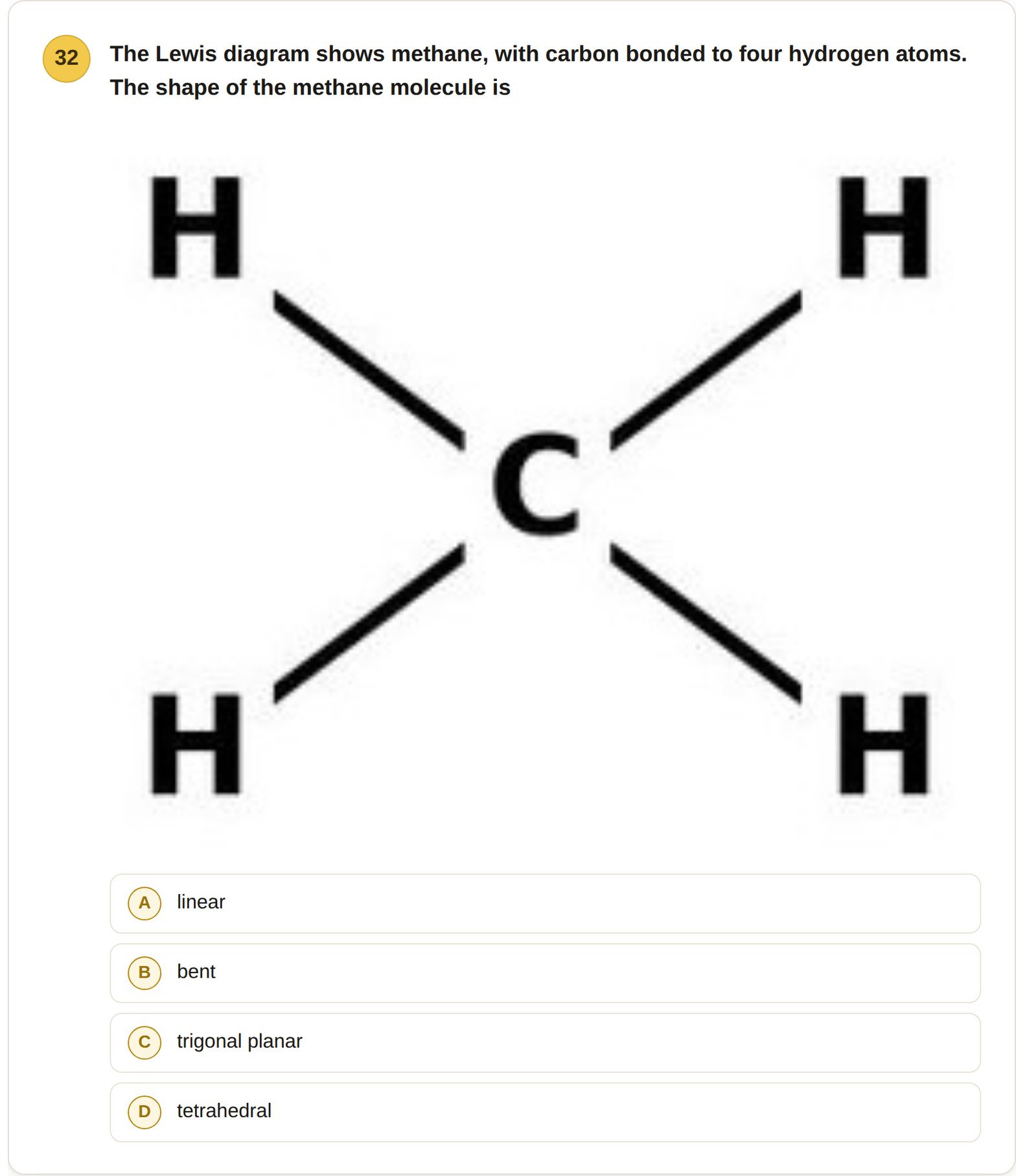
The Lewis diagram shows methane, with carbon bonded to four hydrogen atoms. The shape of the methane molecule is
The molar mass of CO₂ is 44 grams per mole. A sample of 132 grams contains, in moles
A solution contains 50 grams of solute in 500 grams of solution. Its percent by mass is
A gas at pressure 90 kilopascals occupies 6 litres. At constant temperature its pressure is changed to 180 kilopascals. Its new volume, in litres, is
An atom has 9 protons and 10 neutrons. Its mass number is
Water has a high boiling point for its size because of
The molar mass of carbon dioxide, CO₂, is about
A solution contains 8 moles of solute in 4 litres. Its concentration, in moles per litre, is
To find the limiting reagent, compare the
Noble gases are generally
A bond between atoms with electronegativity values 2.8 and 2.0 has a difference of
The equation N₂ plus 3H₂ gives 2NH₃ is balanced. The coefficient in front of H₂ is
Increasing temperature usually increases the solubility of a
A gas at 100 kilopascals occupies 8 litres. At constant temperature its volume is changed to 4 litres. Its new pressure, in kilopascals, is
Halogens are in group
A bond between atoms with electronegativity values 2.4 and 2.0 has a difference of
The equation 2Mg plus O₂ gives 2MgO is balanced. The coefficient in front of MgO is
A solution contains 12 moles of solute in 4 litres. Its concentration, in moles per litre, is
A gas at pressure 120 kilopascals occupies 10 litres. At constant temperature its pressure is changed to 240 kilopascals. Its new volume, in litres, is
Your score: 0 / 50