1
Water of mass 100 grams warms by 10 degrees Celsius. Using a specific heat of 4.2 joules per gram degree, the heat absorbed in joules is
joules
Thermochemistry - Practice Test | New Brunswick Chemistry 121-122 · Unit A · 25 questions
This practice test was made by AI and there may be mistakes. If a question or answer looks wrong, use the Flag a mistake button to let Brett know so he can fix it.
Water of mass 100 grams warms by 10 degrees Celsius. Using a specific heat of 4.2 joules per gram degree, the heat absorbed in joules is
Water of mass 50 grams warms by 20 degrees Celsius. Using a specific heat of 4.2 joules per gram degree, the heat absorbed in joules is
Water of mass 200 grams warms by 5 degrees Celsius. Using a specific heat of 4.2 joules per gram degree, the heat absorbed in joules is
A reaction releases 5000 joules to 100 grams of water. Using a specific heat of 4.2, the temperature change in degrees Celsius to one decimal place is
A reaction has an enthalpy change of -200 kilojoules per mole. For 2 moles the total enthalpy change in kilojoules is
A reaction has an enthalpy change of 100 kilojoules per mole. For 3 moles the total enthalpy change in kilojoules is
By Hess law two steps have enthalpy changes of -100 and -50 kilojoules. The total enthalpy change in kilojoules is
By Hess law two steps have enthalpy changes of 80 and -30 kilojoules. The total enthalpy change in kilojoules is
A fuel releases 4000 kilojoules per mole and 0.5 moles burn. The energy released in kilojoules is
A calorimeter contains 250 grams of water that warms by 4 degrees. Using a specific heat of 4.2, the heat in joules is
An endothermic reaction absorbs 600 joules. The sign of its enthalpy change is positive, represented by the value 1 for positive and -1 for negative. The value is
Bond breaking requires 400 kilojoules and bond forming releases 650 kilojoules. The net enthalpy change in kilojoules is
An exothermic reaction releases energy to the
The diagram shows products lower than reactants. The reaction is
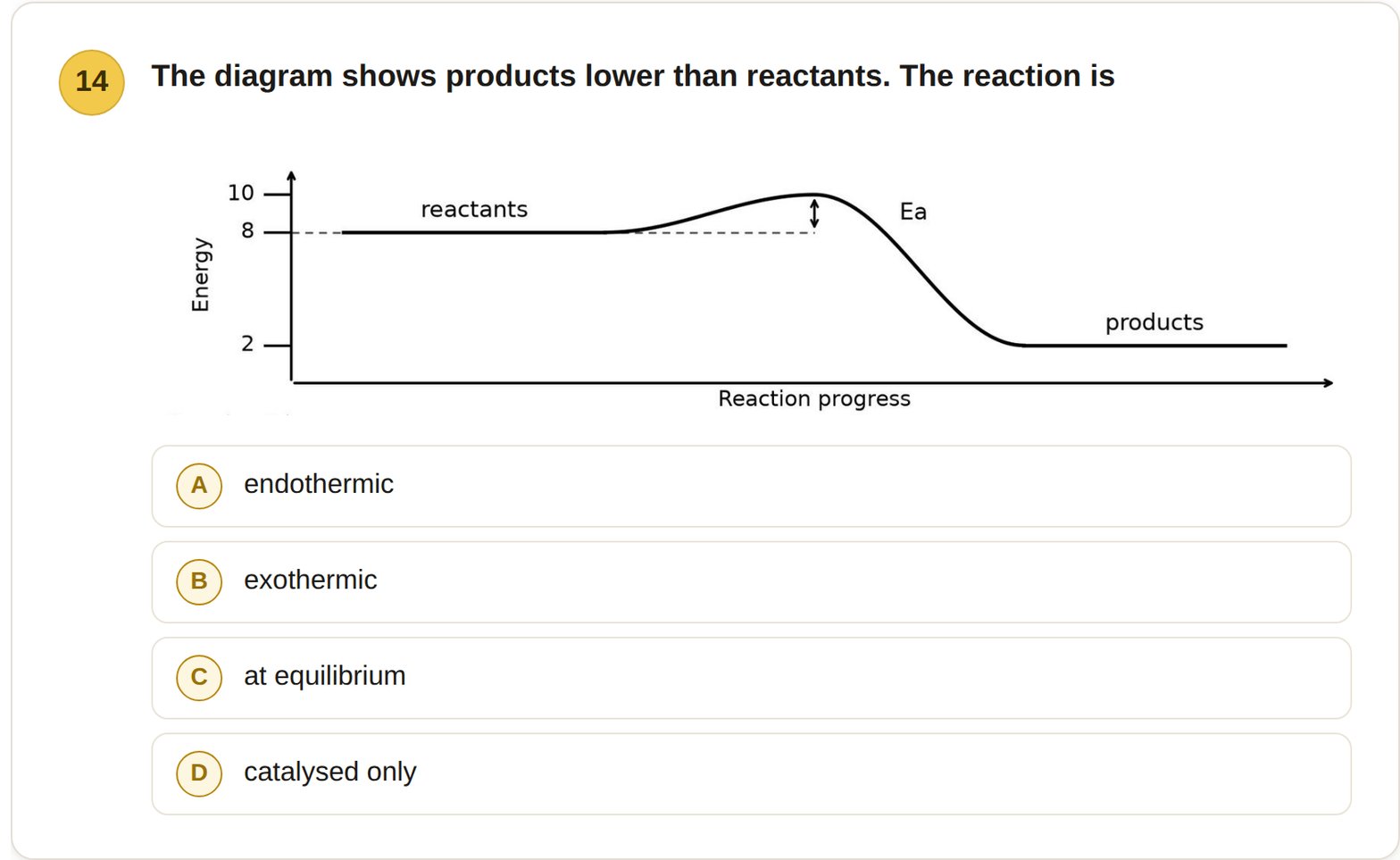
Activation energy is the minimum energy needed for
A catalyst speeds a reaction by providing a pathway with
Enthalpy is measured at constant
In a calorimetry experiment heat lost by the reaction equals heat gained by the
The standard enthalpy of formation of an element in its standard state is
Hess law works because enthalpy is a
Breaking bonds is always
Forming bonds is always
A temperature increase in the surroundings during a reaction suggests the reaction is
The unit of enthalpy change is
A cooling curve for water freezing shows a plateau at
Your score: 0 / 25