1
A solution has 2 moles of solute in 4 litres. Its concentration in moles per litre is
moles per litre
From Solutions to Kinetics to Equilibrium - Practice Test | New Brunswick Chemistry 121-122 · Unit B · 25 questions
This practice test was made by AI and there may be mistakes. If a question or answer looks wrong, use the Flag a mistake button to let Brett know so he can fix it.
A solution has 2 moles of solute in 4 litres. Its concentration in moles per litre is
A solution has 3 moles of solute in 2 litres. Its concentration in moles per litre is
A solution has 0.5 moles of solute in 2 litres. Its concentration in moles per litre is
A 2 molar solution of volume 3 litres contains how many moles
A 0.5 molar solution is diluted from 2 litres to 4 litres. The new concentration in moles per litre is
A reaction rate is measured as 0.4 moles per litre per minute. In 5 minutes the concentration change in moles per litre is
A reaction produces 0.6 moles per litre in 3 minutes. The average rate in moles per litre per minute is
At equilibrium the forward rate equals the reverse rate. If the forward rate is 0.3, the reverse rate is
For a reaction A gives B, at equilibrium A is 0.2 molar and B is 0.8 molar. The equilibrium constant is
For a reaction with products 0.9 molar and reactants 0.3 molar, the equilibrium constant is
A catalyst increases a rate by a factor of 4. A rate of 0.2 becomes
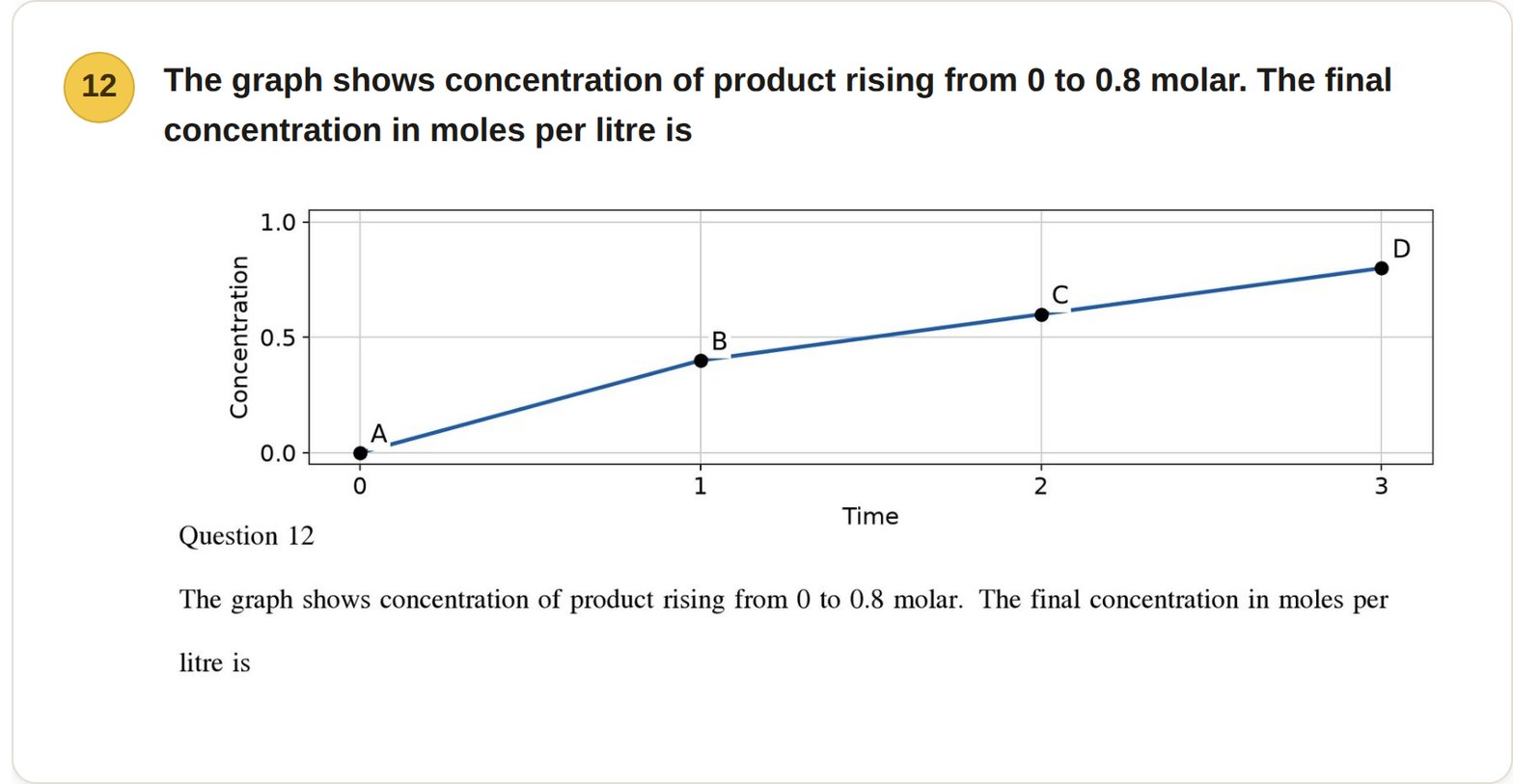
The graph shows concentration of product rising from 0 to 0.8 molar. The final concentration in moles per litre is
Increasing temperature usually increases reaction rate because collisions are
Increasing surface area increases rate because more particles are
A catalyst increases rate without being
At equilibrium the concentrations of reactants and products are
Le Chatelier principle predicts a system at equilibrium shifts to
Adding reactant to an equilibrium system shifts the equilibrium
Increasing pressure on a gas equilibrium shifts toward the side with
A saturated solution contains the maximum solute that dissolves at that
Solubility of most solids in water increases with
A solution with a low concentration is described as
What shared particle makes solubility decrease?
Collision theory requires collisions with sufficient energy and correct
An inhibitor decreases reaction rate by
Your score: 0 / 25