1
A solution has hydrogen ion concentration 0.001 moles per litre. Its pH is
Acids and Bases - Practice Test | New Brunswick Chemistry 121-122 · Unit C · 25 questions
This practice test was made by AI and there may be mistakes. If a question or answer looks wrong, use the Flag a mistake button to let Brett know so he can fix it.
A solution has hydrogen ion concentration 0.001 moles per litre. Its pH is
A solution has hydrogen ion concentration 0.00001 moles per litre. Its pH is
A solution has pH 2. Its hydrogen ion concentration in moles per litre is
A solution has pH 4. Its hydrogen ion concentration in moles per litre is
A solution has pH 9. Its pOH is
A solution has pOH 3. Its pH is
A strong acid of concentration 0.1 molar is fully dissociated. Its hydrogen ion concentration in moles per litre is
A titration uses 20 millilitres of 0.1 molar acid to neutralise a base. The moles of acid used are 0.002. Expressed in millimoles the value is
A titration uses 25 millilitres of 0.2 molar base. The moles of base in millimoles are
A solution has hydrogen ion concentration ten times higher than another. The pH difference is
A neutral solution at 25 degrees has pH 7. A solution with pH 3 is acidic by how many pH units below neutral
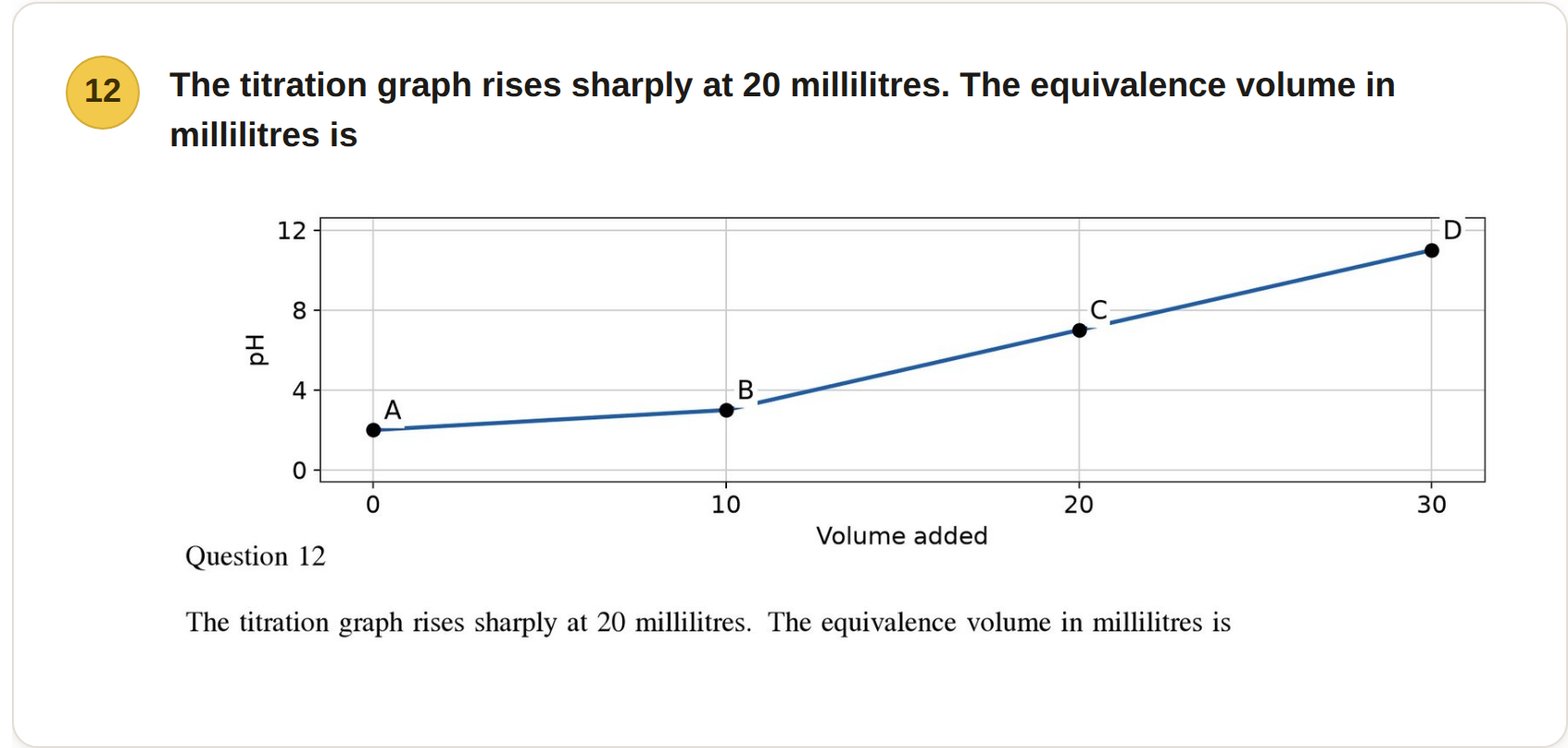
The titration graph rises sharply at 20 millilitres. The equivalence volume in millilitres is
According to the Bronsted Lowry definition, what does an acid donate?
According to the Bronsted Lowry definition, what does a base accept?
A conjugate acid base pair differs by
A strong acid dissociates
A weak acid dissociates
The pH scale is logarithmic because pH equals negative log of hydrogen ion
A buffer resists changes in
A buffer contains a weak acid and its
At the equivalence point of a strong acid strong base titration the pH is about
An indicator changes colour over a narrow pH
Hydrochloric acid is an example of a
Ammonia in water acts as a
Neutralisation of an acid and a base produces a salt and
Your score: 0 / 25