1
Water of mass 50 grams warms by 20 degrees Celsius. Using a specific heat of 4.2 joules per gram degree, the heat absorbed in joules is
joules
What looks wrong with Question 1?
Send anonymously
Cancel
2
A solution has 3 moles of solute in 2 litres. Its concentration in moles per litre is
moles per litre
What looks wrong with Question 2?
Send anonymously
Cancel
3
A solution has hydrogen ion concentration 0.00001 moles per litre. Its pH is
What looks wrong with Question 3?
Send anonymously
Cancel
4
A benzene ring is an example of an
A alkane B alkene only C aromatic compound D alcohol
What looks wrong with Question 4?
Send anonymously
Cancel
5
A reaction has an enthalpy change of -200 kilojoules per mole. For 2 moles the total enthalpy change in kilojoules is
kilojoules
What looks wrong with Question 5?
Send anonymously
Cancel
6
A 0.5 molar solution is diluted from 2 litres to 4 litres. The new concentration in moles per litre is
moles per litre
What looks wrong with Question 6?
Send anonymously
Cancel
7
A solution has pOH 3. Its pH is
What looks wrong with Question 7?
Send anonymously
Cancel
8
Alkanes contain only single bonds and are described as
A saturated B unsaturated C aromatic D ionic
What looks wrong with Question 8?
Send anonymously
Cancel
9
By Hess law two steps have enthalpy changes of 80 and -30 kilojoules. The total enthalpy change in kilojoules is
kilojoules
What looks wrong with Question 9?
Send anonymously
Cancel
10
At equilibrium the forward rate equals the reverse rate. If the forward rate is 0.3, the reverse rate is
What looks wrong with Question 10?
Send anonymously
Cancel
11
A titration uses 25 millilitres of 0.2 molar base. The moles of base in millimoles are
What looks wrong with Question 11?
Send anonymously
Cancel
12
An alcohol with 2 carbon atoms has the formula C₂H₆O. The total atoms in one molecule is
What looks wrong with Question 12?
Send anonymously
Cancel
13
An endothermic reaction absorbs 600 joules. The sign of its enthalpy change is positive, represented by the value 1 for positive and -1 for negative. The value is
What looks wrong with Question 13?
Send anonymously
Cancel
14
A catalyst increases a rate by a factor of 4. A rate of 0.2 becomes
What looks wrong with Question 14?
Send anonymously
Cancel
15
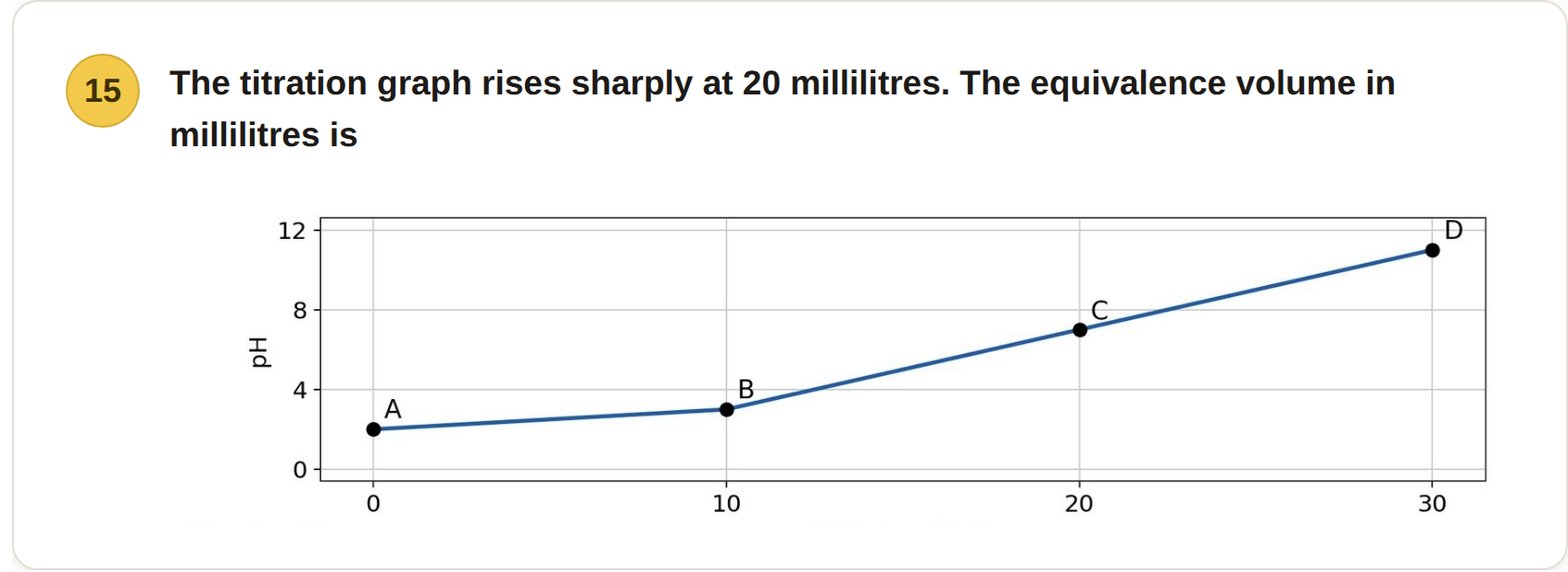
The titration graph rises sharply at 20 millilitres. The equivalence volume in millilitres is
millilitres
What looks wrong with Question 15?
Send anonymously
Cancel
16
Benzene has 6 carbon atoms and 6 hydrogen atoms. The total atoms in one molecule is
What looks wrong with Question 16?
Send anonymously
Cancel
17
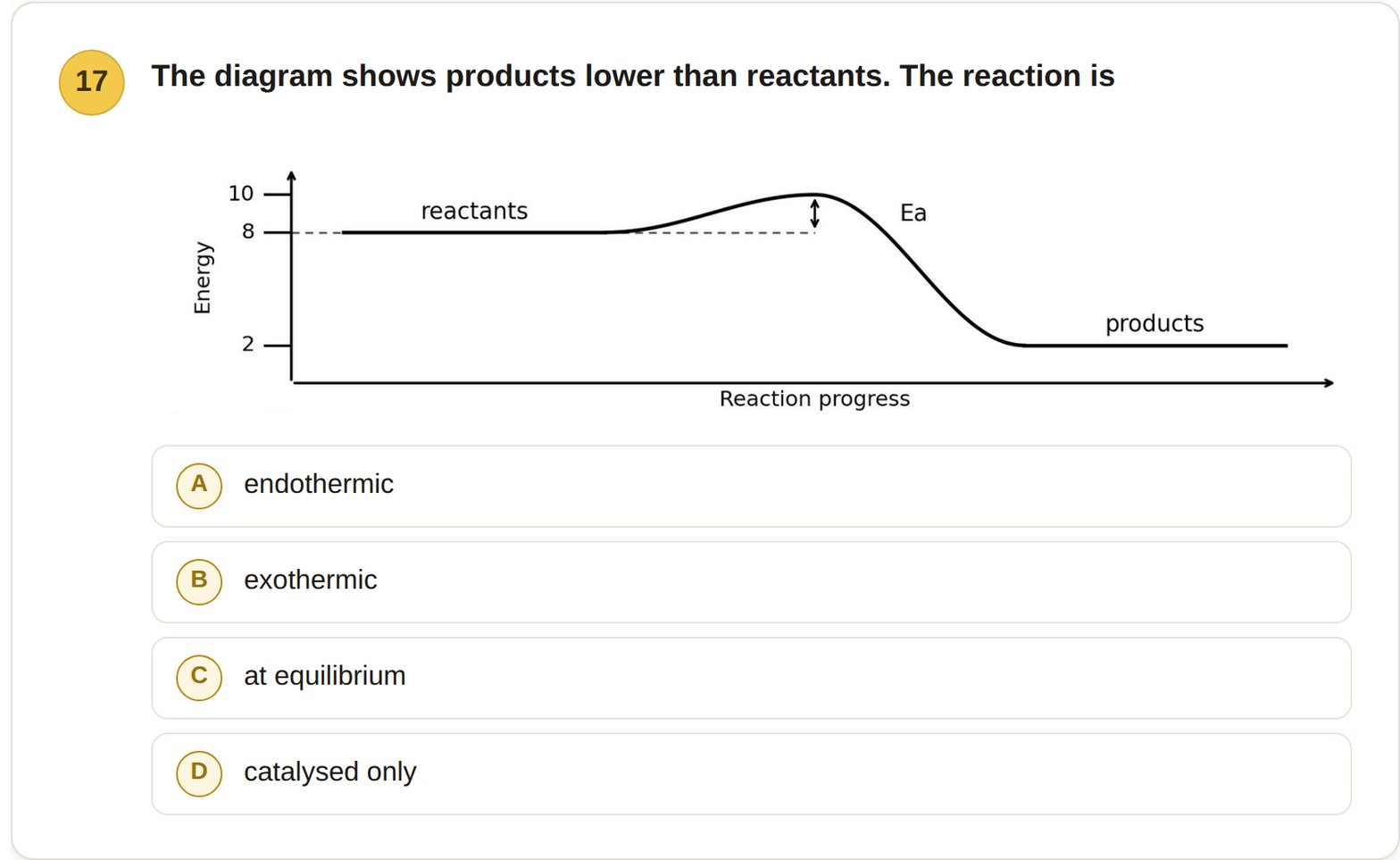
The diagram shows products lower than reactants. The reaction is
A endothermic B exothermic C at equilibrium D catalysed only
What looks wrong with Question 17?
Send anonymously
Cancel
18
Increasing surface area increases rate because more particles are
A heated B exposed C dissolved D charged
What looks wrong with Question 18?
Send anonymously
Cancel
19
A strong acid dissociates
A partly B not at all C only on heating D completely
What looks wrong with Question 19?
Send anonymously
Cancel
20
Esters are formed from an alcohol and a
A alkane B carboxylic acid C alkene D amine
What looks wrong with Question 20?
Send anonymously
Cancel
21
In a calorimetry experiment heat lost by the reaction equals heat gained by the
A air only B water C container only D thermometer
What looks wrong with Question 21?
Send anonymously
Cancel
22
Le Chatelier principle predicts a system at equilibrium shifts to
A counteract a change B increase the change C stop reacting D reach zero
What looks wrong with Question 22?
Send anonymously
Cancel
23
A buffer resists changes in
A temperature B pressure C pH D volume
What looks wrong with Question 23?
Send anonymously
Cancel
24
Ethanol is used as a fuel and a
A solvent B acid C base D salt
What looks wrong with Question 24?
Send anonymously
Cancel
25
Breaking bonds is always
A exothermic B endothermic C neutral D spontaneous
What looks wrong with Question 25?
Send anonymously
Cancel
26
Solubility of most solids in water increases with
A pressure B temperature C volume D mass
What looks wrong with Question 26?
Send anonymously
Cancel
27
An indicator changes colour over a narrow pH
A temperature B range C volume D mass
What looks wrong with Question 27?
Send anonymously
Cancel
28
Fractional distillation separates crude oil by
A colour B density only C mass only D boiling point
What looks wrong with Question 28?
Send anonymously
Cancel
29
The unit of enthalpy change is
A joules per second B moles per litre C kilojoules per gram only D kilojoules per mole
What looks wrong with Question 29?
Send anonymously
Cancel
30
Collision theory requires collisions with sufficient energy and correct
A temperature B pressure C volume D orientation
What looks wrong with Question 30?
Send anonymously
Cancel
31
A solution has hydrogen ion concentration 0.0001 moles per litre. Its pH is
What looks wrong with Question 31?
Send anonymously
Cancel
32
An alkane has 6 carbon atoms. The number of hydrogen atoms is
What looks wrong with Question 32?
Send anonymously
Cancel
33
Water of mass 100 grams warms by 15 degrees Celsius. Using a specific heat of 4.2, the heat in joules is
joules
What looks wrong with Question 33?
Send anonymously
Cancel
34
A 3 molar solution of volume 2 litres contains how many moles
What looks wrong with Question 34?
Send anonymously
Cancel
35
A solution has pOH 2. Its pH is
What looks wrong with Question 35?
Send anonymously
Cancel
36
Polymerisation joins small monomers into long
A rings only B chains C salts D acids
What looks wrong with Question 36?
Send anonymously
Cancel
37
A fuel releases 3000 kilojoules per mole and 2 moles burn. The energy released in kilojoules is
kilojoules
What looks wrong with Question 37?
Send anonymously
Cancel
38
At equilibrium products are 0.6 molar and reactants are 0.2 molar. The equilibrium constant is
What looks wrong with Question 38?
Send anonymously
Cancel
39
A solution with pH 8 is basic by how many units above neutral pH 7
What looks wrong with Question 39?
Send anonymously
Cancel
40
The functional group of a carboxylic acid is
A hydroxyl B carbonyl only C amino D carboxyl
What looks wrong with Question 40?
Send anonymously
Cancel
41
An endothermic reaction absorbs energy from the
A surroundings B products only C catalyst D reactants only
What looks wrong with Question 41?
Send anonymously
Cancel
42
Dissolving salt in water is fastest when the water is
A stirred and warm B still and cold C still and warm D cold and unstirred
What looks wrong with Question 42?
Send anonymously
Cancel
43
A solution with pH greater than 7 is
A acidic B neutral C buffered D basic
What looks wrong with Question 43?
Send anonymously
Cancel
44
The prefix eth indicates how many carbon atoms
A 1 B 3 C 2 D 4
What looks wrong with Question 44?
Send anonymously
Cancel
45
A bomb calorimeter measures heat at constant
A pressure B temperature C mass D volume
What looks wrong with Question 45?
Send anonymously
Cancel
46
A decrease in temperature usually decreases rate because fewer collisions have
A correct orientation B enough mass C enough volume D enough energy
What looks wrong with Question 46?
Send anonymously
Cancel
47
Diluting an acid by a factor of 10 increases its pH by
A ten units B zero units C one unit D two units
What looks wrong with Question 47?
Send anonymously
Cancel
48
The suffix oic acid indicates a
A carboxylic acid B alcohol C alkane D alkene
What looks wrong with Question 48?
Send anonymously
Cancel
49
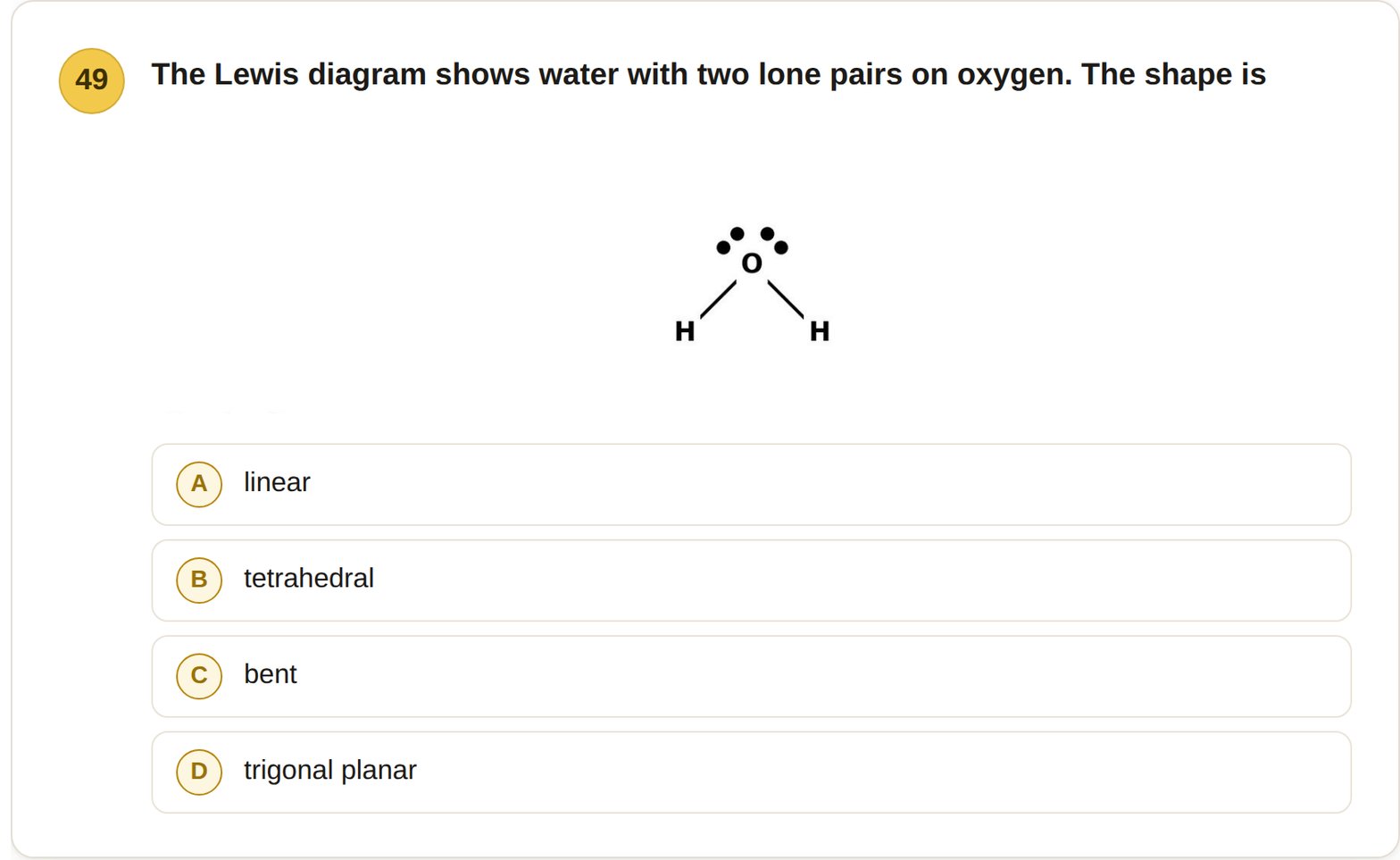
The Lewis diagram shows water with two lone pairs on oxygen. The shape is
A linear B tetrahedral C bent D trigonal planar
What looks wrong with Question 49?
Send anonymously
Cancel
50
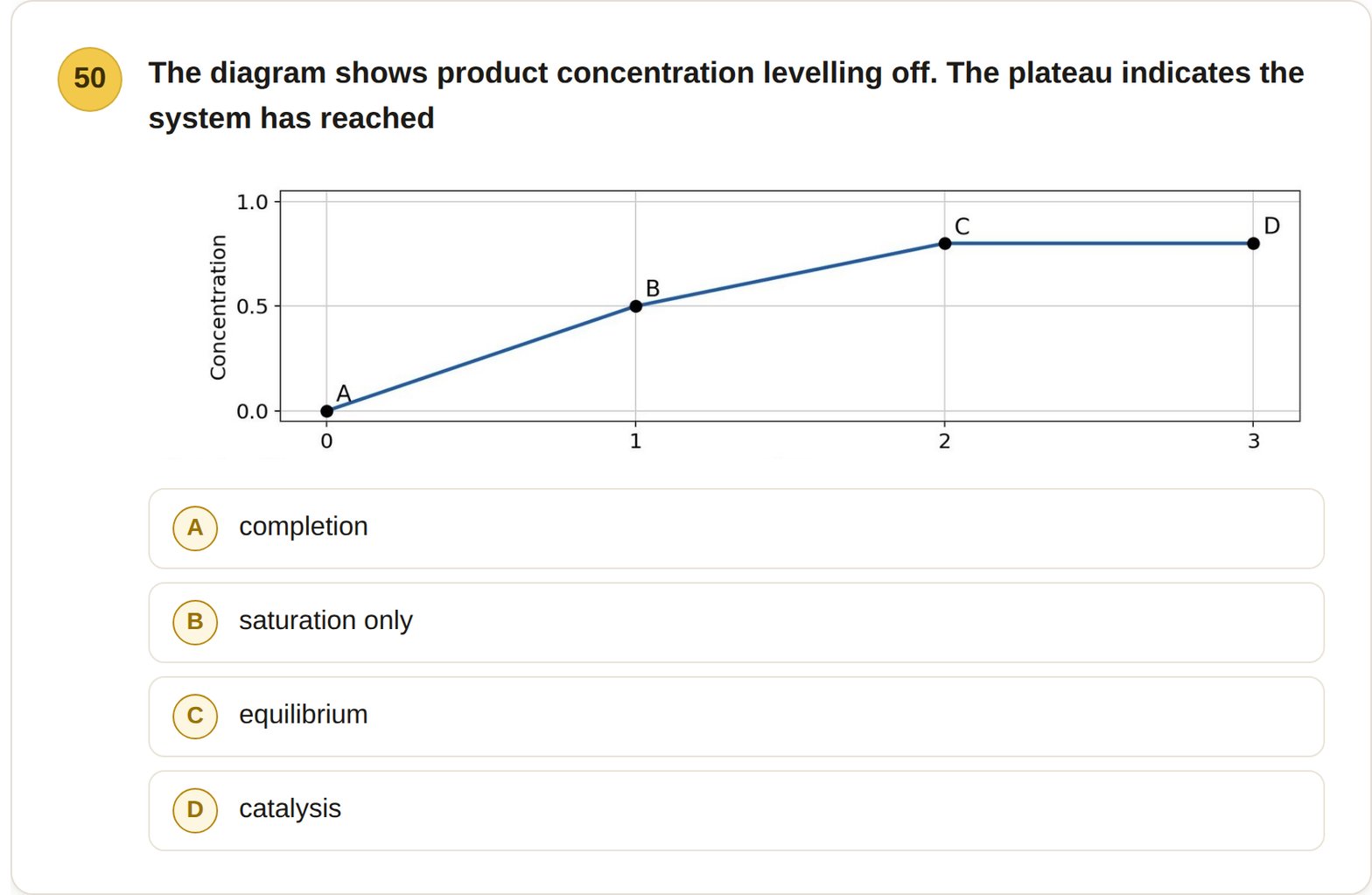
The diagram shows product concentration levelling off. The plateau indicates the system has reached
A completion B saturation only C equilibrium D catalysis
What looks wrong with Question 50?
Send anonymously
Cancel