1
Producers capture 10000 kilocalories. At 10 percent transfer, primary consumers gain kilocalories of
Basic Ecology - Practice Test | New Brunswick Environmental Science 120 · Unit A · 25 questions
This practice test was made by AI and there may be mistakes. If a question or answer looks wrong, use the Flag a mistake button to let Brett know so he can fix it.
Producers capture 10000 kilocalories. At 10 percent transfer, primary consumers gain kilocalories of
Primary consumers gain 1000 kilocalories. At 10 percent transfer, secondary consumers gain kilocalories of
Secondary consumers gain 100 kilocalories. At 10 percent transfer, tertiary consumers gain kilocalories of
A food chain has 4 trophic levels starting with 20000 kilocalories. The energy at the fourth level in kilocalories is
A population of 200 grows by 20 births and loses 10 deaths in a year. The net change is
A population of 500 has 50 births and 30 deaths. The final population is
A habitat can support 1000 deer. The population is 800. The remaining capacity is
A pond has 120 fish and 30 are removed. The remaining fish are
A quadrat sample finds 8 plants in 1 m². In 10 square metres the estimated plants are
A mark recapture study marks 20 animals and later captures 40 with 10 marked. The estimated population is
A community has 5 species with counts 10, 20, 30, 40 and 50. The total individuals are
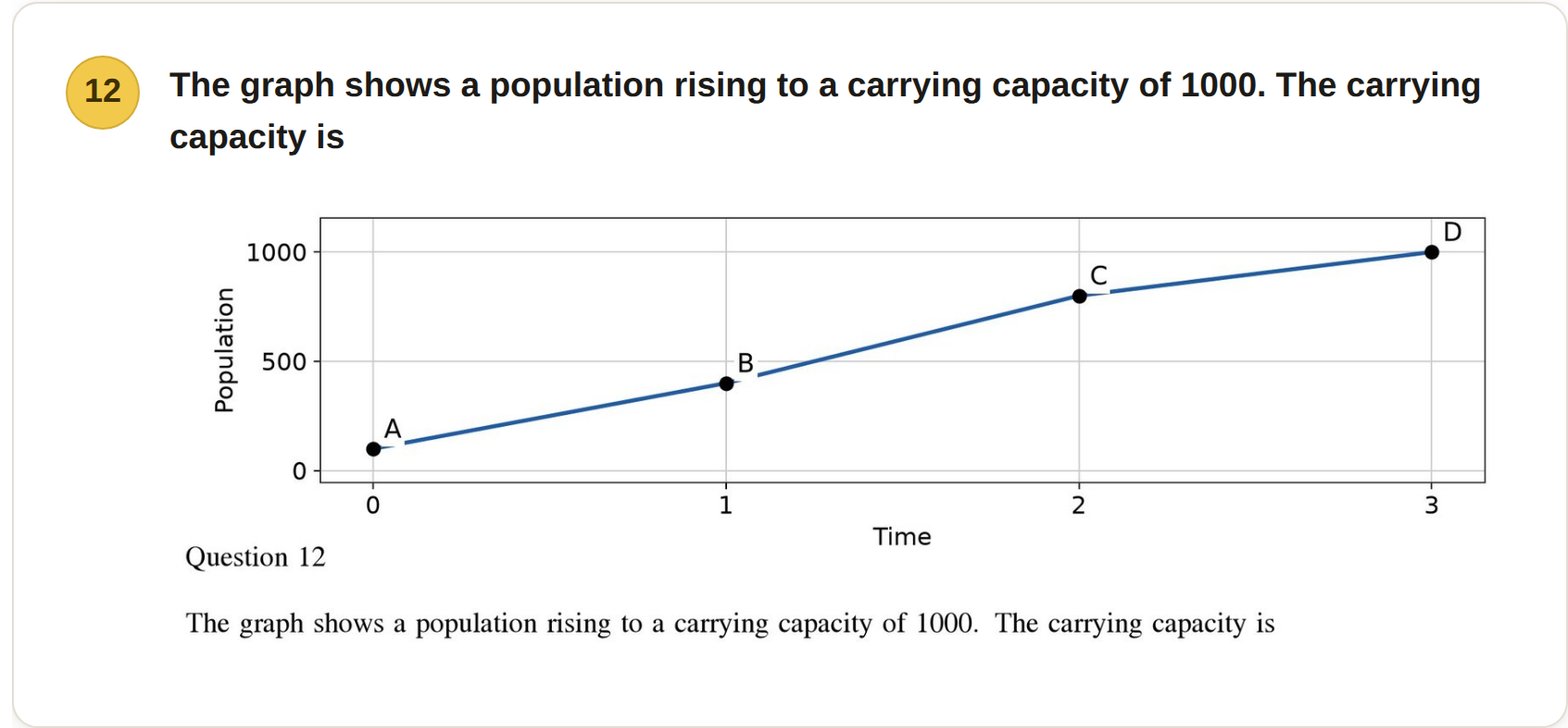
The graph shows a population rising to a carrying capacity of 1000. The carrying capacity is
Producers in most ecosystems obtain energy from
Decomposers recycle nutrients by breaking down
A food web is more realistic than a food chain because it shows
The trophic level with the most energy is the
Biotic factors are the living components of an
Abiotic factors include temperature, water and
A niche is the role of a species in its
Competition occurs when organisms need the same
Predation is an interaction where one organism eats
Mutualism benefits
Parasitism benefits one species and harms the
Succession after a disturbance on existing soil is
A climax community is relatively
Your score: 0 / 25