1
Primary consumers gain 1000 kilocalories. At 10 percent transfer, secondary consumers gain kilocalories of
Final Exam - Practice Test | New Brunswick Environmental Science 120 · Final Exam · 50 questions
This practice test was made by AI and there may be mistakes. If a question or answer looks wrong, use the Flag a mistake button to let Brett know so he can fix it.
Primary consumers gain 1000 kilocalories. At 10 percent transfer, secondary consumers gain kilocalories of
A city produces 400 tonnes of waste and recycles 25 percent. The recycled mass in tonnes is
A population grows at 5 percent per year. By the rule of 70 the doubling time in years is
A solar panel produces 300 watts for 5 hours. The energy in watt hours is
A population of 200 grows by 20 births and loses 10 deaths in a year. The net change is
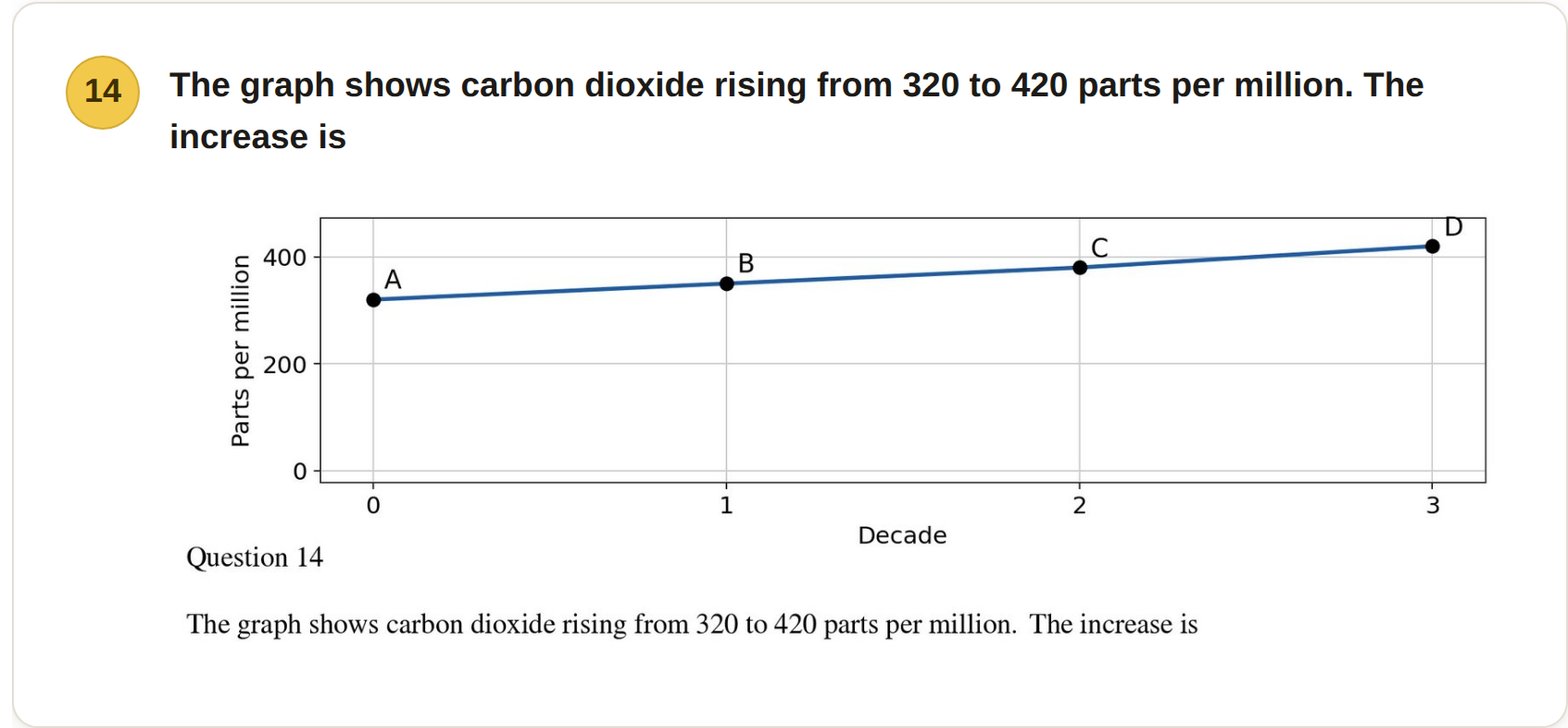
Atmospheric carbon dioxide rises from 320 to 420 parts per million. The increase is
A resource reserve of 5000 units is used at 250 units per year. The years until depletion are
A green roof reduces cooling energy by 25 percent. From 800 units the saving is
A pond has 120 fish and 30 are removed. The remaining fish are
A household uses 300 litres of water per day and saves 10 percent. The saving in litres is
A fish stock of 4000 is harvested at 10 percent per year. The harvest is
A rain barrel collects 200 litres from a storm. Four barrels collect litres of
A community has 5 species with counts 10, 20, 30, 40 and 50. The total individuals are
The graph shows carbon dioxide rising from 320 to 420 parts per million. The increase is
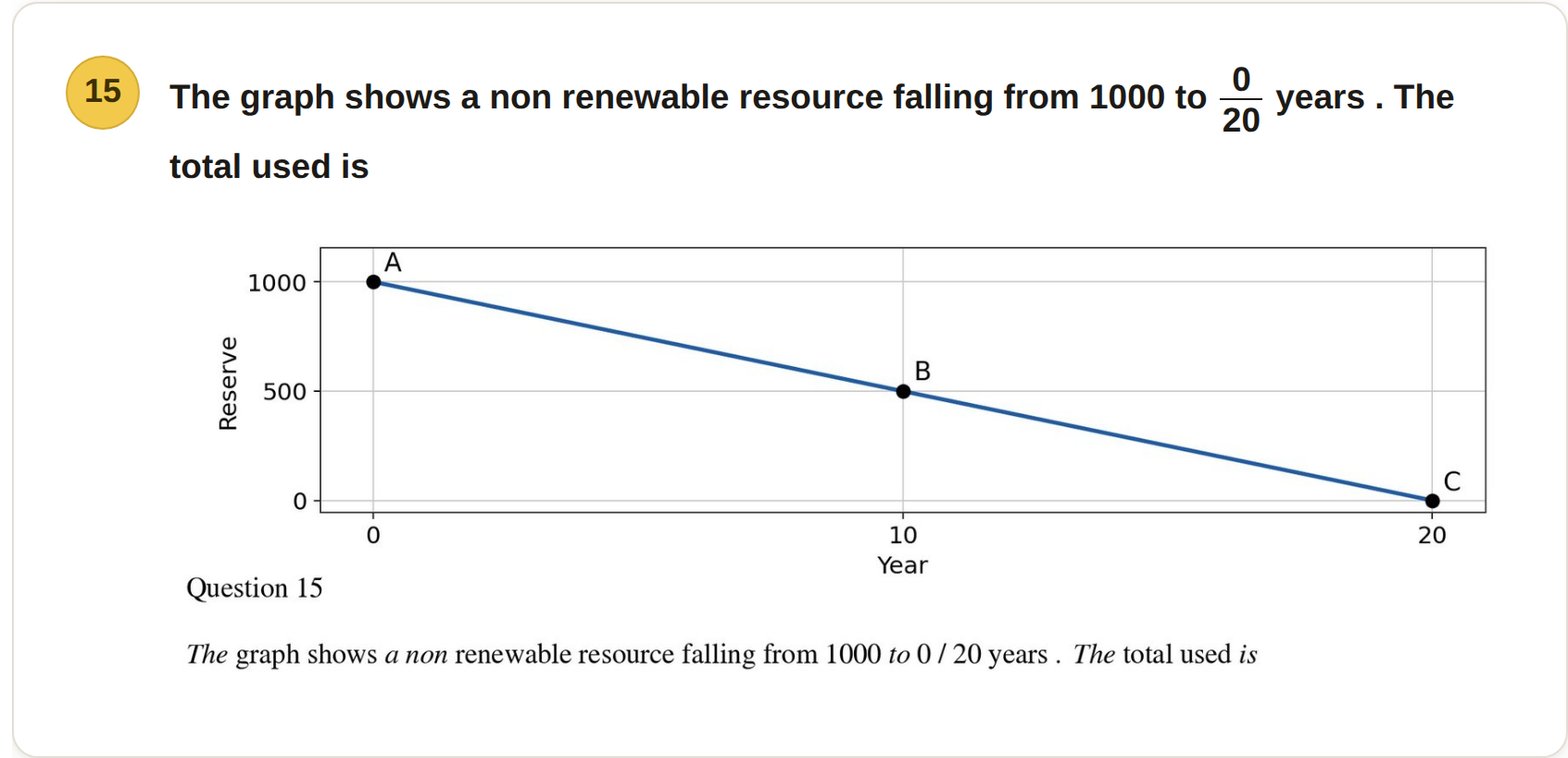
The graph shows a non renewable resource falling from 1000 to 020 years . The total used is
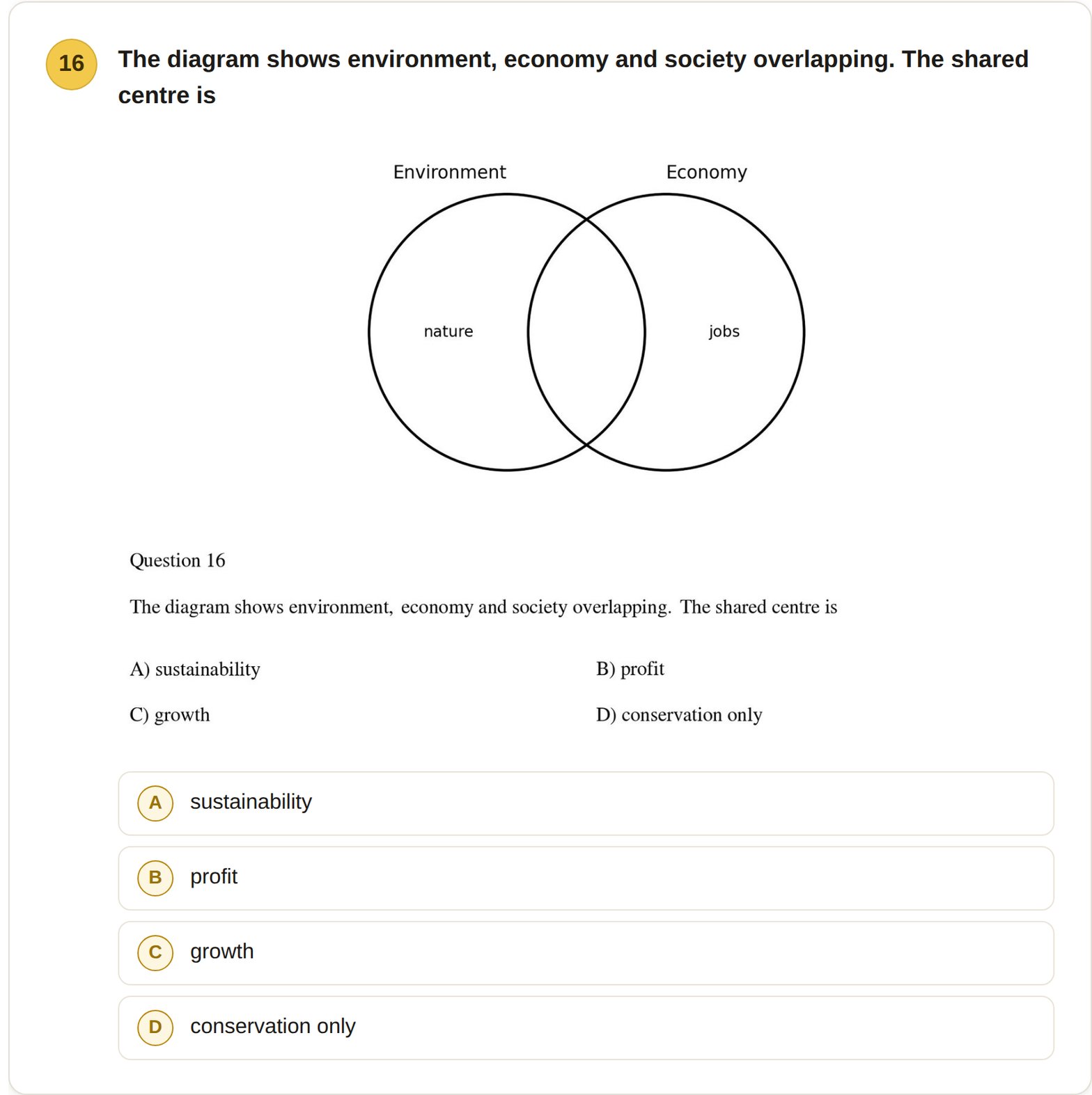
The diagram shows environment, economy and society overlapping. The shared centre is
Decomposers recycle nutrients by breaking down
The greenhouse effect warms Earth because greenhouse gases absorb
A renewable resource can be replenished on a human
Green building design uses insulation and natural light to reduce
Abiotic factors include temperature, water and
Eutrophication is caused by excess nutrients leading to algal
Urbanisation increases demand for housing, water and
Environmental stewardship means caring for resources for
Predation is an interaction where one organism eats
A carbon footprint measures total greenhouse gas emissions from an activity or
Water scarcity is worsened by over extraction from
Reforestation restores forests by planting
Mutualism benefits
An environmental impact assessment is done before a project to predict its
A population grows at 4 percent per year. The doubling time by the rule of 70 in years is
A community saves 10 percent of 2000 kilowatt hours. The saving is
A population of 300 has 60 births and 20 deaths. The final population is
A factory cuts 1200 tonnes by 10 percent. The reduction in tonnes is
A fish stock of 5000 harvested at 20 percent gives a harvest of
A town recycles 300 of 1200 tonnes. The recycling rate in percent is
Mark recapture marks 30, recaptures 50 with 15 marked. The estimated population is
A program collects 900 kilograms in 30 days. The daily average in kilograms is
A country uses 300 units and recycles 100. The net use is
A compost program diverts 200 kilograms per month. In 6 months the diversion is
An ecosystem includes biotic and abiotic factors interacting in a
Smog is air pollution that reduces
Groundwater is water stored in
Environmental education helps communities make
Photosynthesis stores light energy as
Biomagnification means pollutant concentration increases up the
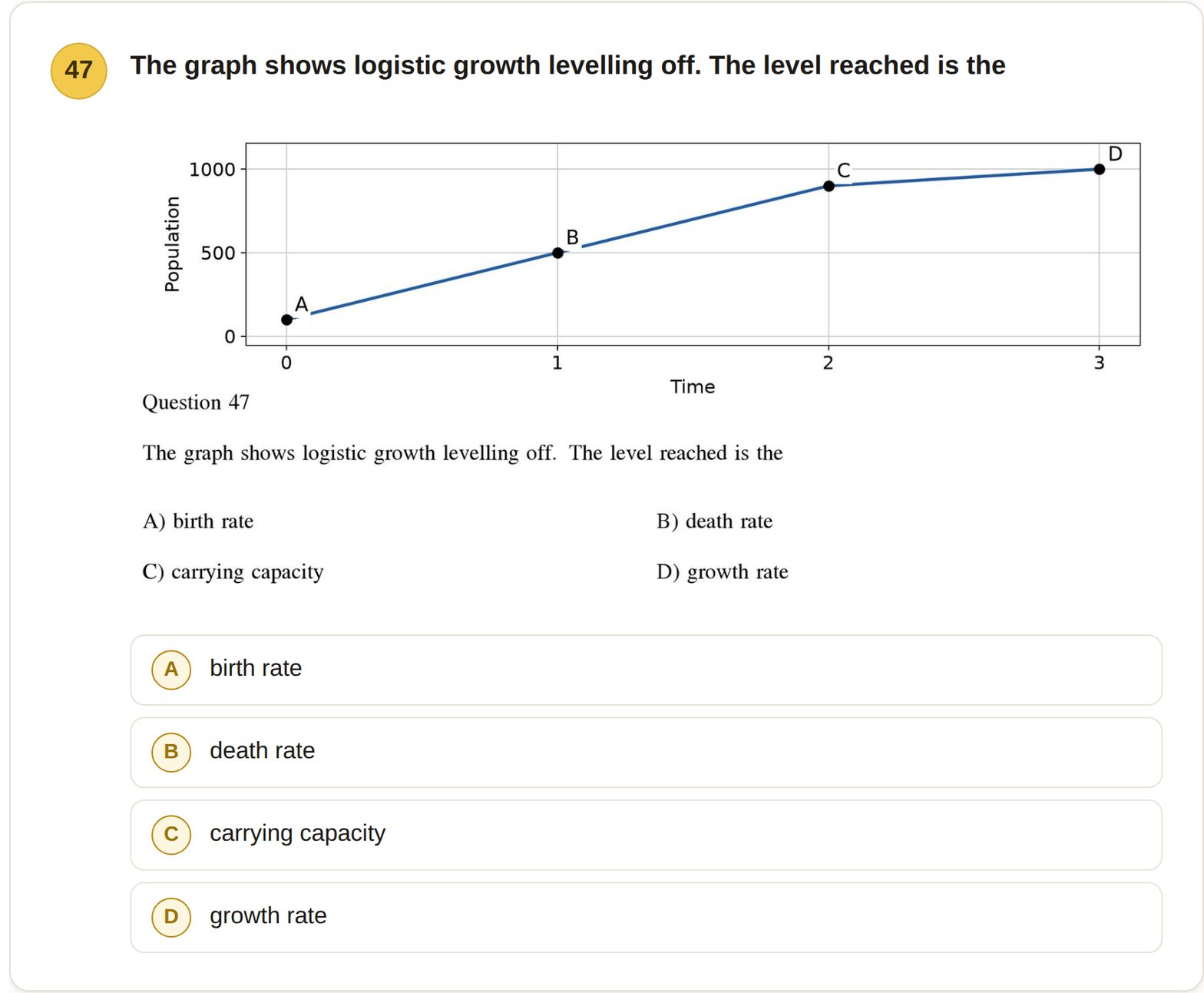
The graph shows logistic growth levelling off. The level reached is the
A sustainable community plan considers housing, transport and
Biodiversity includes variety of species, genes and
The Paris Agreement aims to limit global warming to well below
Your score: 0 / 50