View as PDF

Geometry: Angles, Polygons, and the Pythagorean Theorem - Practice Test | New Brunswick Geometry, Measurement and Finance 10 · Unit B · 25 questions

Geometry: Angles, Polygons, and the Pythagorean Theorem, 25-question test — Practice Test

This practice test was made by AI and there may be mistakes. If a question or answer looks wrong, use the Flag a mistake button to let Brett know so he can fix it.

1

The diagram shows a right triangle with legs 3 and 4. The hypotenuse is
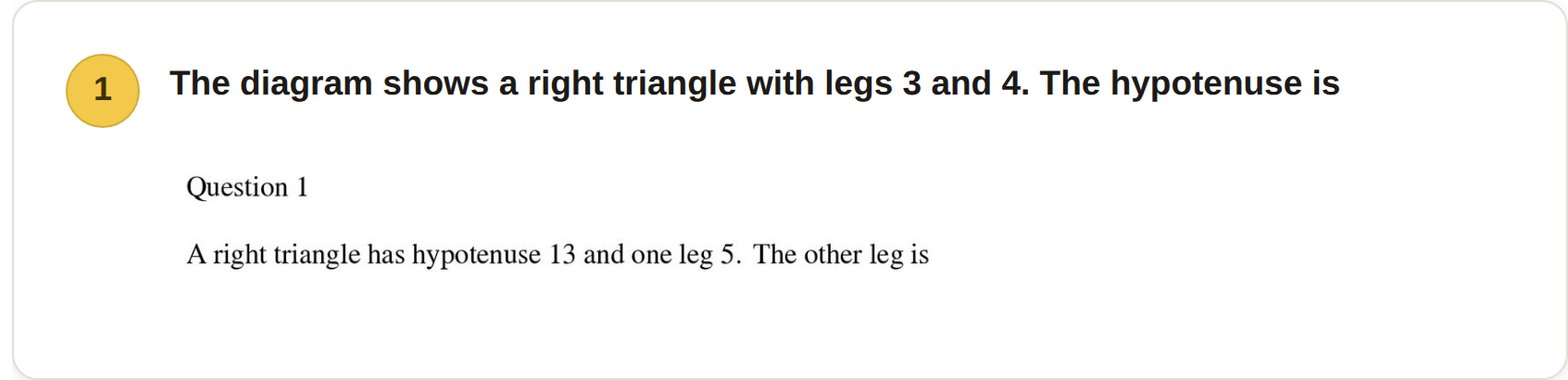
Question 1 diagram and text as printed in the PDF
Understand It with Pulse
2

A right triangle has legs 3 and 4. The hypotenuse is
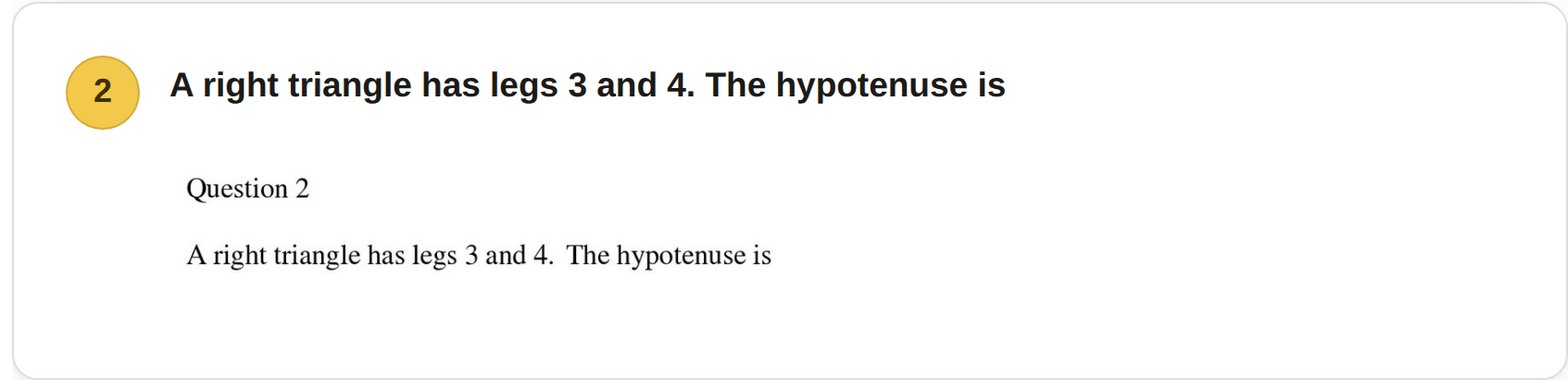
Question 2 diagram and text as printed in the PDF
Understand It with Pulse
3

The diagram shows a right triangle with legs 6 and 8. The hypotenuse is
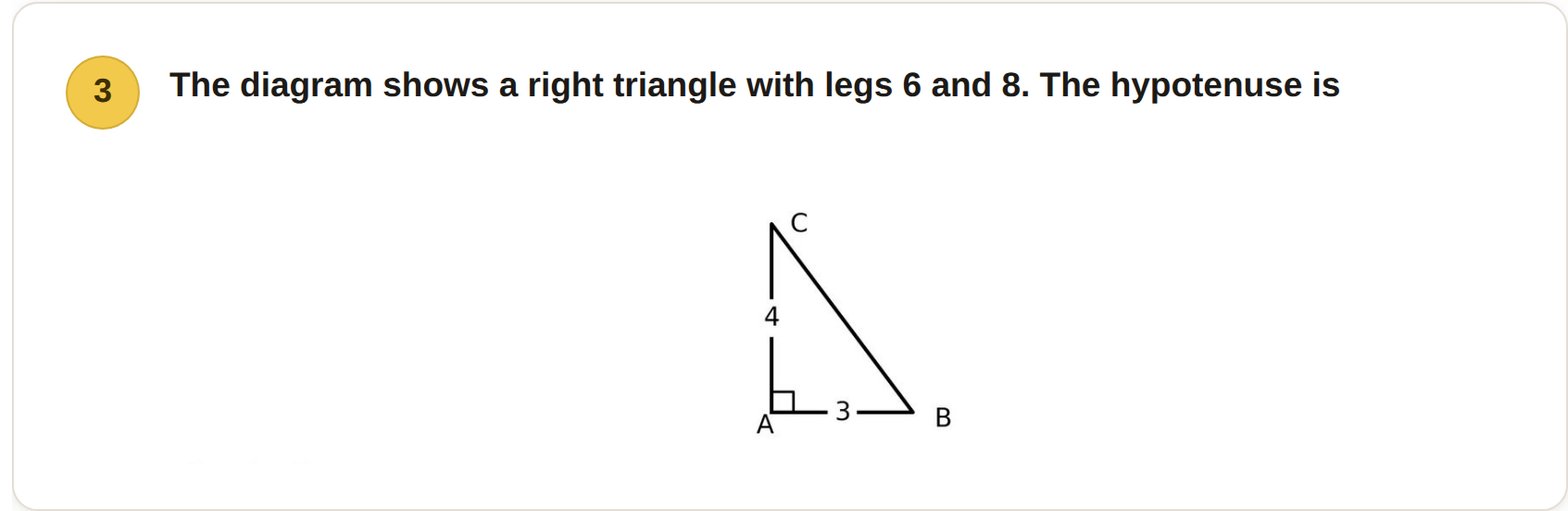
Question 3 diagram and text as printed in the PDF
Understand It with Pulse
4

A right triangle has legs 6 and 8. The hypotenuse is
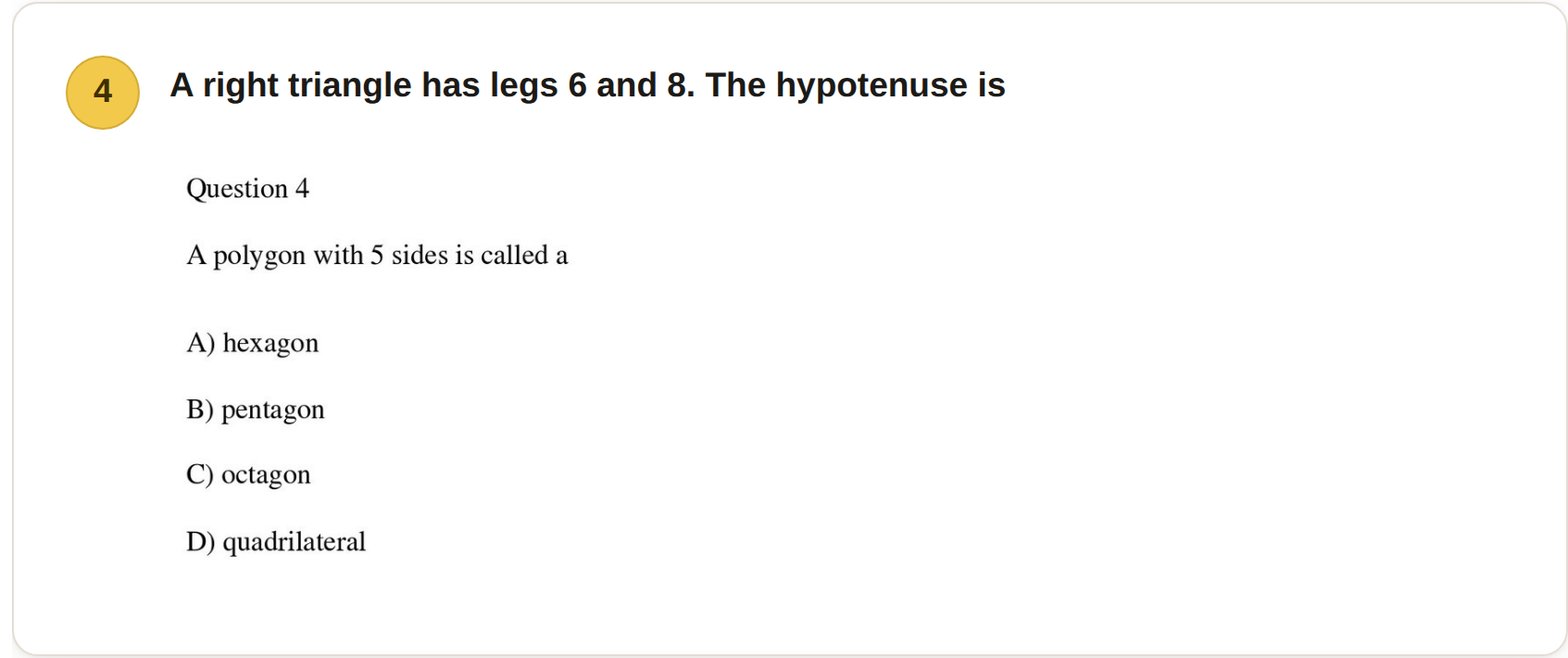
Question 4 diagram and text as printed in the PDF
Understand It with Pulse
5

The diagram shows a right triangle with legs 5 and 12. The hypotenuse is
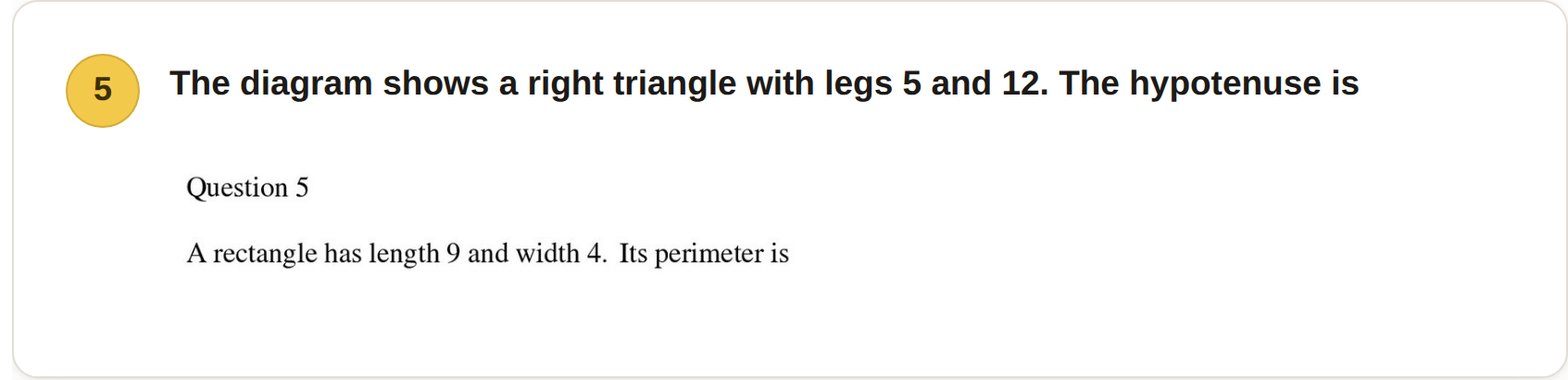
Question 5 diagram and text as printed in the PDF
Understand It with Pulse
6

A right triangle has legs 5 and 12. The hypotenuse is
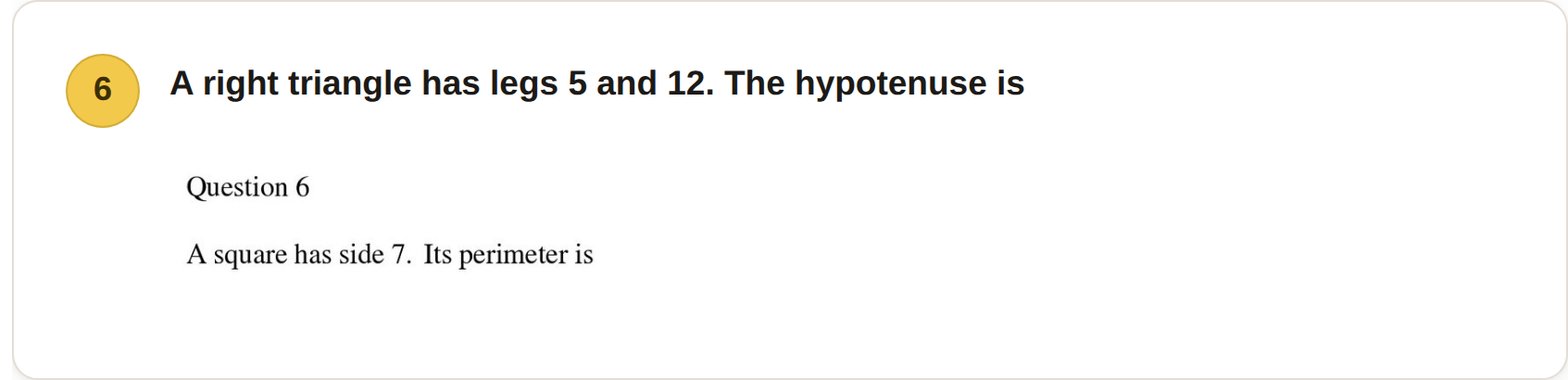
Question 6 diagram and text as printed in the PDF
Understand It with Pulse
7

The diagram shows a right triangle with legs 9 and 12. The hypotenuse is
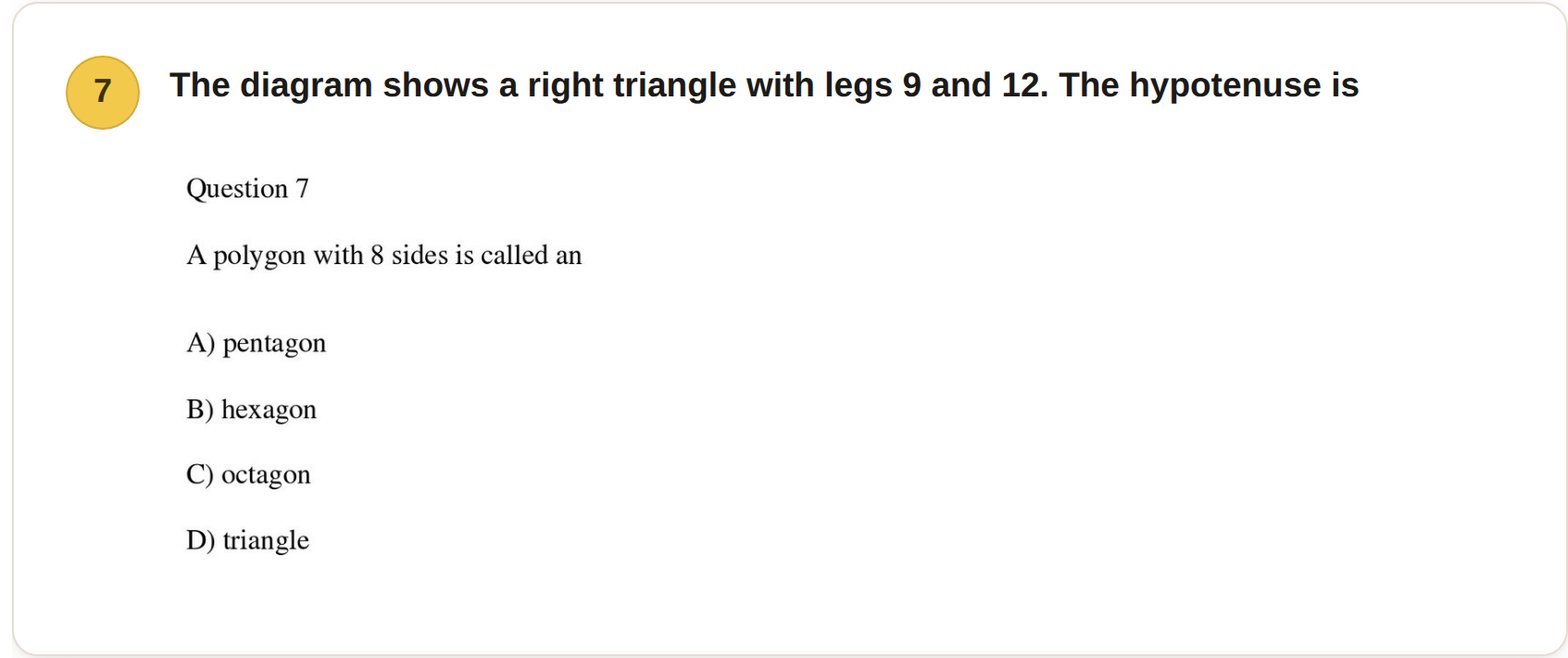
Question 7 diagram and text as printed in the PDF
Understand It with Pulse
8

A right triangle has legs 9 and 12. The hypotenuse is
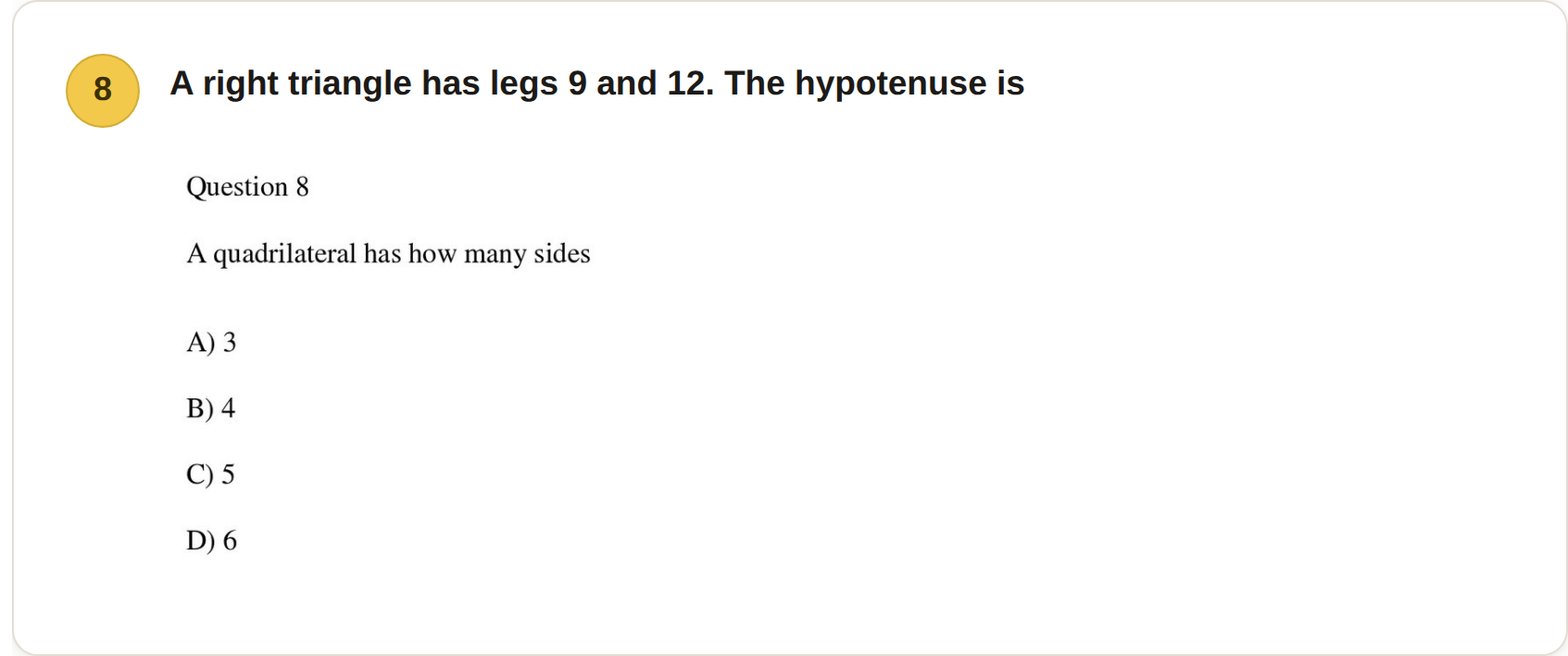
Question 8 diagram and text as printed in the PDF
Understand It with Pulse
9

The diagram shows a right triangle with legs 8 and 15. The hypotenuse is
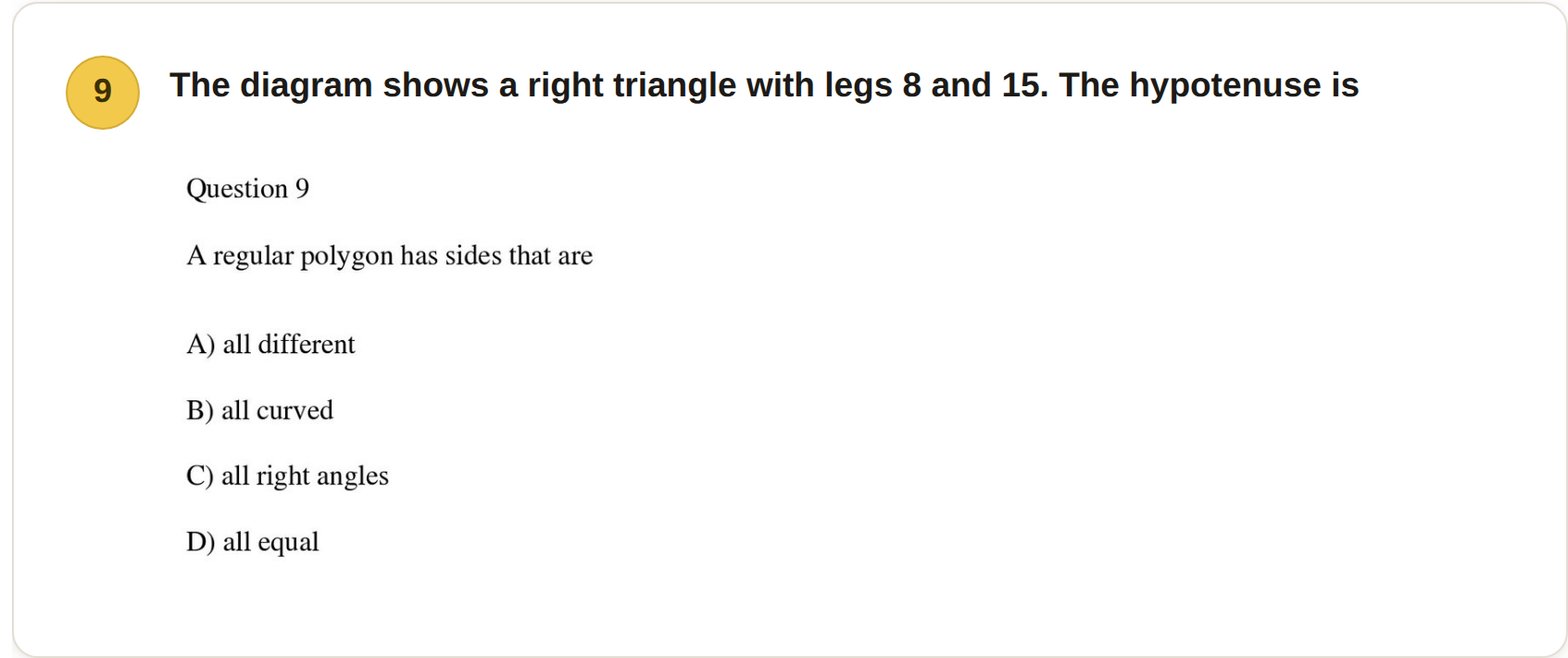
Question 9 diagram and text as printed in the PDF
Understand It with Pulse
10

A right triangle has legs 8 and 15. The hypotenuse is
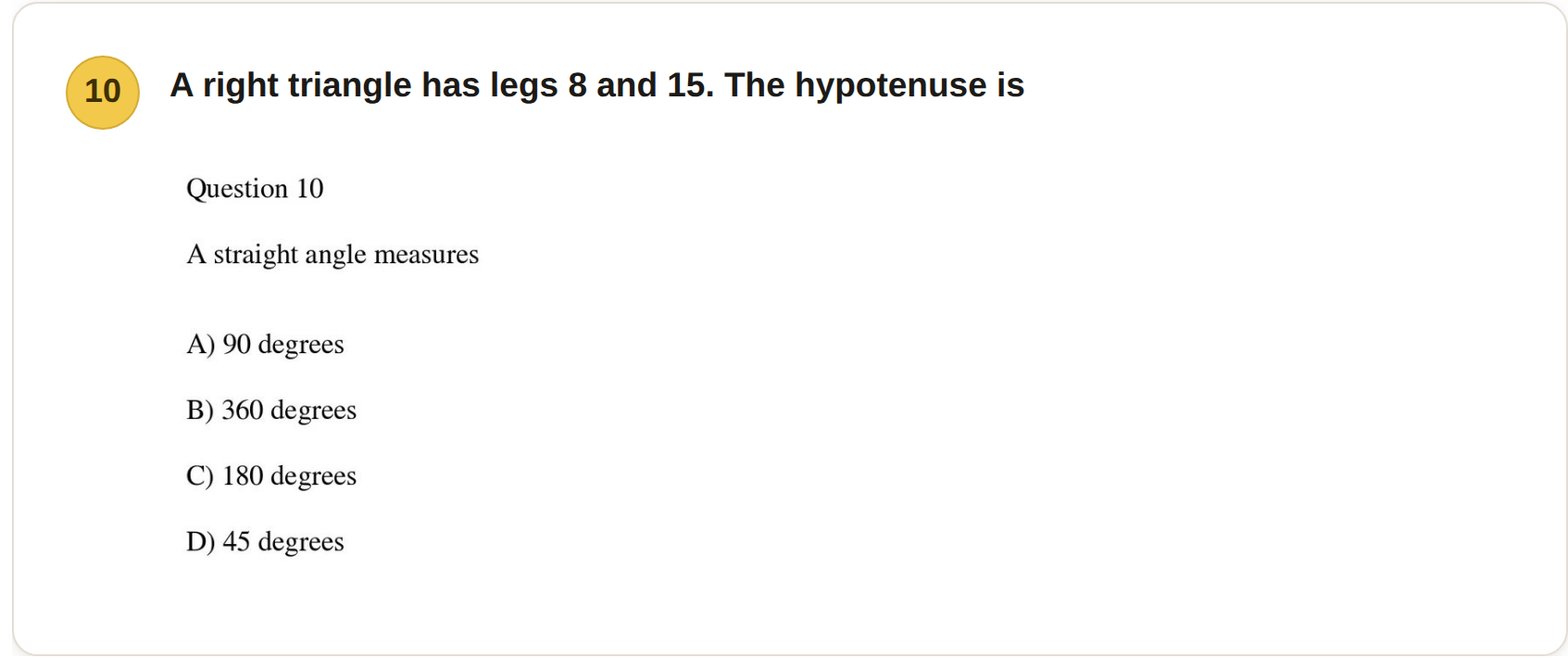
Question 10 diagram and text as printed in the PDF
Understand It with Pulse
11

A right triangle has hypotenuse 13 and one leg 5. The other leg is
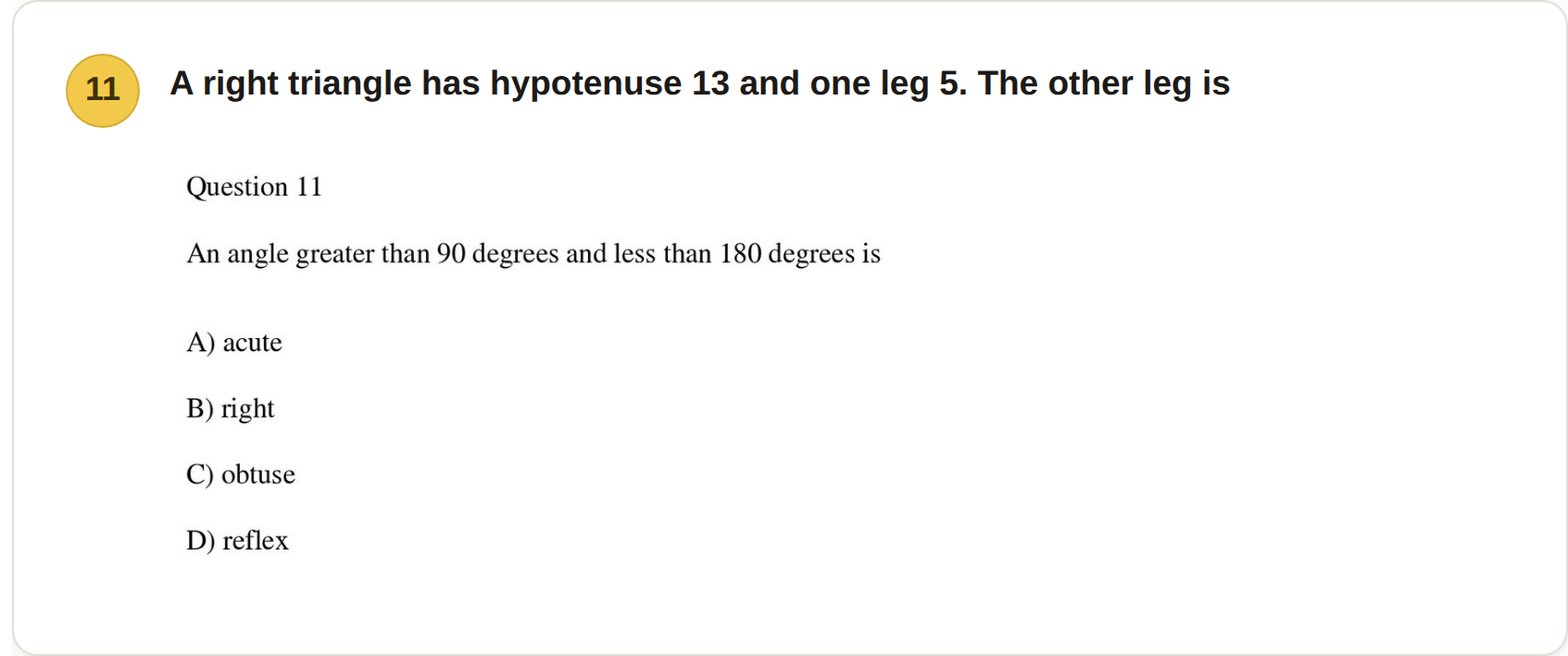
Question 11 diagram and text as printed in the PDF
Understand It with Pulse
12

A right triangle has hypotenuse 25 and one leg 7. The other leg is
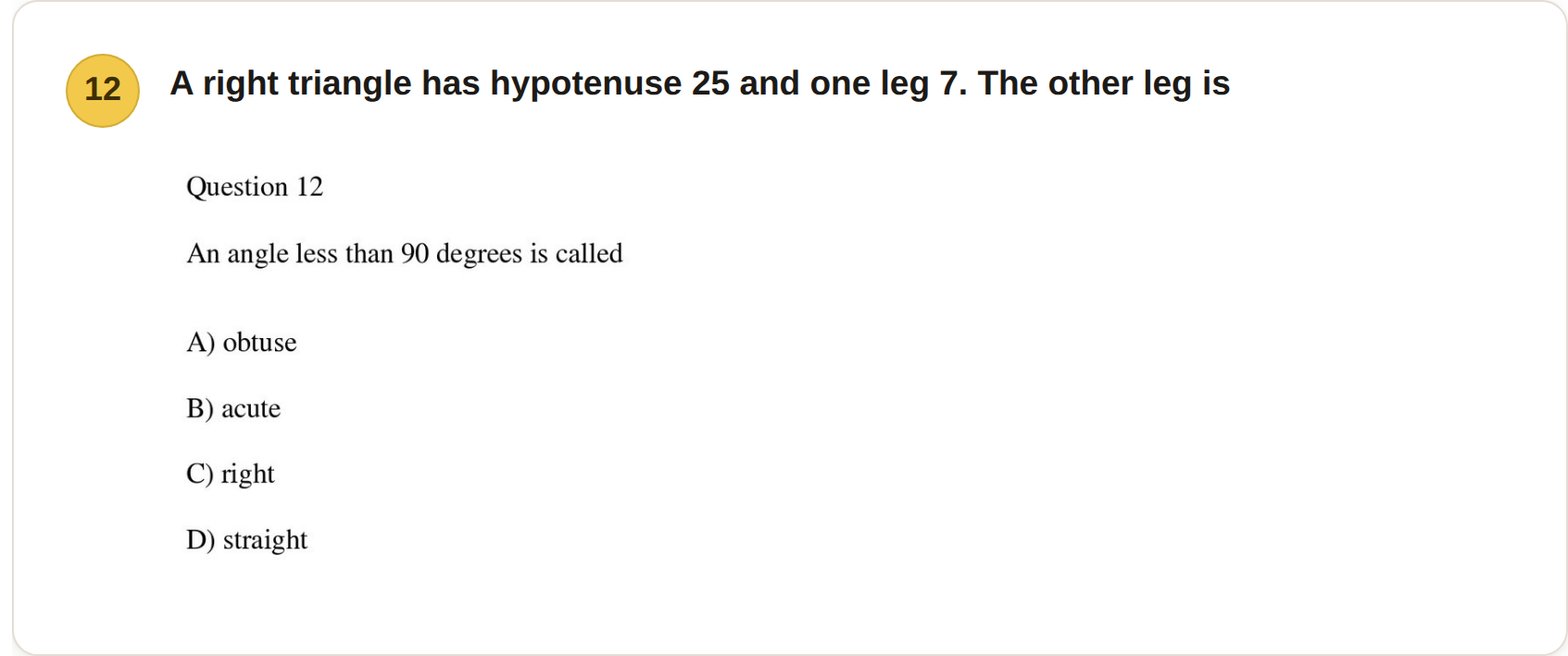
Question 12 diagram and text as printed in the PDF
Understand It with Pulse
13

A right triangle has hypotenuse 10 and one leg 6. The other leg is
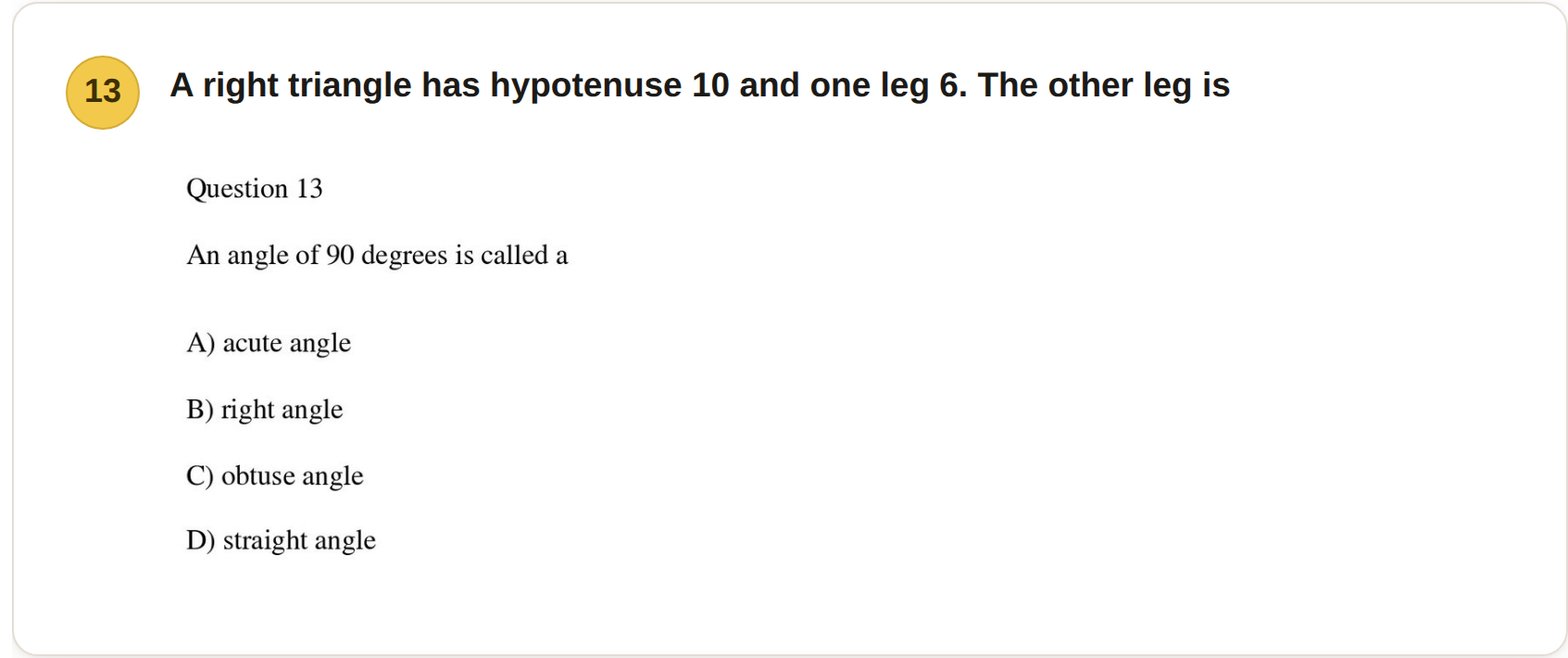
Question 13 diagram and text as printed in the PDF
Understand It with Pulse
14

The sum of the interior angles of any triangle is
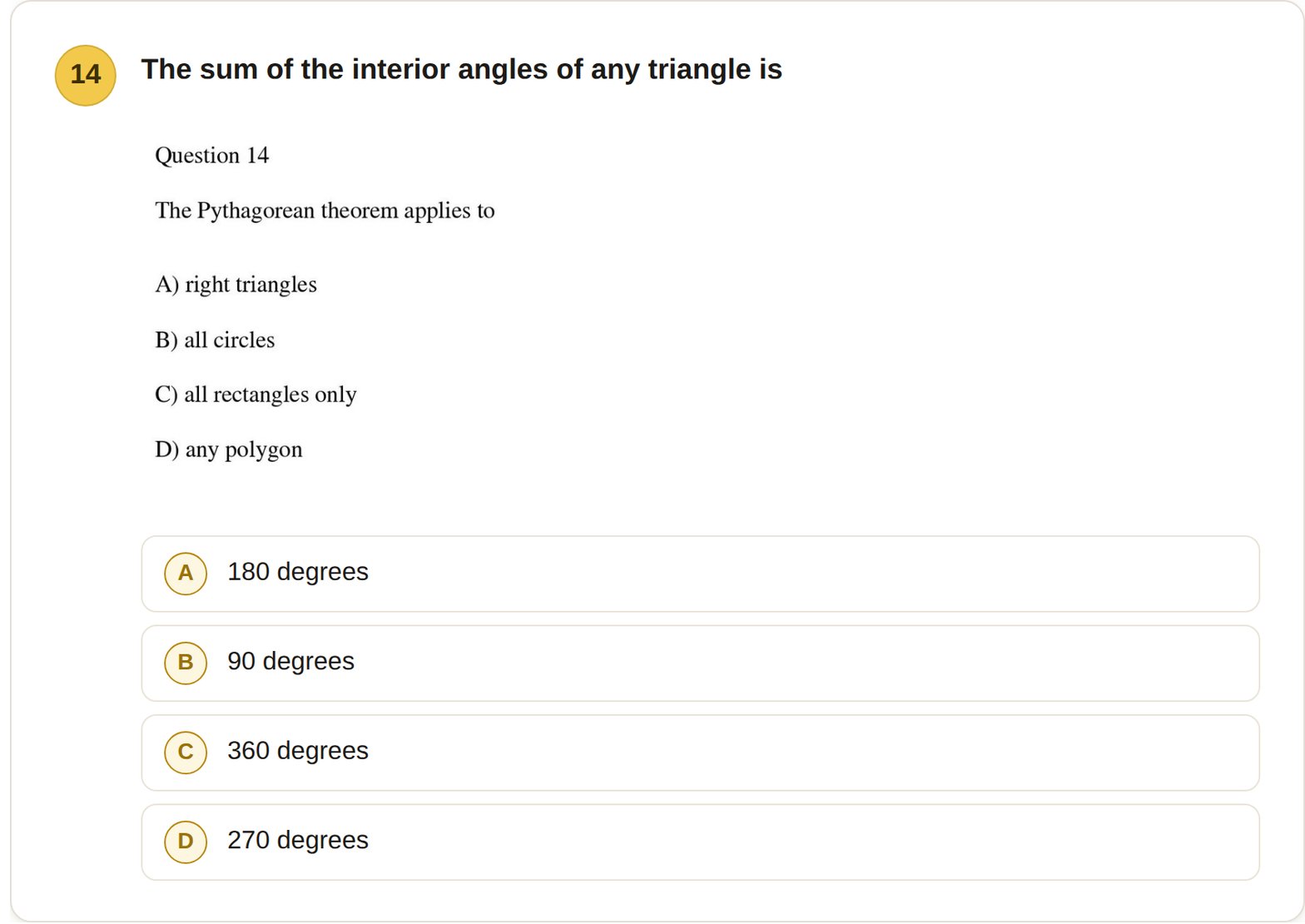
Question 14 diagram and text as printed in the PDF
Understand It with Pulse
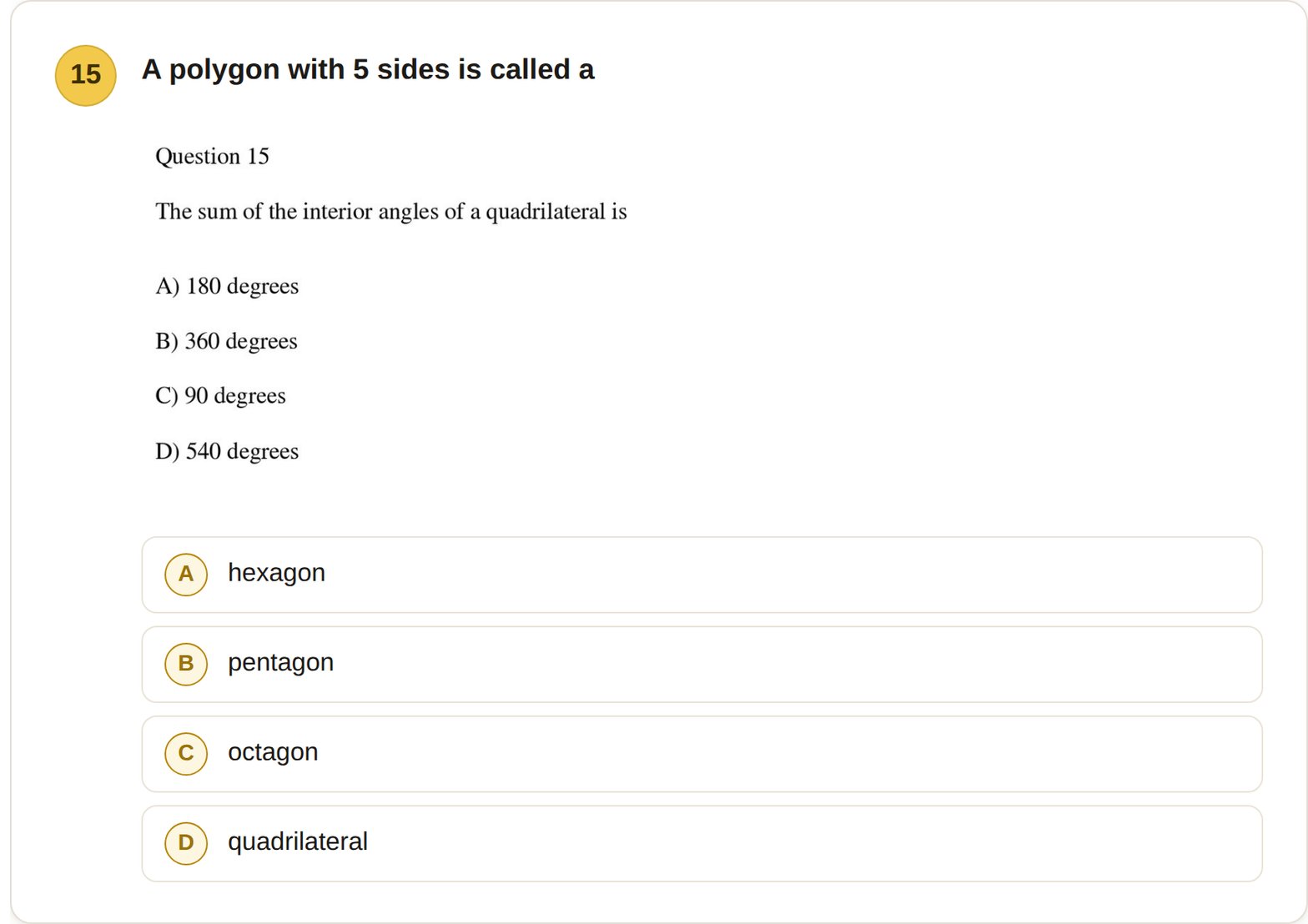
15

A polygon with 5 sides is called a

Question 15 diagram and text as printed in the PDF
Understand It with Pulse
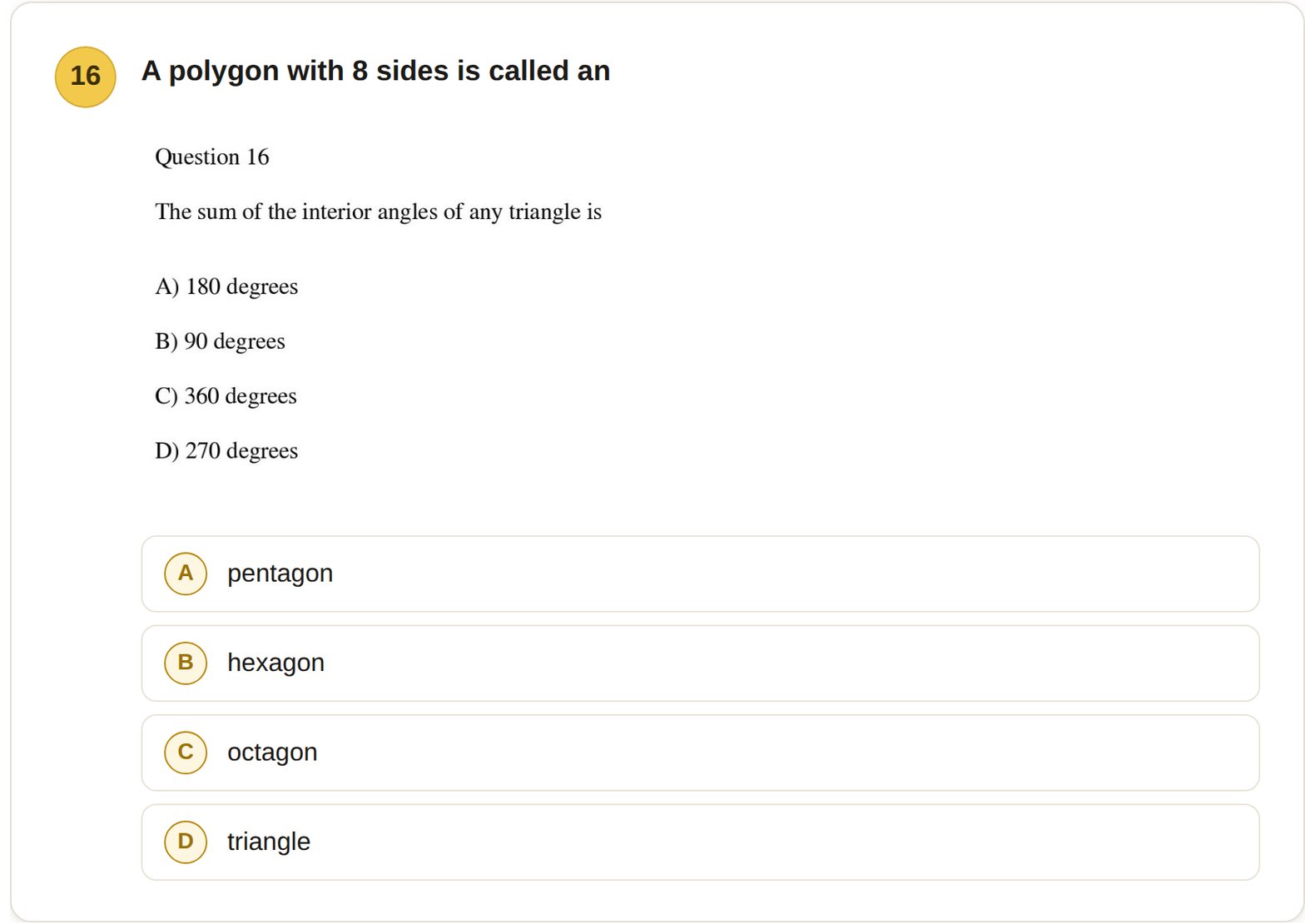
16

A polygon with 8 sides is called an

Question 16 diagram and text as printed in the PDF
Understand It with Pulse
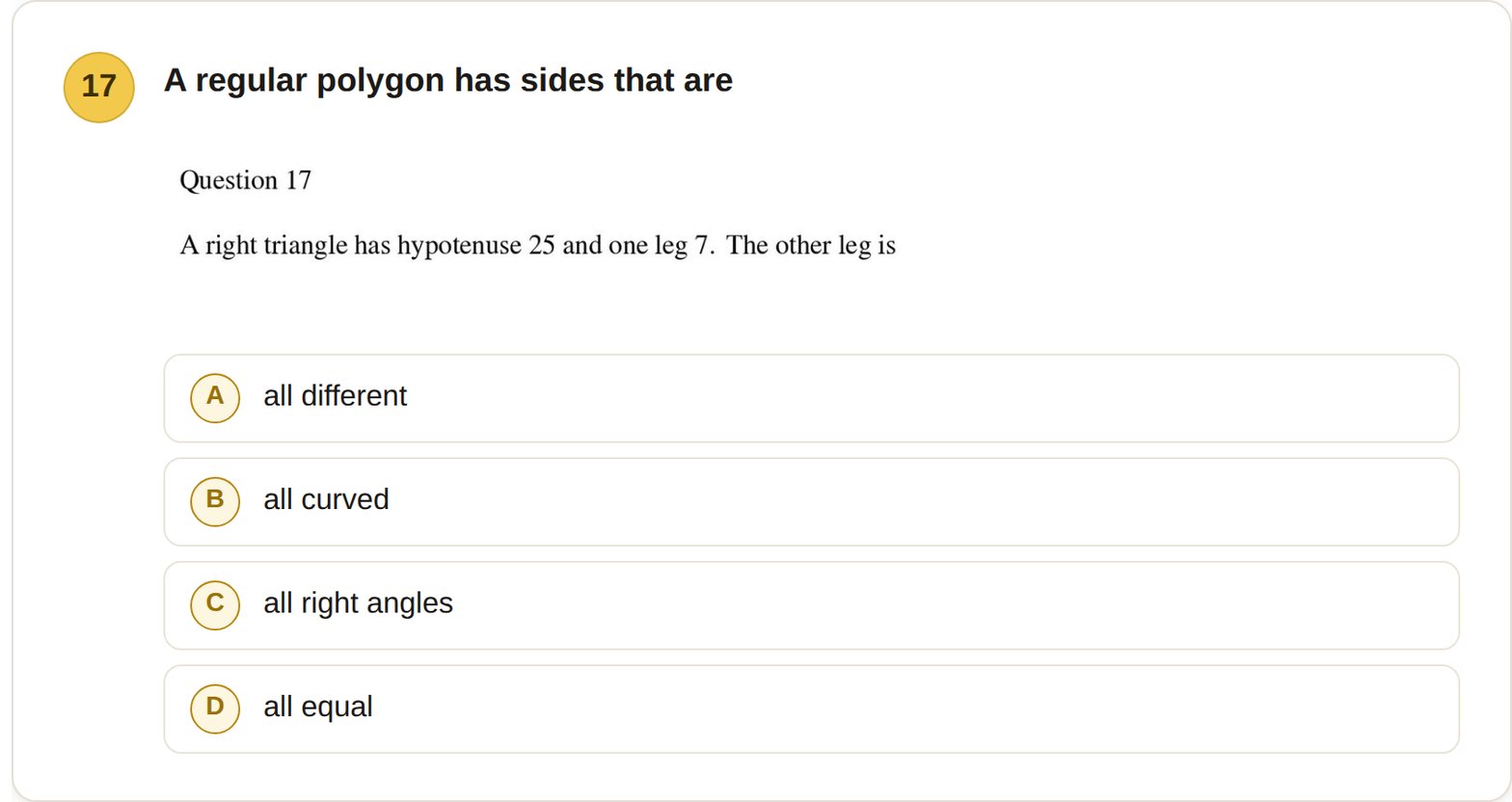
17

A regular polygon has sides that are

Question 17 diagram and text as printed in the PDF
Understand It with Pulse
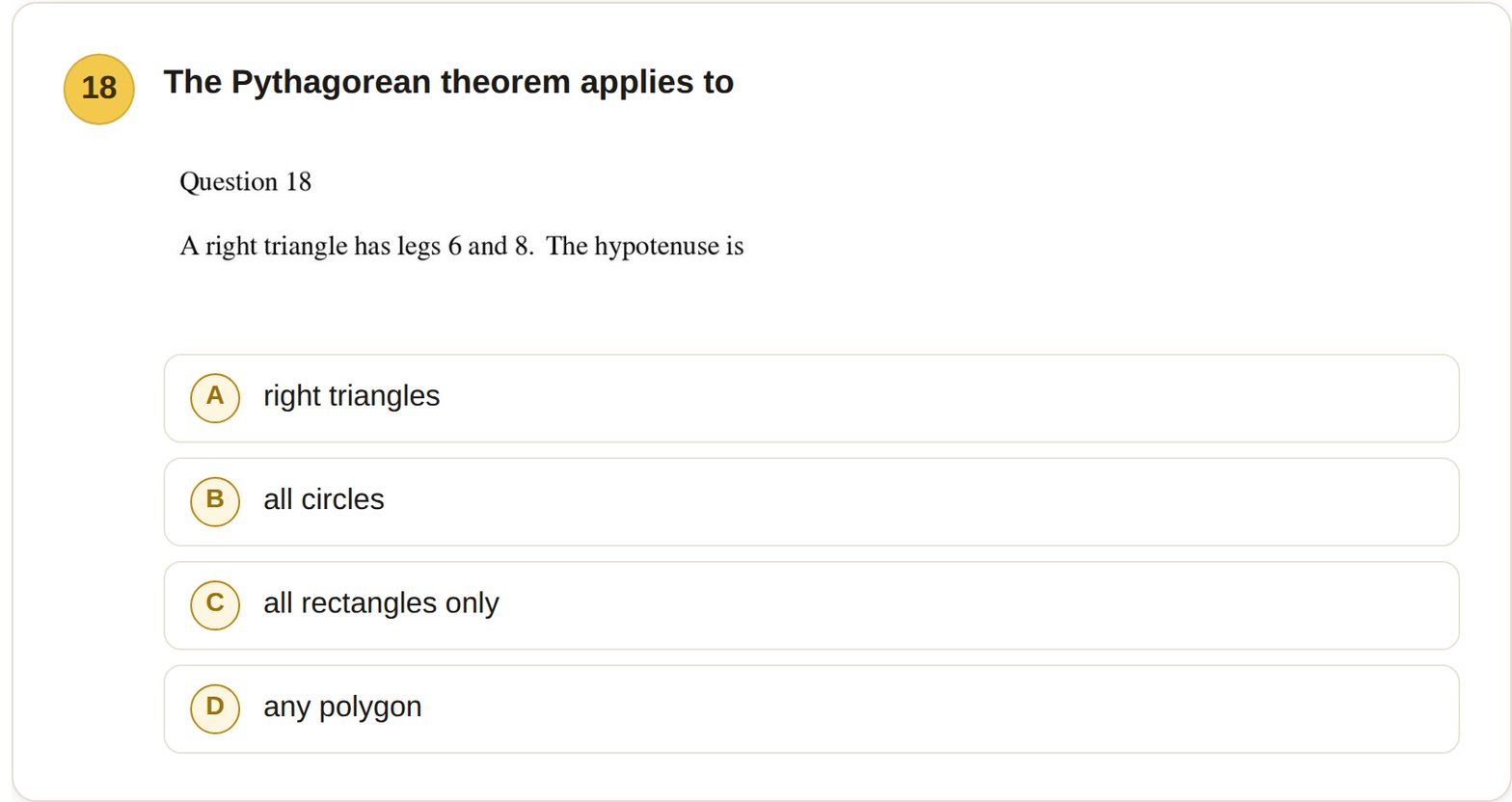
18

The Pythagorean theorem applies to

Question 18 diagram and text as printed in the PDF
Understand It with Pulse
19

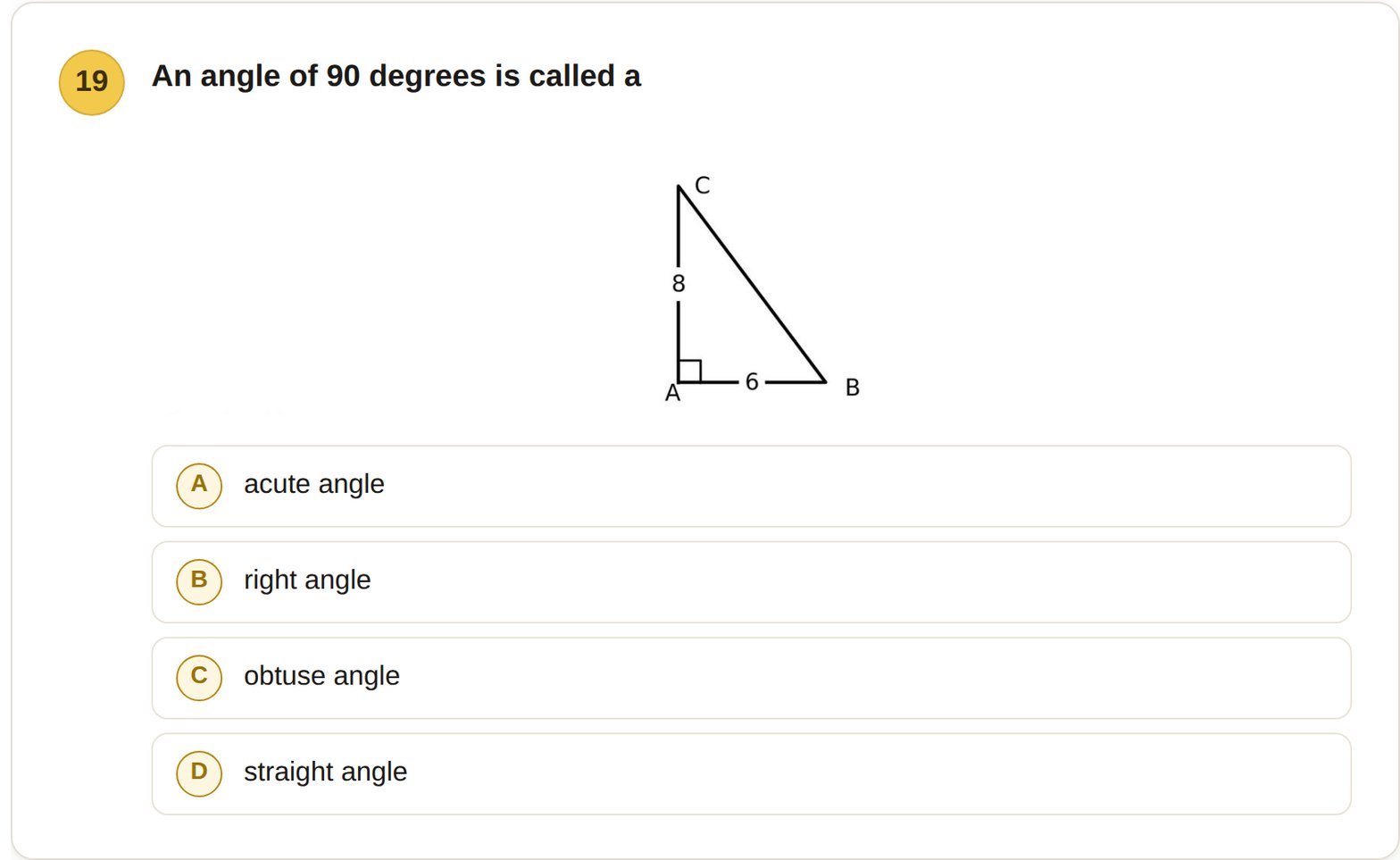
An angle of 90 degrees is called a

Question 19 diagram and text as printed in the PDF
Understand It with Pulse
20

An angle greater than 90 degrees and less than 180 degrees is
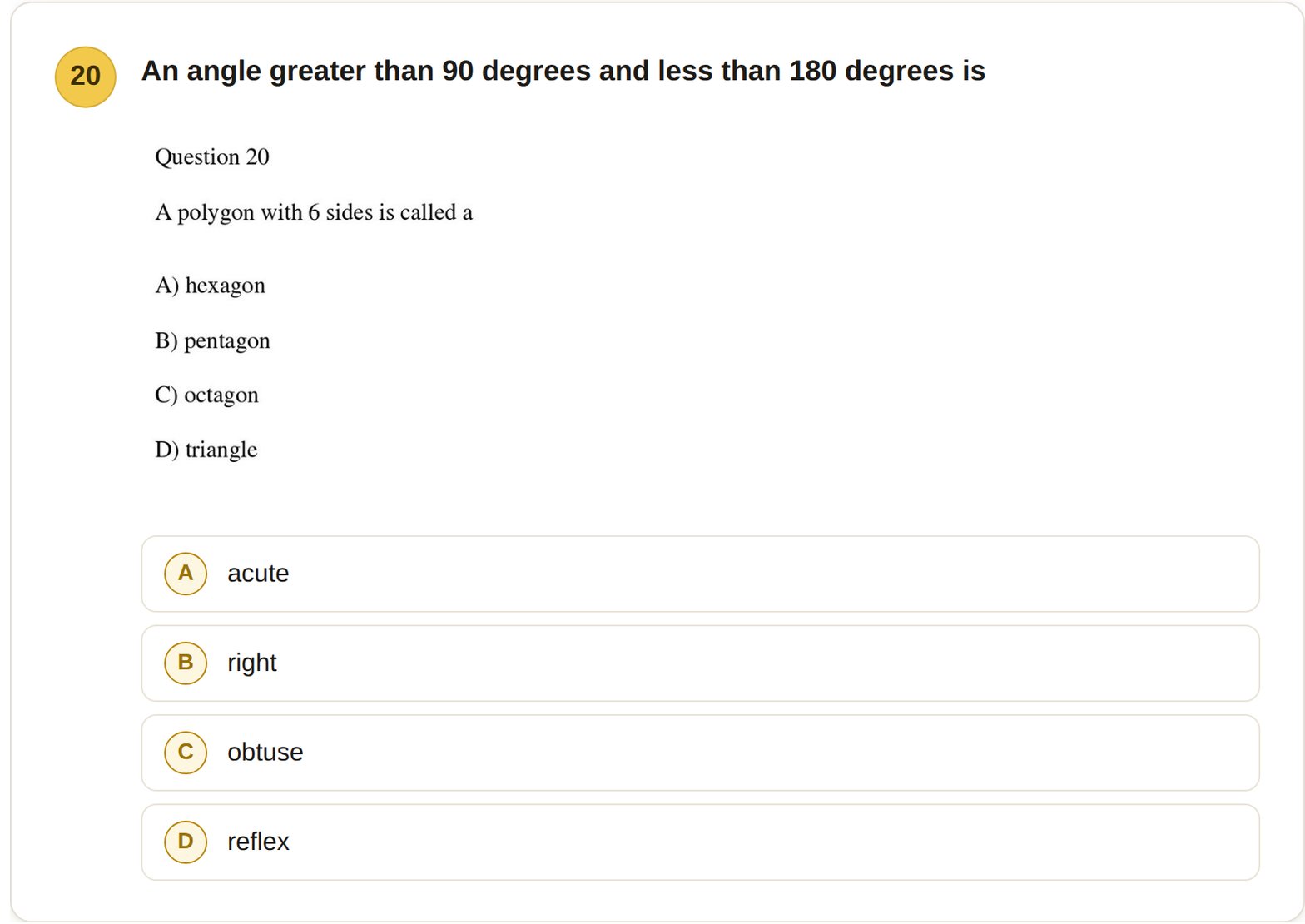
Question 20 diagram and text as printed in the PDF
Understand It with Pulse
21

Two angles that add to 90 degrees are called
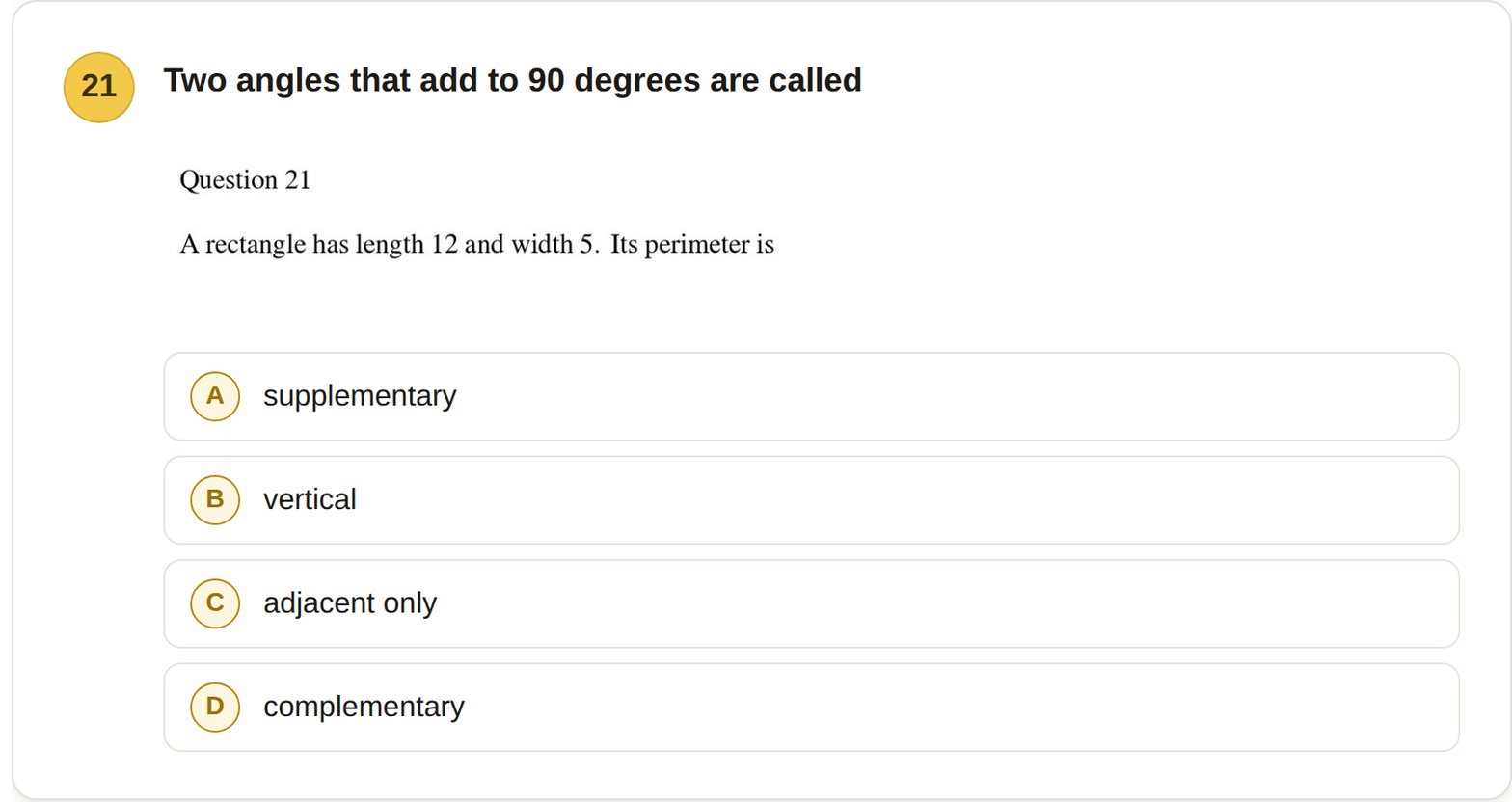
Question 21 diagram and text as printed in the PDF
Understand It with Pulse
22

Two angles that add to 180 degrees are called
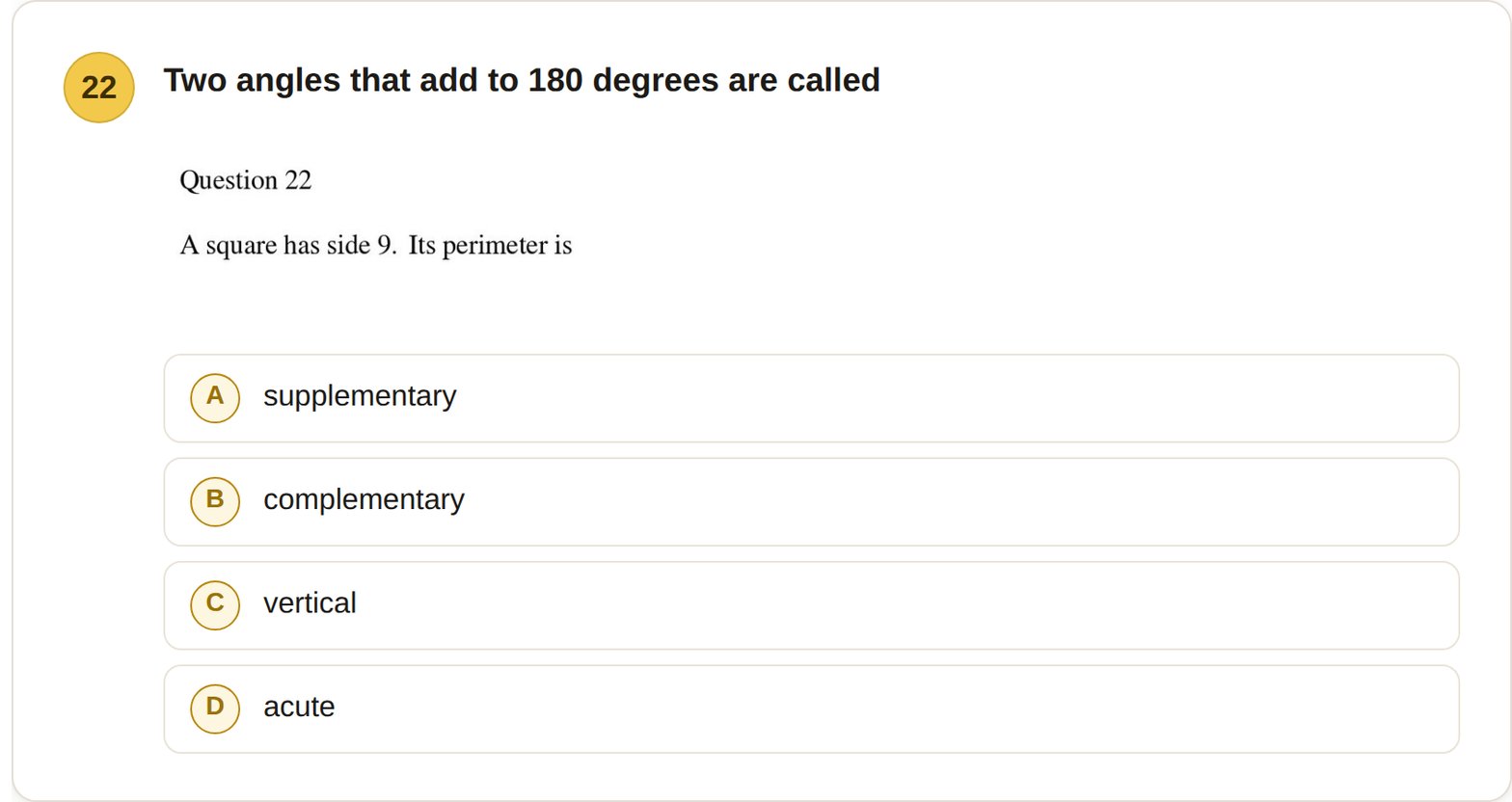
Question 22 diagram and text as printed in the PDF
Understand It with Pulse
23

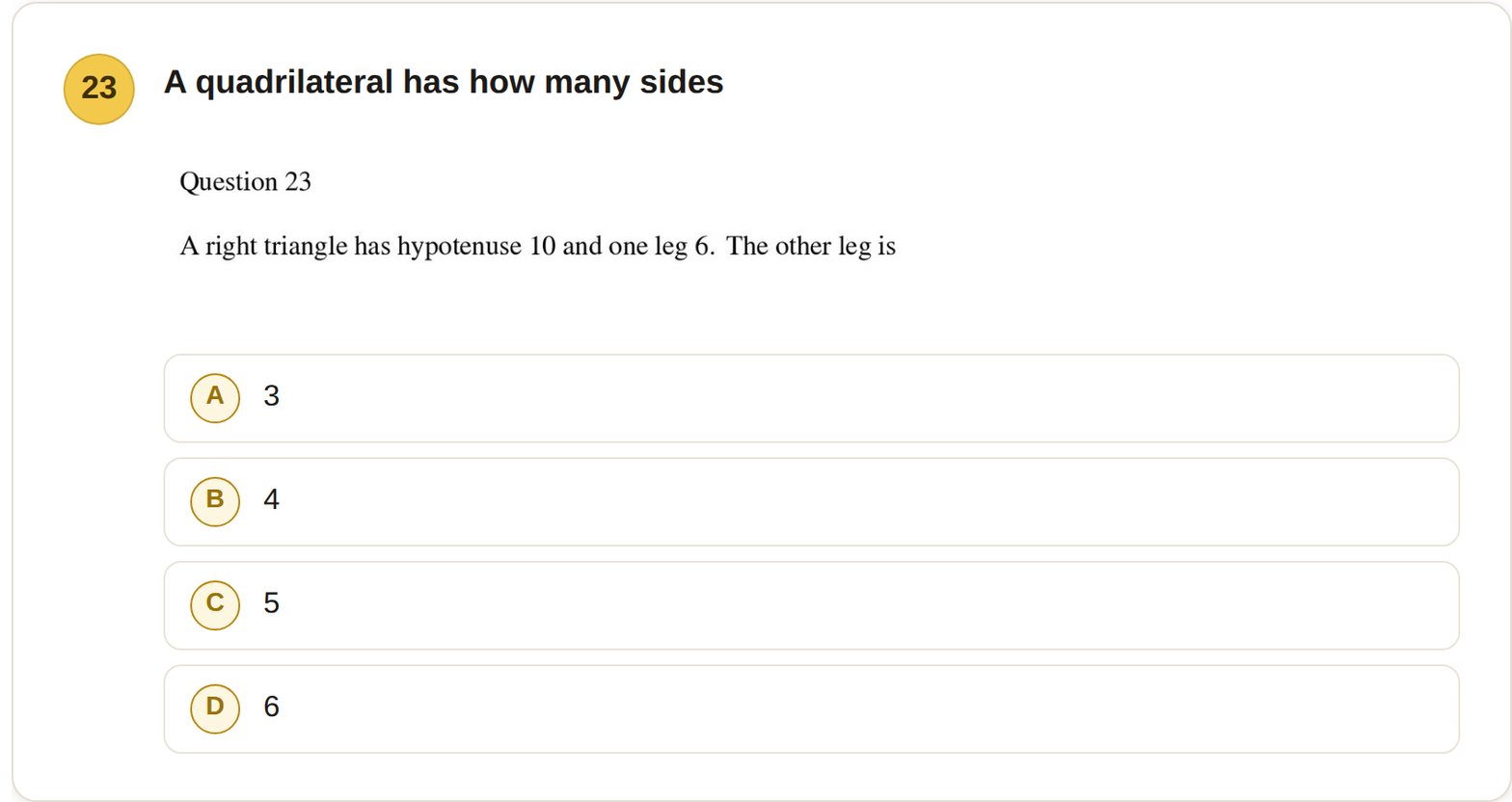
A quadrilateral has how many sides

Question 23 diagram and text as printed in the PDF
Understand It with Pulse
24

A rectangle has length 9 and width 4. Its perimeter is
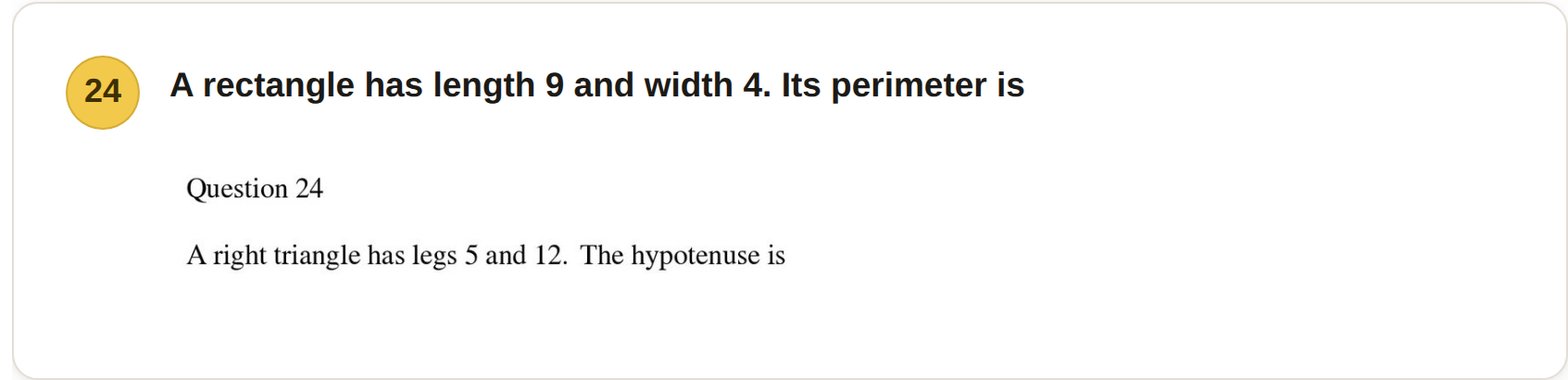
Question 24 diagram and text as printed in the PDF
Understand It with Pulse
25

A square has side 7. Its perimeter is
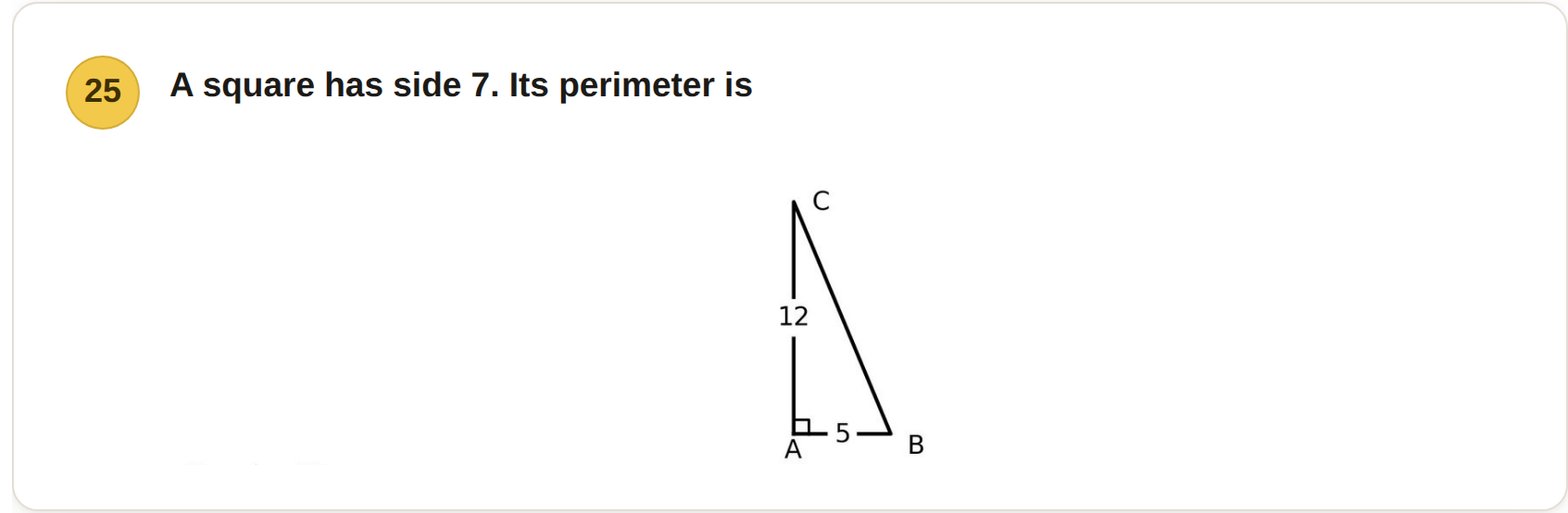
Question 25 diagram and text as printed in the PDF
Understand It with Pulse