1
Two charges of 2 microcoulombs each are 1 metre apart. The Coulomb force is proportional to the product of charges. If one charge doubles the force doubles. A force of 36 millinewtons becomes
Electrostatics and Fields - Practice Test | New Brunswick Physics 121-122 · Unit E · 25 questions
This practice test was made by AI and there may be mistakes. If a question or answer looks wrong, use the Flag a mistake button to let Brett know so he can fix it.
Two charges of 2 microcoulombs each are 1 metre apart. The Coulomb force is proportional to the product of charges. If one charge doubles the force doubles. A force of 36 millinewtons becomes
A charge of 4 microcoulombs in an electric field of 10 newtons per coulomb experiences a force in millinewtons of
A force of 60 millinewtons acts on a charge of 3 microcoulombs. The field strength in newtons per coulomb is
A parallel plate capacitor has voltage 100 volts and separation 0.02 metres. The field strength in volts per metre is
A parallel plate capacitor has voltage 200 volts and separation 0.04 metres. The field strength in volts per metre is
A field of 4000 volts per metre across 0.05 metres gives a voltage in volts of
An electron charge is 1.6 × 10⁻¹⁹ coulombs . Two electrons have total charge magnitude in units of 10⁻¹⁹ coulombs of
A charge moves 2 metres in a field of 500 volts per metre. The potential difference in volts is
The Coulomb force at distance d is 90 newtons. At distance 3d the force in newtons is
The Coulomb force at distance d is 80 newtons. At distance 2d the force in newtons is
A point charge field at distance 2 metres is 9 newtons per coulomb. At distance 6 metres the field is
A charge of 2 coulombs gains 100 joules moving through a potential difference. The potential difference in volts is
Like charges exert forces that are
Opposite charges exert forces that are
Electric field lines start on positive charges and end on
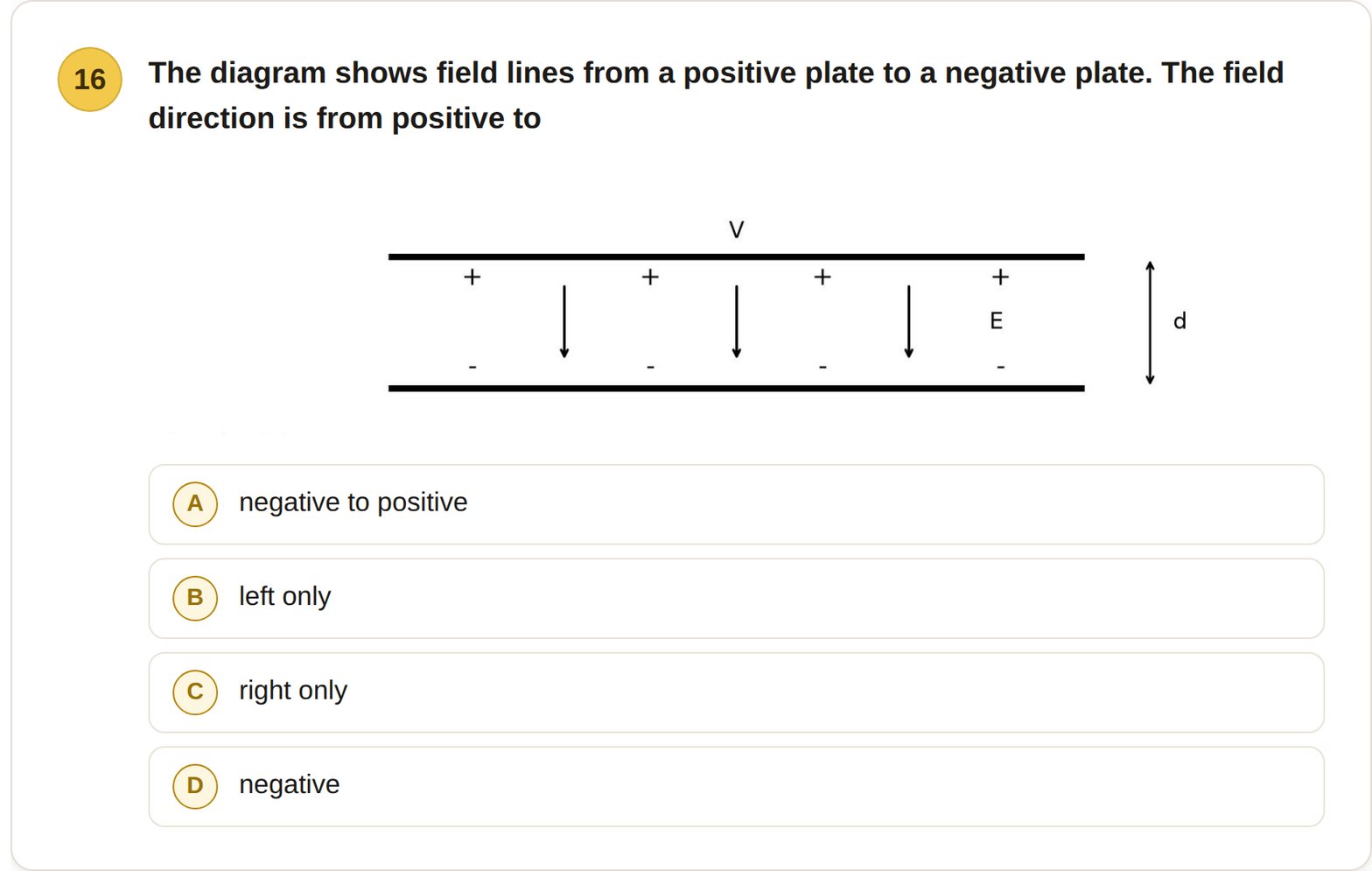
The diagram shows field lines from a positive plate to a negative plate. The field direction is from positive to
Electric field strength is defined as force per unit
The unit of electric field strength is newtons per
A conductor allows charge to move
An insulator does not allow charge to move
Charging by induction involves a grounded conductor and a nearby
The electric field inside a hollow conductor in equilibrium is
Potential difference is energy per unit
A volt is one joule per
Field lines never cross because the field at a point has one
Your score: 0 / 25