1
An atom has 6 protons and 6 neutrons. Its mass number is
New Brunswick Science 10 (Science for Sustainable Societies) · Unit C · 25 questions
This practice test was made by AI and there may be mistakes. If a question or answer looks wrong, use the Flag a mistake button to let Brett know so he can fix it.
An atom has 6 protons and 6 neutrons. Its mass number is
An atom has 8 protons and 8 neutrons. Its mass number is
An atom has 11 protons and 12 neutrons. Its mass number is
An atom has atomic number 6 and mass number 14. Its number of neutrons is
An atom has atomic number 8 and mass number 18. Its number of neutrons is
A neutral atom with 6 protons has how many electrons
A neutral atom with 17 protons has how many electrons
Carbon 14 decays with a half life of 5730 years. After 5730 years the fraction remaining is one half written as a decimal
A sample decays through 2 half lives. The fraction remaining as a decimal is
A sample decays through 3 half lives. The fraction remaining as a decimal is
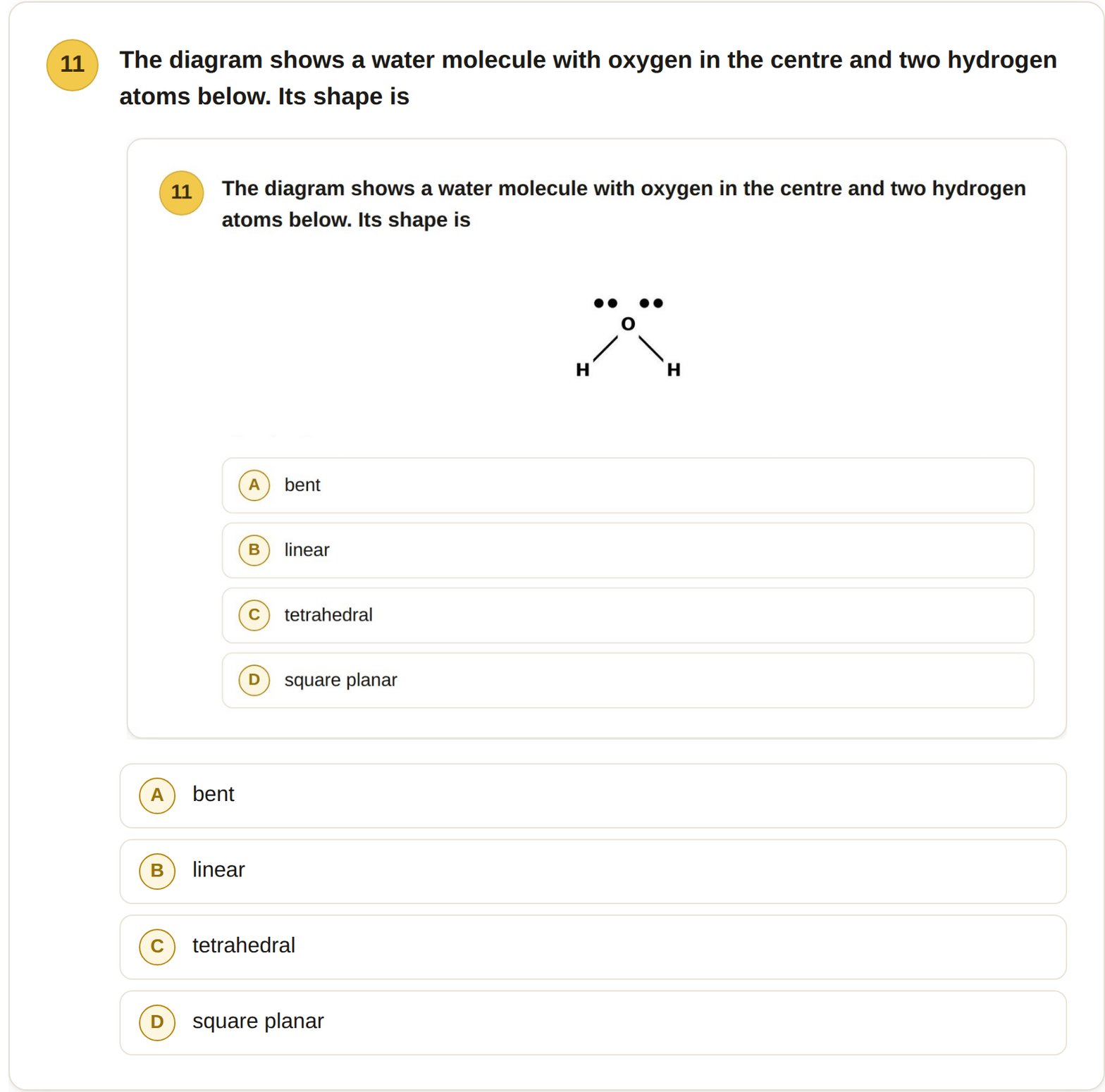
The diagram shows a water molecule with oxygen in the centre and two hydrogen atoms below. Its shape is
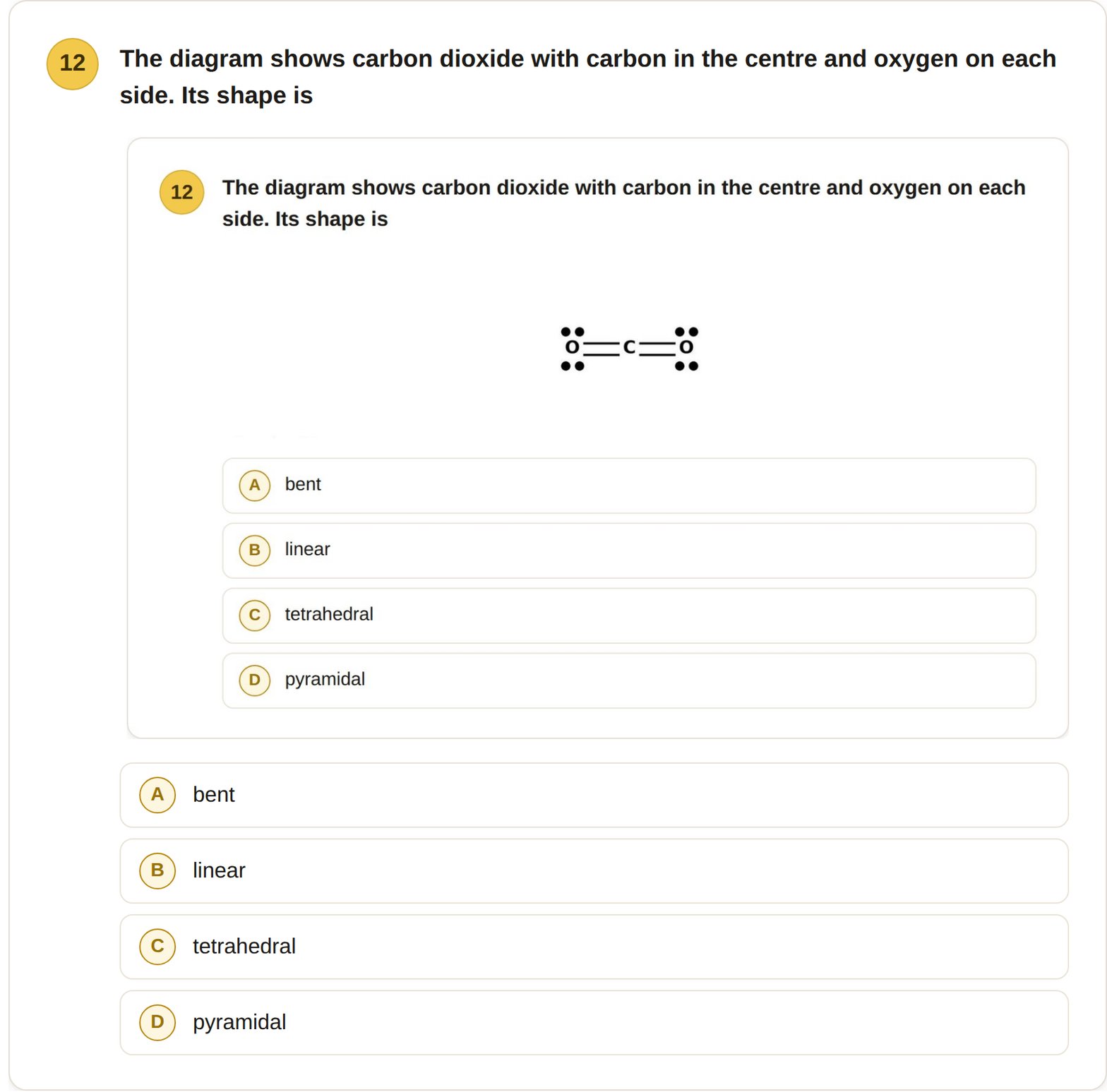
The diagram shows carbon dioxide with carbon in the centre and oxygen on each side. Its shape is
The nucleus of an atom contains protons and
Electrons are found in regions around the
Isotopes of an element have the same number of protons and different numbers of
Nuclear fission splits a heavy nucleus into
Nuclear fusion joins light nuclei to form a
Alpha radiation is a stream of helium
Beta radiation is a stream of fast
Gamma radiation is a form of high energy
A half life is the time for half of a radioactive sample to
The atomic number of an element equals its number of
An ion is an atom that has gained or lost
The periodic table organises elements by atomic number and
A chemical bond forms when atoms share or transfer
Your score: 0 / 25