1
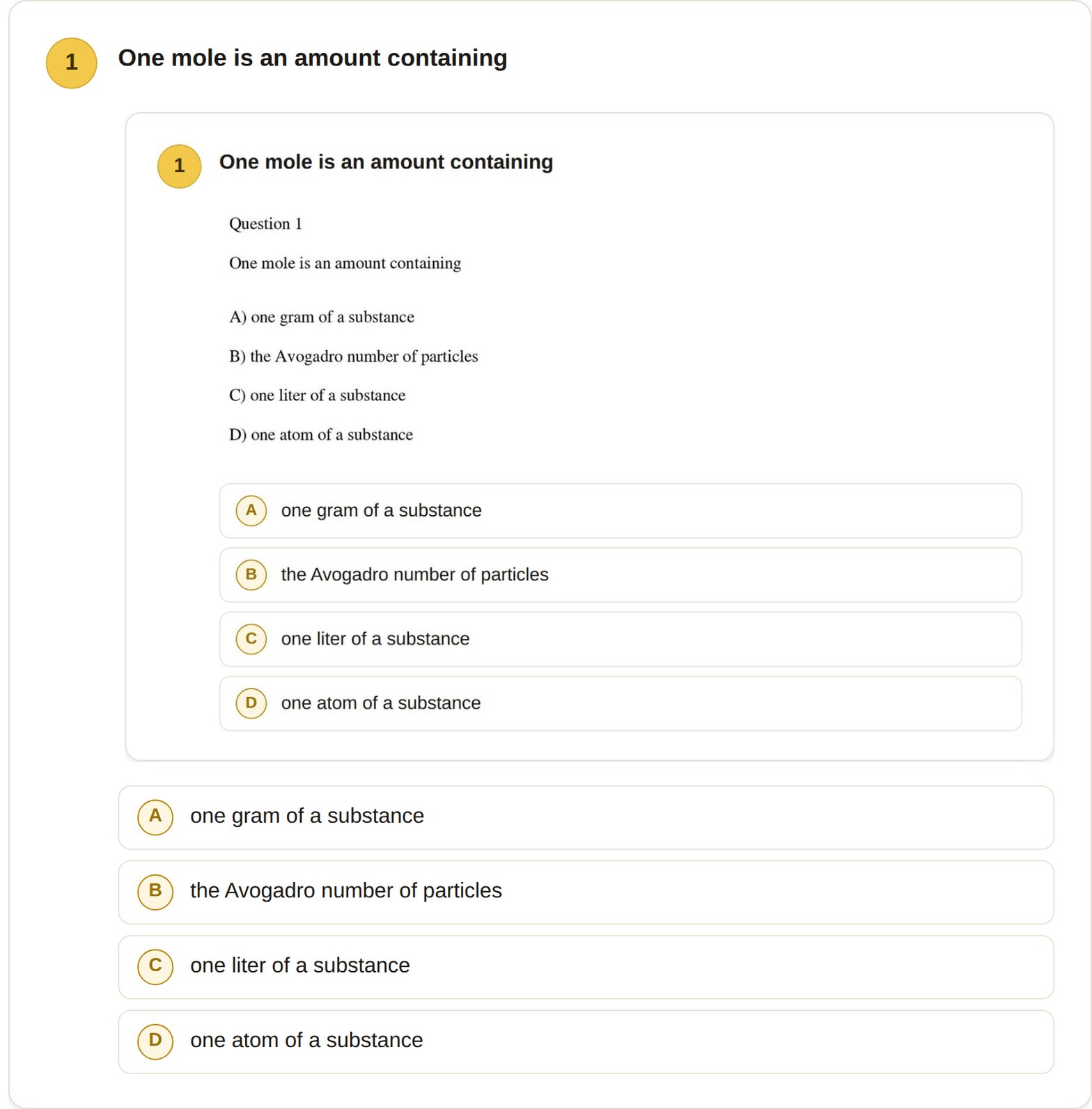
One mole is an amount containing
North Carolina Chemistry · Unit 3 · 25 questions
This practice test was made by AI and there may be mistakes. If a question or answer looks wrong, use the Flag a mistake button to let Brett know so he can fix it.
One mole is an amount containing
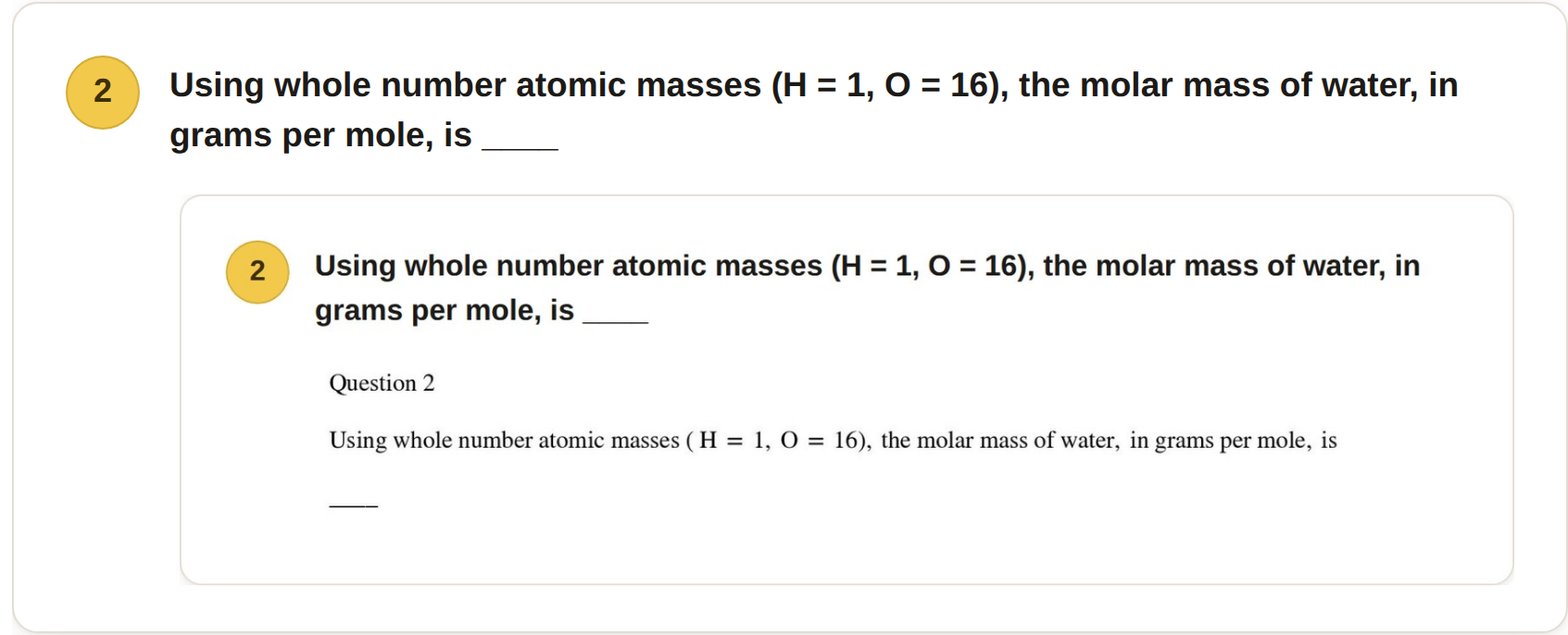
Using whole number atomic masses (H = 1, O = 16), the molar mass of water, in grams per mole, is ____
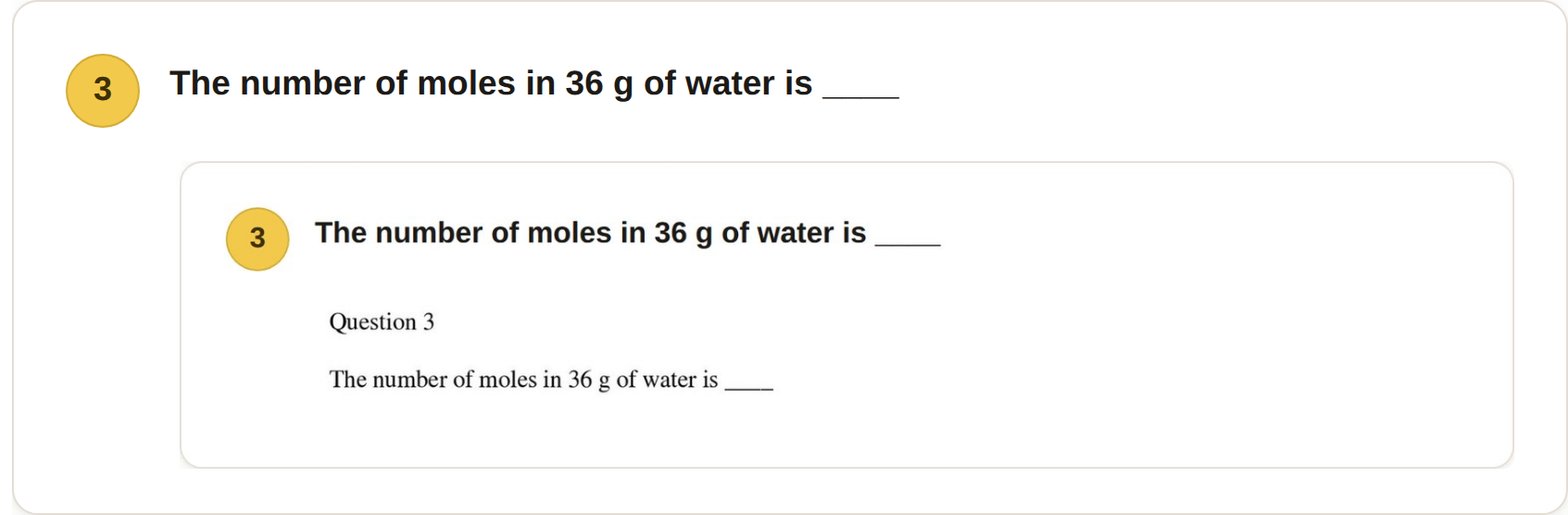
The number of moles in 36 g of water is ____
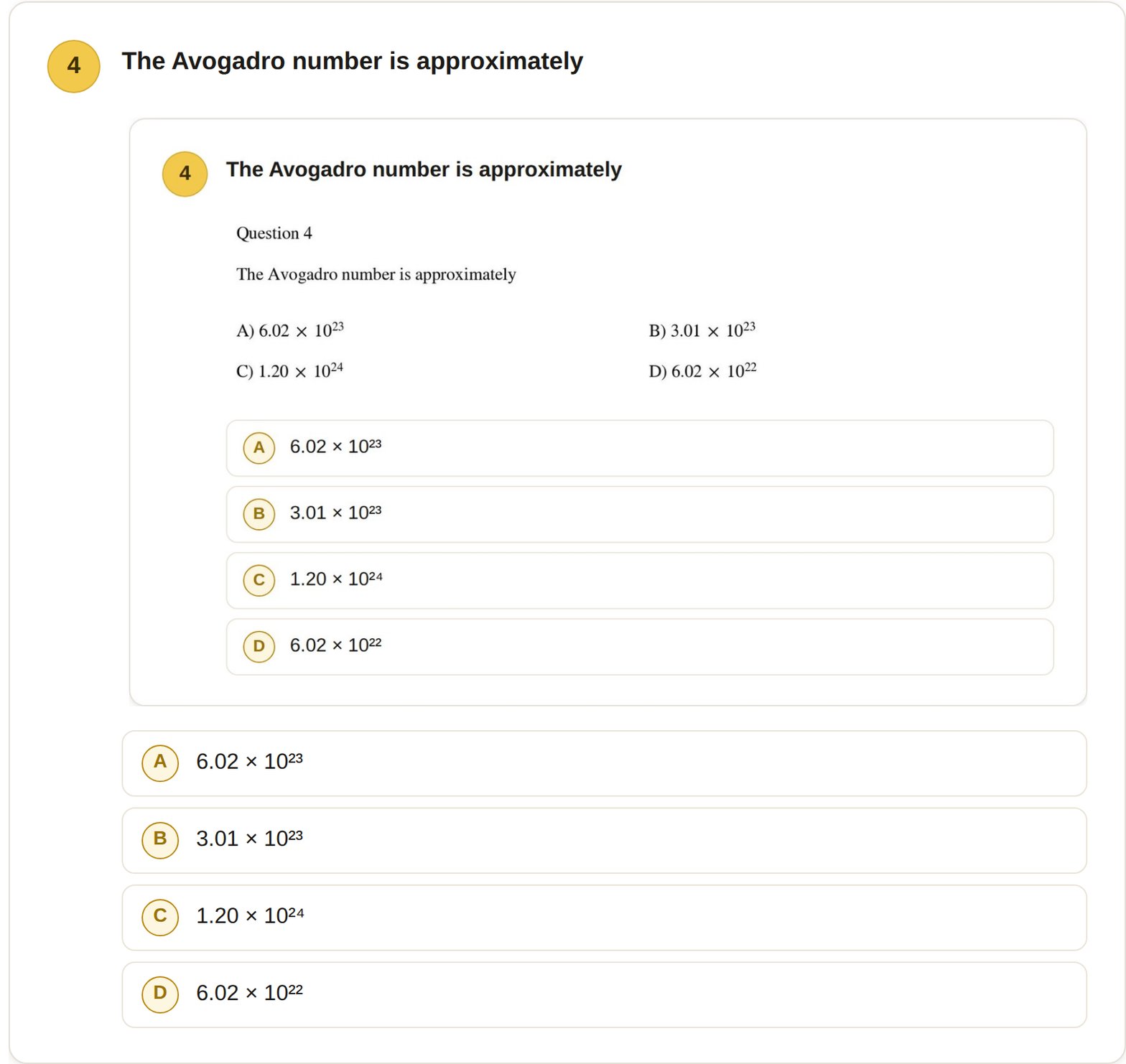
The Avogadro number is approximately
The mass, in grams, of 2 mol of carbon dioxide is ____
Molarity is defined as moles of solute per
The molarity, in moles per liter, of a solution containing 1 mol of solute in 2 L is ____
The number of moles in 20 g of sodium hydroxide is ____
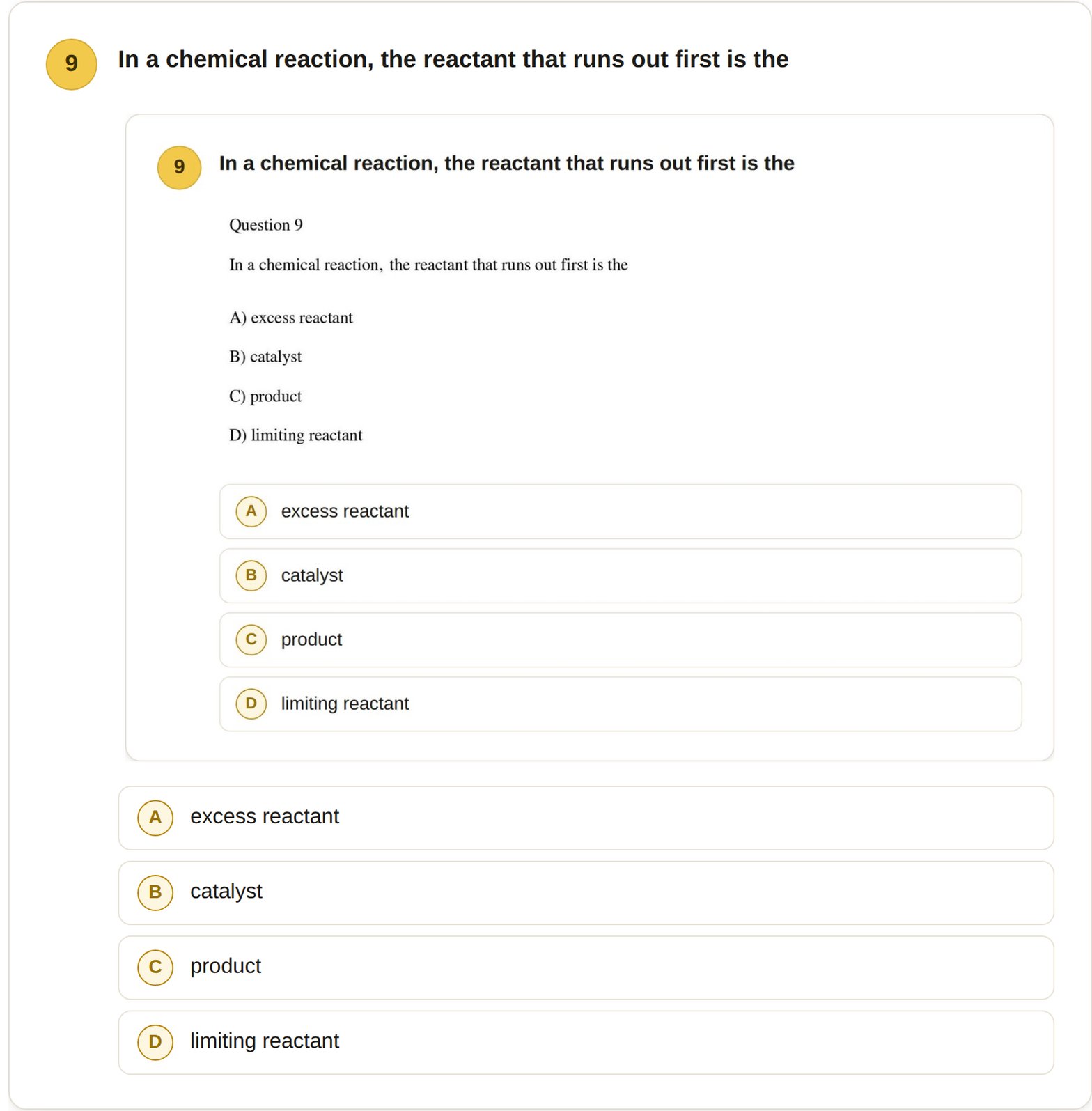
In a chemical reaction, the reactant that runs out first is the
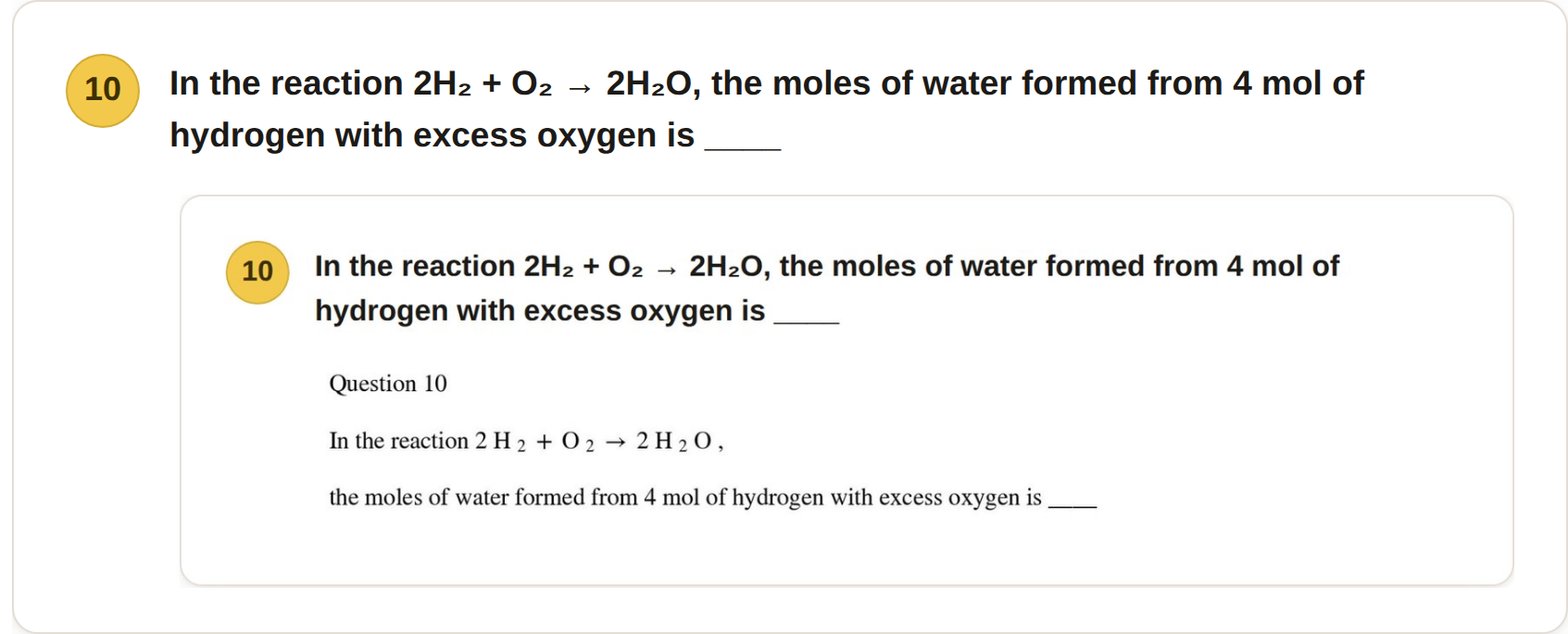
In the reaction 2H₂ + O₂ → 2H₂O, the moles of water formed from 4 mol of hydrogen with excess oxygen is ____
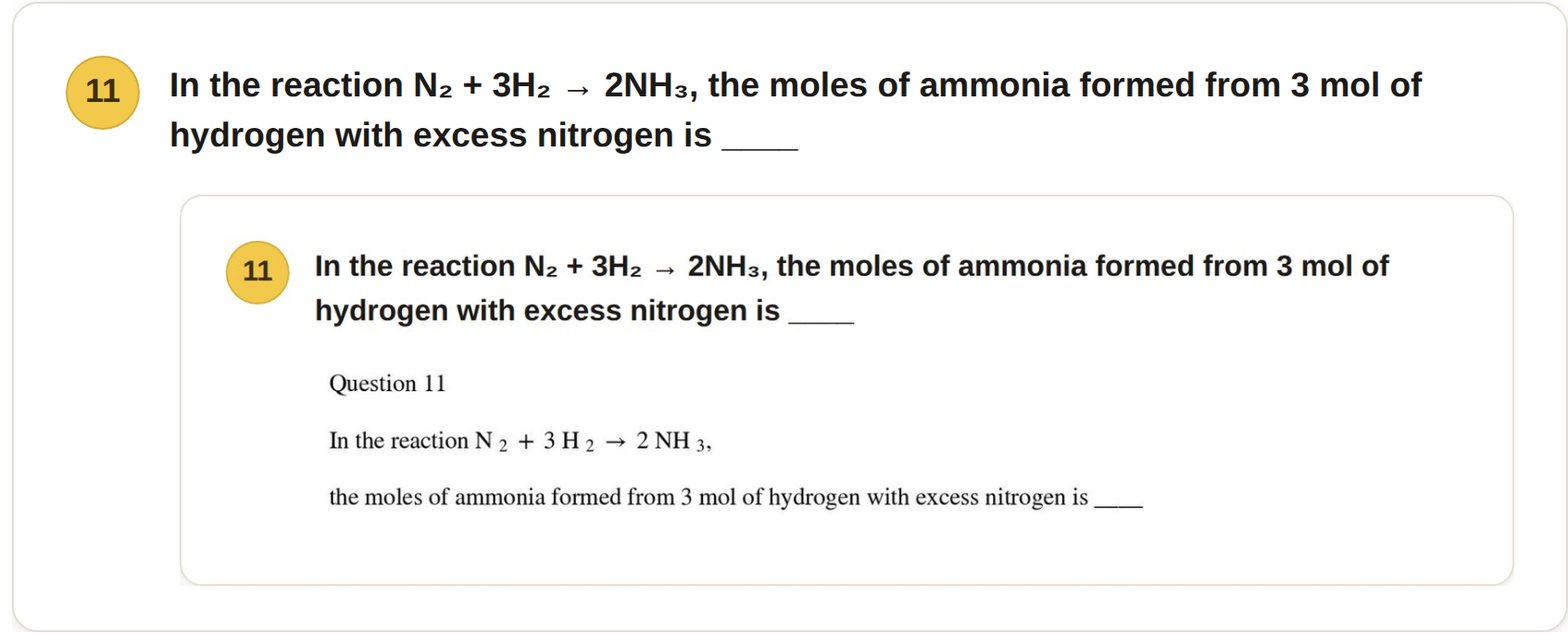
In the reaction N₂ + 3H₂ → 2NH₃, the moles of ammonia formed from 3 mol of hydrogen with excess nitrogen is ____
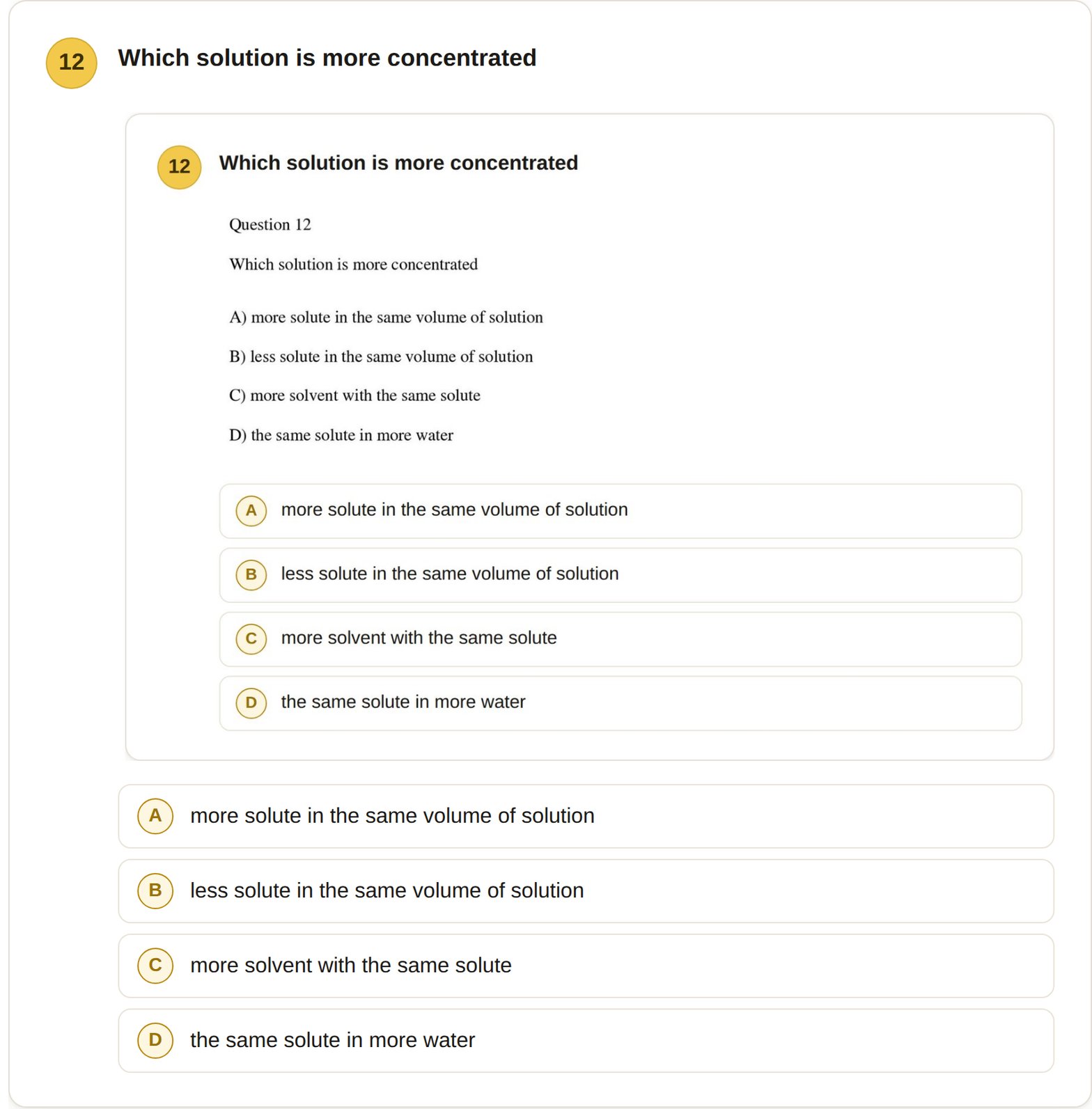
Which solution is more concentrated
The mass, in grams, of 3 mol of water is ____
The molarity, in moles per liter, of a solution containing 2 mol of solute in 0.5 L is ____
Percent yield is calculated as
The percent by mass of oxygen in carbon dioxide, to one decimal place, is ____
A 100 mL sample of 2.0 M solution is diluted to 400 mL. The new molarity, in moles per liter, is ____
An empirical formula gives the
A compound contains 12 g of carbon (1 mol) and 2 g of hydrogen (2 mol). The number of hydrogen atoms per carbon atom in its empirical formula is ____
In salt water, the salt is the
At standard temperature and pressure, the volume, in liters, of 1 mol of hydrogen gas is ____
In the reaction 2Mg + O₂ → 2MgO, the mass, in grams, of magnesium oxide formed from 2 mol of magnesium is ____
A saturated solution at a given temperature
The number of moles in 90 g of glucose, C₆H₁₂O₆, is ____
In the reaction 2H₂ + O₂ → 2H₂O, with 4 mol of hydrogen and 1 mol of oxygen, the moles of water formed is ____
Your score: 0 / 25