1
According to Source I, what can the reader infer about Alden's decision in spring?
Final Exam - Practice Test | North Carolina English 12 · Final Exam · 50 questions
This practice test was made by AI and there may be mistakes. If a question or answer looks wrong, use the Flag a mistake button to let Brett know so he can fix it.
According to Source I, what can the reader infer about Alden's decision in spring?
In a stone room above the market town, a young scribe named Alden copied books by hand. Each morning he sharpened his quills, mixed his ink, and settled at a slanted desk beside a narrow window. The work was slow. A single page could take a whole day, and one careless stroke could spoil hours of labor.
Alden did not mind the slowness. He loved the way a finished page looked, with its even lines and bright first letter painted in red and gold. He believed that books kept memory alive, carrying stories and laws from one generation to the next, long after the people who first told them were gone.
One winter, a traveler brought news of a printing press in a distant city, a machine that could make many copies of a book in days. Alden felt both wonder and fear. He wondered what would happen to scribes like him, yet he also imagined books reaching people who had never owned one. By spring, he had decided to learn the new craft, not to fight it, because he wanted stories to travel farther than his own hand could carry them.
According to Source I, what evidence supports later start times?
Many studies of teenagers find the same pattern: the brain's sleep clock shifts later in adolescence, so many teens do not feel sleepy until late at night, yet early school start times still require them to wake before dawn. The result is a regular sleep debt that builds across the school week.
Researchers who studied schools that moved start times later found that students reported less daytime sleepiness and, in several districts, tardiness fell. Supporters argue that a later start is a low cost change with clear benefits for attention and mood. Critics note that later starts can clash with bus schedules, after school jobs, and sports practice, so districts must plan the whole day, not just the first bell.
The evidence does not prove that a later start alone will fix every school problem. It does suggest, however, that sleep is one factor schools can influence, and that decisions about start times should weigh student health alongside transport and activities.
According to Source I, which revision would most improve the opening?
Many schools should start later in the morning. Teenagers need sleep. Buses are a problem. Some students work after school. Later starts could help students pay attention. This paper will discuss sleep, buses, and jobs.
The writer of this draft knows the topic but has not yet shaped a clear argument. The ideas are listed rather than connected, and the reader cannot tell which reason matters most or what evidence will follow.
According to Source I, which words in Version A are vague?
Version A: The storm was bad. It did stuff to the town. People were upset.
Version B: The storm tore roofs from houses, flooded Main Street, and left families without power for two days. Neighbors shared food and generators, and by Friday, crews had cleared most roads.
Version B does not just name a feeling. It shows specific actions and results, so the reader can picture the storm and judge its impact. Precise verbs and concrete nouns do work that vague words like bad and stuff cannot do.
According to Source I, the narrow window in the stone room most likely symbolizes
In a stone room above the market town, a young scribe named Alden copied books by hand. Each morning he sharpened his quills, mixed his ink, and settled at a slanted desk beside a narrow window. The work was slow. A single page could take a whole day, and one careless stroke could spoil hours of labor.
Alden did not mind the slowness. He loved the way a finished page looked, with its even lines and bright first letter painted in red and gold. He believed that books kept memory alive, carrying stories and laws from one generation to the next, long after the people who first told them were gone.
One winter, a traveler brought news of a printing press in a distant city, a machine that could make many copies of a book in days. Alden felt both wonder and fear. He wondered what would happen to scribes like him, yet he also imagined books reaching people who had never owned one. By spring, he had decided to learn the new craft, not to fight it, because he wanted stories to travel farther than his own hand could carry them.
According to Source I, the phrase sleep debt most nearly means
Many studies of teenagers find the same pattern: the brain's sleep clock shifts later in adolescence, so many teens do not feel sleepy until late at night, yet early school start times still require them to wake before dawn. The result is a regular sleep debt that builds across the school week.
Researchers who studied schools that moved start times later found that students reported less daytime sleepiness and, in several districts, tardiness fell. Supporters argue that a later start is a low cost change with clear benefits for attention and mood. Critics note that later starts can clash with bus schedules, after school jobs, and sports practice, so districts must plan the whole day, not just the first bell.
The evidence does not prove that a later start alone will fix every school problem. It does suggest, however, that sleep is one factor schools can influence, and that decisions about start times should weigh student health alongside transport and activities.
According to Source II, the speaker appeals to emotion mainly by
Friends, we have a choice. We can keep a park that is safe and clean, or we can let it fall apart and lose the one free place where our whole neighborhood gathers. I have volunteered in this park for three years, and I have seen children learn to ride bikes on its paths and older neighbors meet for morning walks.
Some will say repairs cost too much. They are right that money is tight. But the cost of losing the park, in safety, health, and community, is higher. Let us fix the paths, add lights, and keep this park open for everyone.
Which pair shows a difference mainly in connotation?
According to Source II, what does the speaker suggest about the moor?
The wind walks low across the moor at dusk,
and heather bends like listeners bowing their heads.
A path of pale stone climbs toward the hill,
where the last light gathers and quietly fades.
I have walked this way in joy and in grief,
and the moor has kept both, asking nothing in return.
According to Source II, what does the author concede?
Some argue that public libraries are outdated because almost any fact can be found on a phone. That argument misses what libraries actually do. Libraries lend books, but they also provide quiet study space, help with job applications, classes for new readers, and free internet access for people who have none at home.
A town that closes its library does not just lose books. It loses a free, shared place where students can study after school, where job seekers can print resumes, and where older residents can learn new technology with patient help. Digital access helps, but it is not the same as a staffed public space open to everyone.
Keeping a library does cost money, and towns must make hard budget choices. The question is not whether libraries are free to run, but whether the services they provide are worth funding as a public good, like parks and roads.
In a five paragraph essay, how many body paragraphs are there?
Personification is shown in
According to Source III, why did Shakespeare's plays mix comedy and tragedy?
In Shakespeare's London, a play was a shared public event. People from many walks of life crowded into an open air playhouse: merchants, apprentices, soldiers, and nobles. The cheapest places were in the yard, where groundlings stood through the whole play, close to the stage.
Because there were few sets and no electric lights, language had to do much of the work. Actors used words to tell the audience whether a scene took place at night, on a battlefield, or in a forest. Costumes, music, and gesture helped, but the spoken lines carried the story.
Plays were performed in the afternoon, in daylight, so actors could see the crowd and the crowd could see them. A successful play depended on holding that crowd's attention, which is one reason Shakespeare's plays mix comedy and tragedy, highborn characters and common ones, and fast action with quiet speeches.
According to Source III, what should a reader do with a biased source?
Not every source that looks professional is reliable. A strong researcher checks who wrote a source, when it was published, what evidence it cites, and whether other reliable sources agree. A personal blog may be honest, but it is not the same as a peer reviewed study or a report from an agency that checks its facts.
Bias does not always mean a source is useless. A source with a clear point of view can still be useful if the reader names the bias, checks its claims against other sources, and separates facts from opinions. The danger comes when a reader accepts one source alone, without checking, and treats opinion as settled fact.
A conclusion should
Which sentence is in passive voice?
Beowulf is best described as
A primary source is
Which sentence gives the best evidence for a claim about reading?
The word effect is usually used as
A Shakespearean sonnet has how many lines?
Plagiarism is best defined as
Which is the most formal tone?
Parallel structure means
The Romantic poets, including Wordsworth, most often valued
Which statement shows a fact, not an opinion?
Which opening is most effective for a persuasive essay?
Diction refers to
According to Source I, what is the main idea of the passage?
In a stone room above the market town, a young scribe named Alden copied books by hand. Each morning he sharpened his quills, mixed his ink, and settled at a slanted desk beside a narrow window. The work was slow. A single page could take a whole day, and one careless stroke could spoil hours of labor.
Alden did not mind the slowness. He loved the way a finished page looked, with its even lines and bright first letter painted in red and gold. He believed that books kept memory alive, carrying stories and laws from one generation to the next, long after the people who first told them were gone.
One winter, a traveler brought news of a printing press in a distant city, a machine that could make many copies of a book in days. Alden felt both wonder and fear. He wondered what would happen to scribes like him, yet he also imagined books reaching people who had never owned one. By spring, he had decided to learn the new craft, not to fight it, because he wanted stories to travel farther than his own hand could carry them.
A student plans a research paper with 3 main sections and 2 sources discussed in each section. How many source discussions are planned in total?
According to Source I, what is the main problem with Sam's email?
hi principal i want a chess club at school lots of kids like chess can we have one thanks sam
The message has a real request, but its tone and form are too casual for a school leader, and it gives no reasons, plan, or offer to help.
According to Source I, the phrase its porch sagging like a tired mouth is
The house on the hill did not shout. It waited, its windows dark, its porch sagging like a tired mouth. Ivy climbed its walls as if trying to keep it warm. When the wind moved through the empty rooms, the floorboards answered with low, careful creaks.
Visitors called the house haunted, but the narrator calls it lonely. The difference matters: a haunted house threatens, while a lonely house waits for company that no longer comes.
According to Source I, why does Alden value his work as a scribe?
In a stone room above the market town, a young scribe named Alden copied books by hand. Each morning he sharpened his quills, mixed his ink, and settled at a slanted desk beside a narrow window. The work was slow. A single page could take a whole day, and one careless stroke could spoil hours of labor.
Alden did not mind the slowness. He loved the way a finished page looked, with its even lines and bright first letter painted in red and gold. He believed that books kept memory alive, carrying stories and laws from one generation to the next, long after the people who first told them were gone.
One winter, a traveler brought news of a printing press in a distant city, a machine that could make many copies of a book in days. Alden felt both wonder and fear. He wondered what would happen to scribes like him, yet he also imagined books reaching people who had never owned one. By spring, he had decided to learn the new craft, not to fight it, because he wanted stories to travel farther than his own hand could carry them.
According to Source I, by about how much had household water use fallen after five years?
The town of Red Mesa gets less than ten inches of rain in a typical year. For decades, residents watered lawns as if rain were plentiful, and the town's wells dropped lower each summer. In 2019, the council offered rebates for low water plants, fixed leaks in town pipes, and charged more for very high household use.
Five years later, total household water use had fallen by about one fifth, even though the town had grown. Supporters credit the rebates and the leak repairs. Critics point out that farms outside town still use far more water, and they argue that household savings alone will not secure the town's future supply. Both sides agree on one point: without a long term plan, a dry town cannot keep using water as if it were unlimited.
According to Source I, which reason would best support a chess club?
hi principal i want a chess club at school lots of kids like chess can we have one thanks sam
The message has a real request, but its tone and form are too casual for a school leader, and it gives no reasons, plan, or offer to help.
According to Source I, the mood of the passage is best described as
The house on the hill did not shout. It waited, its windows dark, its porch sagging like a tired mouth. Ivy climbed its walls as if trying to keep it warm. When the wind moved through the empty rooms, the floorboards answered with low, careful creaks.
Visitors called the house haunted, but the narrator calls it lonely. The difference matters: a haunted house threatens, while a lonely house waits for company that no longer comes.
Blank verse, used by Milton in Paradise Lost, is
Which is a primary source for a study of a school's history?
Which is a run on sentence?
Which sentence uses there correctly?
According to Source II, what problem did critics link to the mill?
When the mill opened beside the river, the town changed in a single generation. Cottages that had housed farm workers filled with mill hands, and the lane to the church grew busy at dawn and again at dusk. Wages were steadier than farm pay, but hours were long and the air in the mill was thick with dust.
Some townspeople praised the change. Shops sold more goods, and families could plan beyond the next harvest. Others warned that children worked too long and that the river, once clear, now ran dark after rain. The town council argued for years about rules for hours, safety, and clean water, while the mill bell kept marking the day.
An author who uses loaded words like corrupt and heroic to sway readers is mainly using
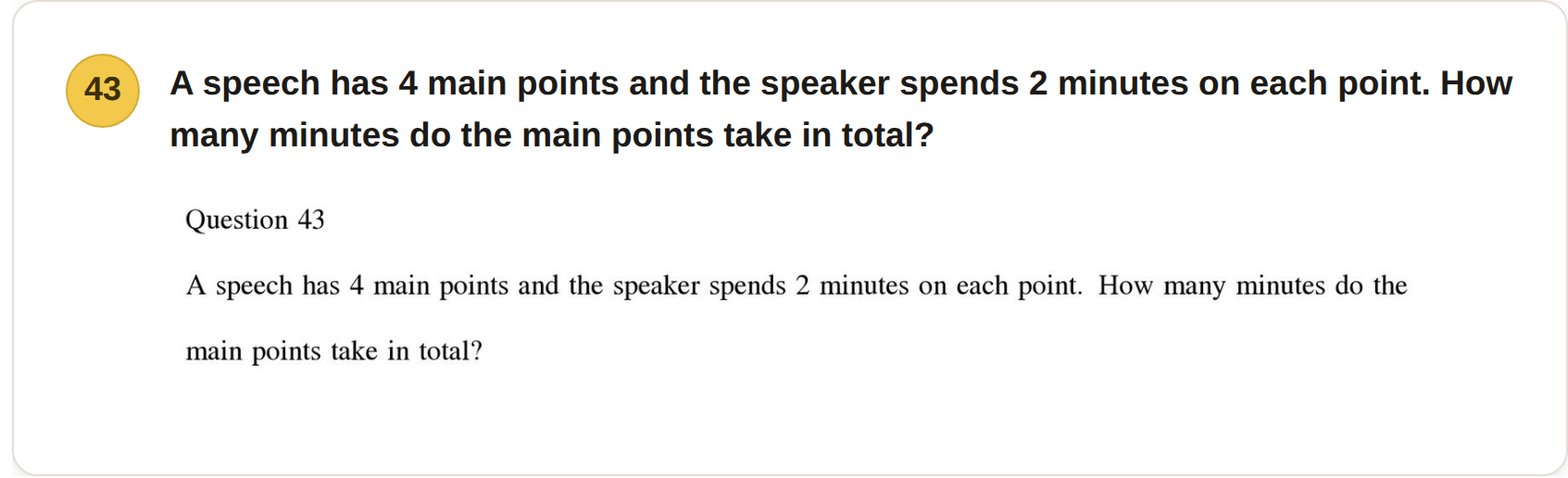
A speech has 4 main points and the speaker spends 2 minutes on each point. How many minutes do the main points take in total?
Which is a dependent clause?
In Macbeth, ambition is best described as
A summary should
A writer who anticipates an objection and answers it is using
Which revision uses the most precise diction?
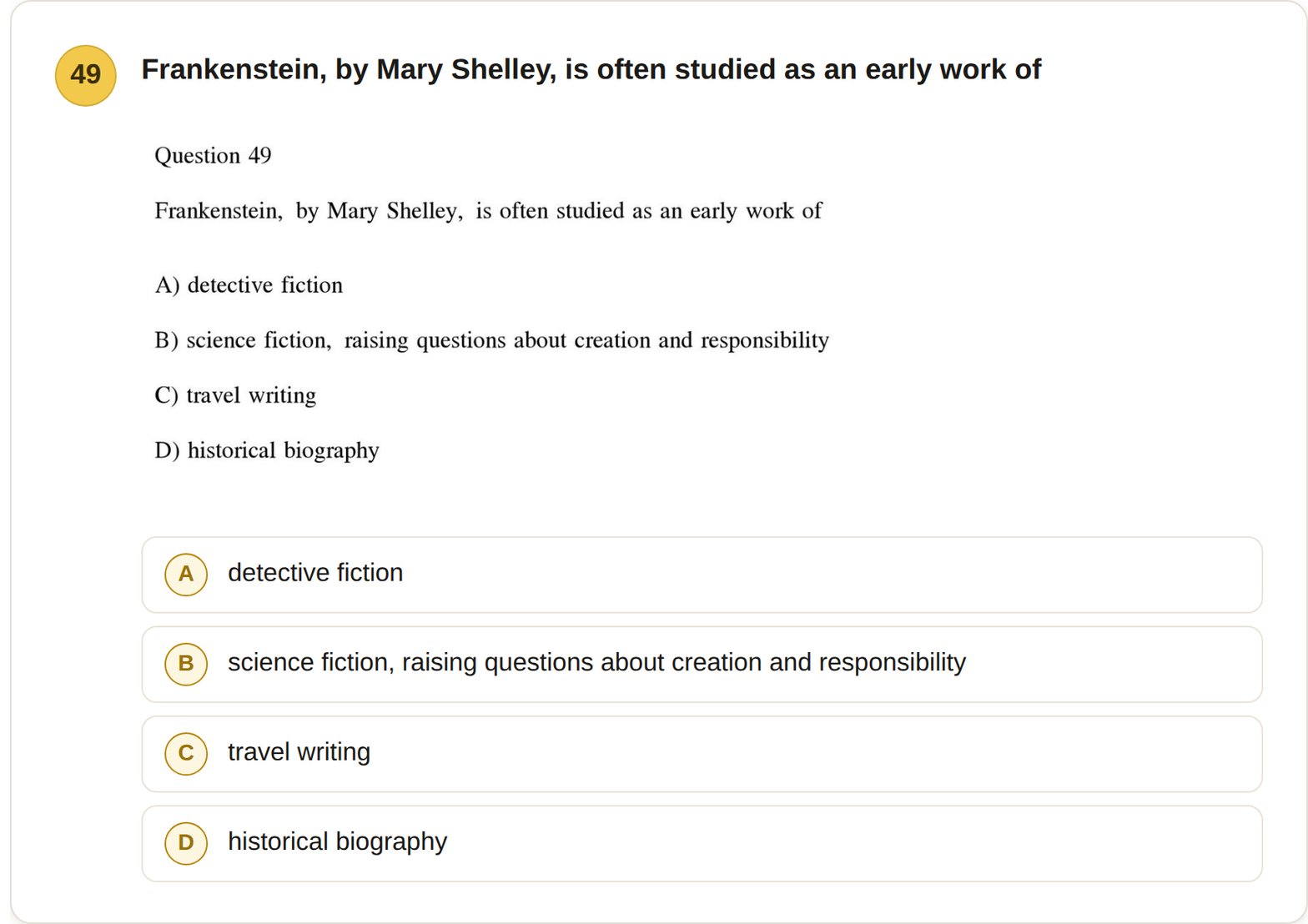
Frankenstein, by Mary Shelley, is often studied as an early work of
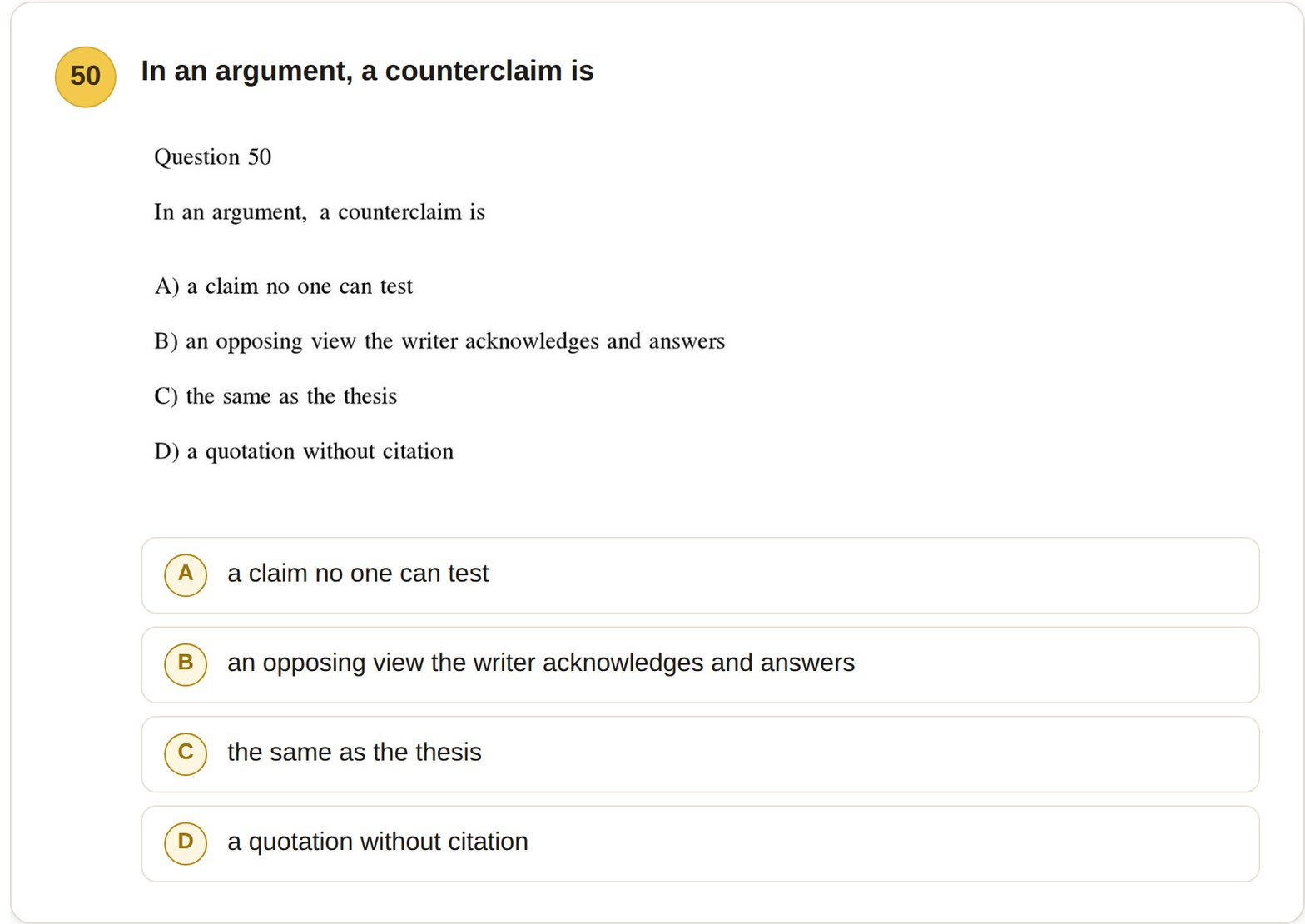
In an argument, a counterclaim is
Your score: 0 / 50