
1
A triangle has sides a, b, c and angle A opposite side a. Write the cosine law for side a.
MATHEMATICS · GRADES 10-12
This document was made by AI and there may be mistakes. If a question or answer looks wrong, use the Flag a mistake button to let Brett know so he can fix it.
This is how you work out a distance or an angle in a triangle that is not a right triangle. A surveyor uses it to measure across a lake or a river without walking through the water. A builder uses it to find the angle of a roof that is not square. Any time you know two sides and the angle between them, or all three sides, it gives you the missing piece.
Cosine law: a² = b² + c² - 2bc cos A.
It gives a side of any triangle from the other two sides and the angle between them. When the angle is 90 degrees, cos A is 0 and it becomes the Pythagorean theorem.
Sides
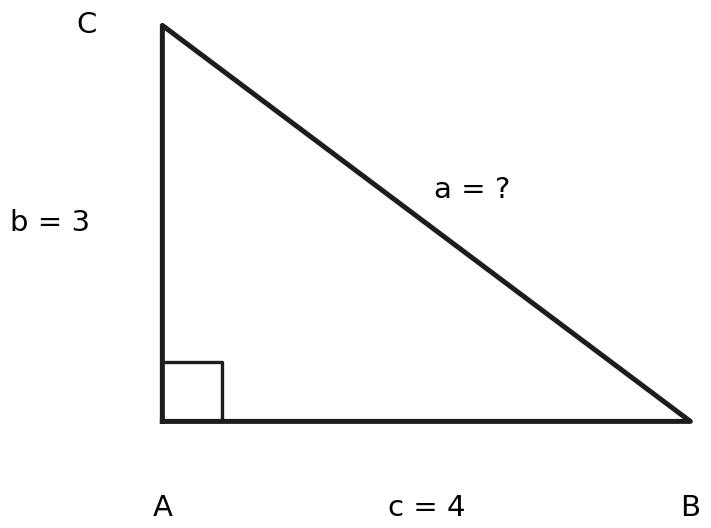
Solution
Cosine law: a² = b² + c² − 2bc cos A
Cos 90 degrees = 0, so a² = 9 + 16 − 0 = 25
So a = 5, which matches the Pythagorean theorem.
Sides
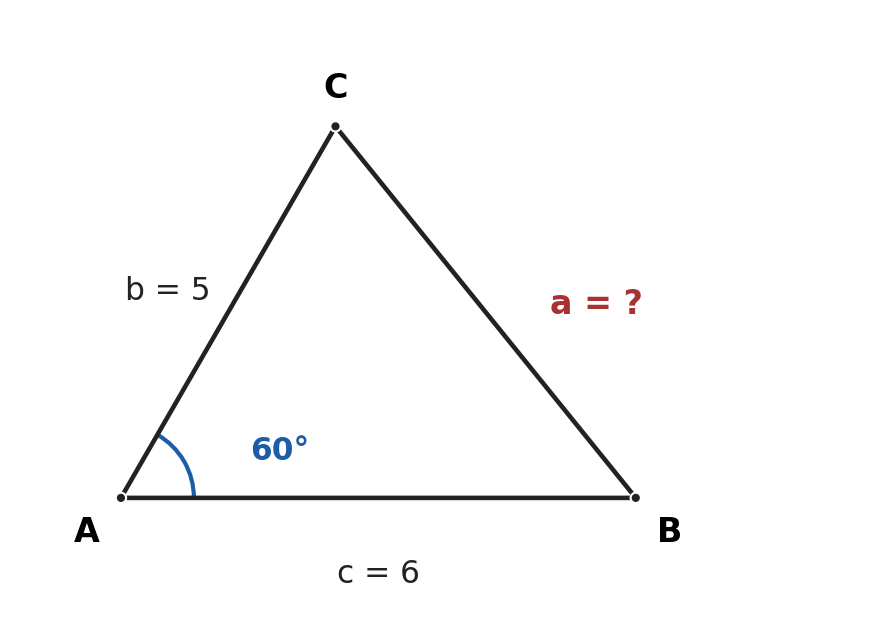
Solution
a² = 25 + 36 − 2 × 5 × 6 × cos 60 degrees
Cos 60 degrees = 0.5, so a² = 61 − 30 = 31
So a = 31square root of 31, about 5.57
A triangle has sides a, b, c and angle A opposite side a. Write the cosine law for side a.
b = 6, c = 8, and the angle between them A = 90 degrees. Find side a.
b = 3, c = 3, and A = 60 degrees. Find side a.
b = 5, c = 12, and A = 90 degrees. Find the third side, a.
In what situation is the cosine law the right choice?
b = 4, c = 4, and A = 60 degrees. Find side a.
b = 2, c = 2, and A = 90 degrees. Find side a, to two decimal places.
A triangle has a right angle, A = 90 degrees. What does the cosine law simplify to?
b = 7, c = 24, and A = 90 degrees. Find side a.
b = 10, c = 10, and A = 60 degrees. Find side a.
Your score: 0 / 10
1. a² = b² + c² - 2bc cos A
2. 10
3. 3
4. 13
5. When you know two sides and the included angle, or all three sides
6. 4
7. 2.83
8. The Pythagorean theorem
9. 25
10. 10