
1
A child fare is $1 for ages under 12 and $2 for ages over 12. Find the left and right limits at 12. Does the ordinary limit exist?
MATHEMATICS · GRADES 10-12
This document was made by AI and there may be mistakes. If a question or answer looks wrong, use the Flag a mistake button to let Brett know so he can fix it.
This is how you work out what something is approaching from one side only, like the fare just below an age cutoff or a reading just before a gauge hits its limit. A child who is almost twelve pays the child fare right up to the birthday, then the price jumps, so the value just below the cutoff matters. A phone plan works the same way, with one rate up to a data cap and a different rate after it. Looking from one side only tells you what happens just before the change, which is often the number you actually need.
A limit exists only if the left-hand limit and the right-hand limit are the same.
If the two sides agree, that shared value is the limit. If they disagree, the limit does not exist.
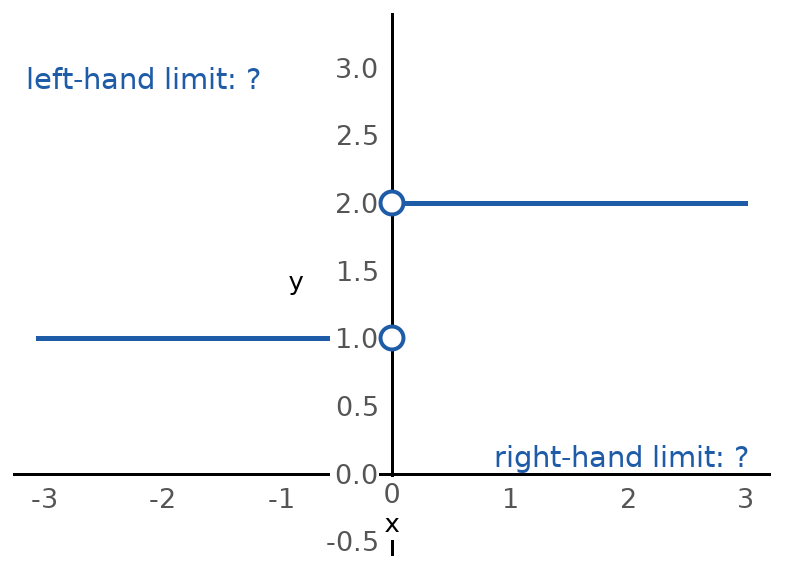
For
Solution
From the left, x is negative, so f(x) = 1: left limit 1.
From the right, x is positive, so f(x) = 2: right limit 2.
The two sides disagree, so the ordinary limit at 0 does not exist.
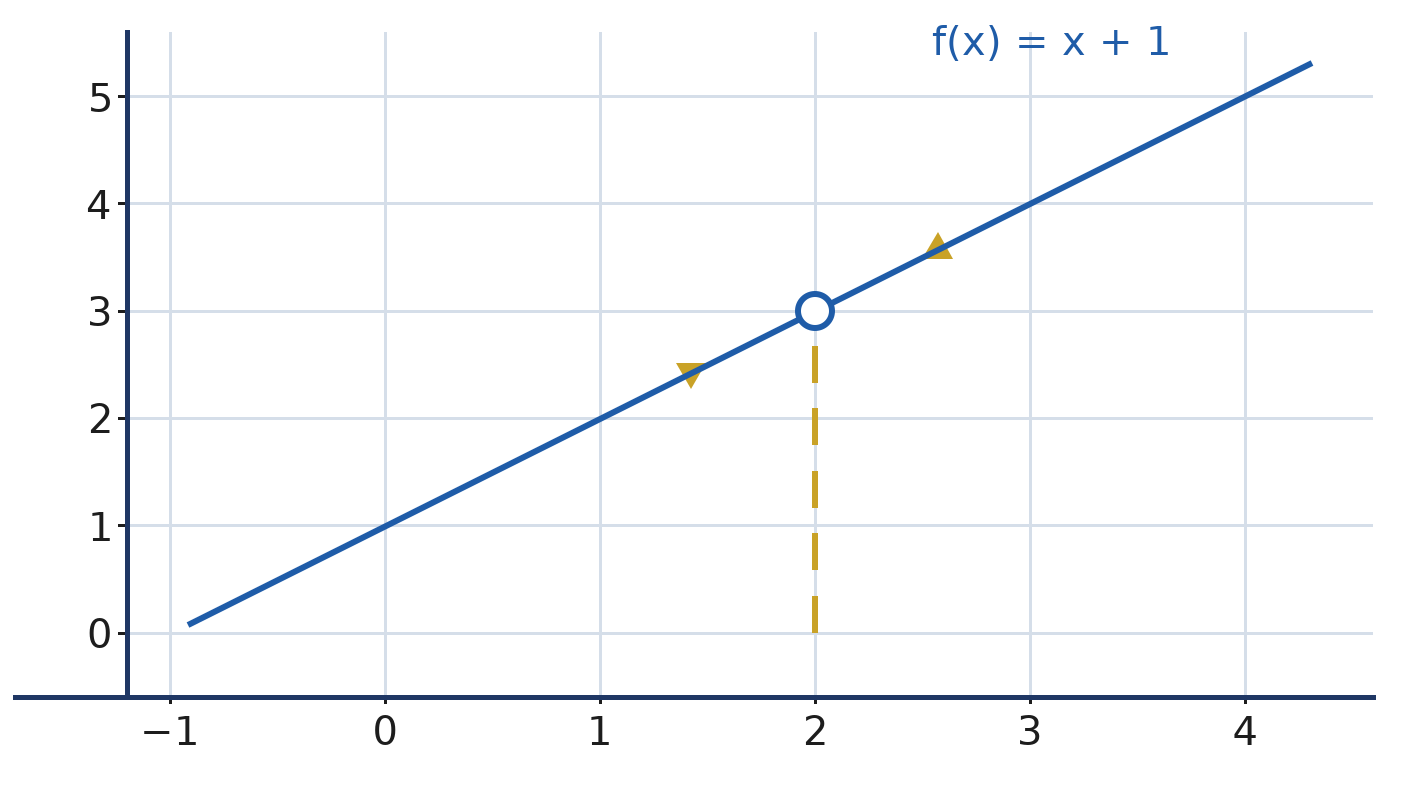
For f(x) = x + 1 everywhere,
Solution
From the left, x gets close to 2, so x + 1 gets close to 2 + 1 = 3.
From the right, x also gets close to 2, so x + 1 also gets close to 3.
Both sides agree, so the limit at 2 is 3.
A child fare is $1 for ages under 12 and $2 for ages over 12. Find the left and right limits at 12. Does the ordinary limit exist?
For f(x) = x + 1 everywhere, find both one-sided limits at 5.
A phone plan charges $0 below the data cap and $1 above it. What is the left-hand limit at the cap?
For f(x) = 2x everywhere, what is the left-hand limit at 4?
For f(x) = 4 when x is less than 2, and 7 when x is greater than 2, what is the right-hand limit at 2?
For f(x) = x² everywhere, what is the right-hand limit at 2?
For f(x) = x when x is less than 0, and x + 1 when x is greater than 0, find the left and right limits at 0. Does the ordinary limit exist?
A function has left limit 4 and right limit 4 at x = 1, but f(1) = 9. What is the limit at 1?
If the left limit is 7 and the right limit is 7, what is the limit?
If the left limit is 3 and the right limit is 4, does the limit exist?
Your score: 0 / 10
1. Left limit 1, right limit 2; the ordinary limit does not exist
2. Both 6, so the limit at 5 is 6
3. 0
4. 8
5. 7
6. 4
7. Left limit 0, right limit 1; the ordinary limit does not exist
8. 4
9. 7
10. No