Reading II - River at Dawn
Use this reading for questions 1 to 2.
At dawn the river is a road that moves, carrying leaves and light downstream.
I stand on the bank and watch my own reflection break and reform with the current.
Nothing stays in one shape for long, and that, I think, is the river's honest lesson.
What I was last year has loosened its hold, and I am still learning how to flow.
1
According to Reading II, what does the speaker notice about the river?
A the river never changes B the river is frozen solid C the river is always moving and changing shape D the river flows uphill
What looks wrong with Question 1?
Send anonymously
Cancel
2
According to Reading II, the river as a road that moves is what kind of figurative language?
A a fact about roads B a metaphor comparing the river to a road C a historical date D a direct quotation
What looks wrong with Question 2?
Send anonymously
Cancel
3
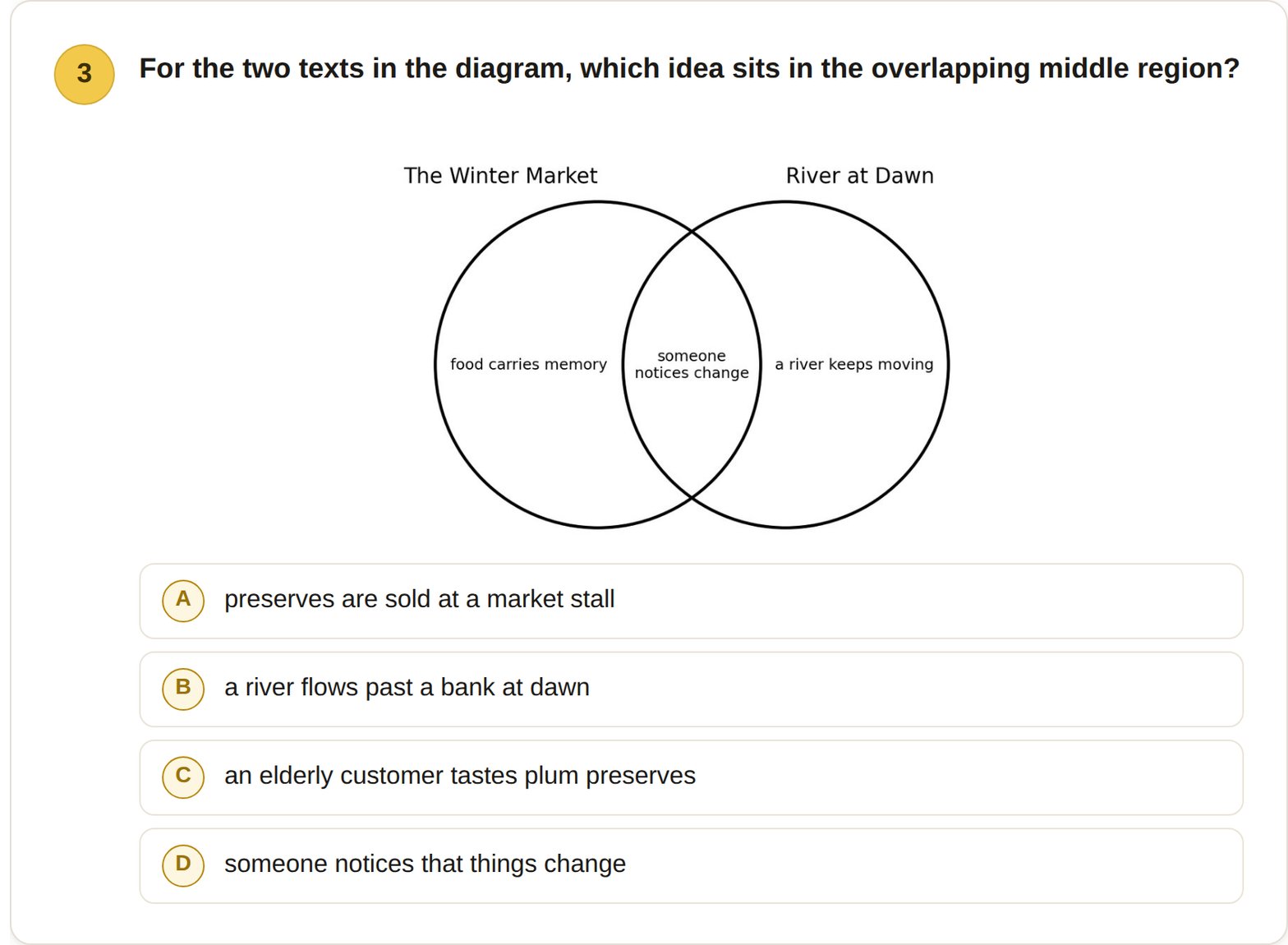
For the two texts in the diagram, which idea sits in the overlapping middle region?
A preserves are sold at a market stall B a river flows past a bank at dawn C an elderly customer tastes plum preserves D someone notices that things change
What looks wrong with Question 3?
Send anonymously
Cancel
4
How is a motif different from a single symbol in a text?
A a motif is a repeated element, a symbol may appear once B a motif is always a character C a motif appears only in poems D a motif and a symbol are the same
What looks wrong with Question 4?
Send anonymously
Cancel
5
What is the strongest way to compare two texts on a shared idea?
A count which text is longer B examine how each text treats the idea, with evidence C choose the text with the better title D summarise only the first text
What looks wrong with Question 5?
Send anonymously
Cancel
6
How does point of view differ from voice in a text?
A point of view is the font, voice is the length B point of view is the price, voice is the author C point of view is who tells it, voice is how it sounds D point of view and voice are identical
What looks wrong with Question 6?
Send anonymously
Cancel
7
The diagram shows how often the word river appears in each stanza. In which stanza does the count rise most sharply?
A Stanza 1 B Stanza 2 C Stanza 3 D Stanza 4
What looks wrong with Question 7?
Send anonymously
Cancel
8
Why might a reader need context about when a text was written?
A context reveals what words and customs meant at the time B context makes the text shorter C context removes all difficult words D context proves the author was correct
What looks wrong with Question 8?
Send anonymously
Cancel
9
When closely reading dialogue, what should a reader attend to most?
A how many lines each speaker has B what word choices reveal about feelings and relationships C whether the dialogue is printed in bold D how fast the dialogue can be read
What looks wrong with Question 9?
Send anonymously
Cancel
10
Which interpretation of a text is weakest?
A one supported by several passages B one that explains a key symbol C one with no evidence from the text at all D one that considers context
What looks wrong with Question 10?
Send anonymously
Cancel